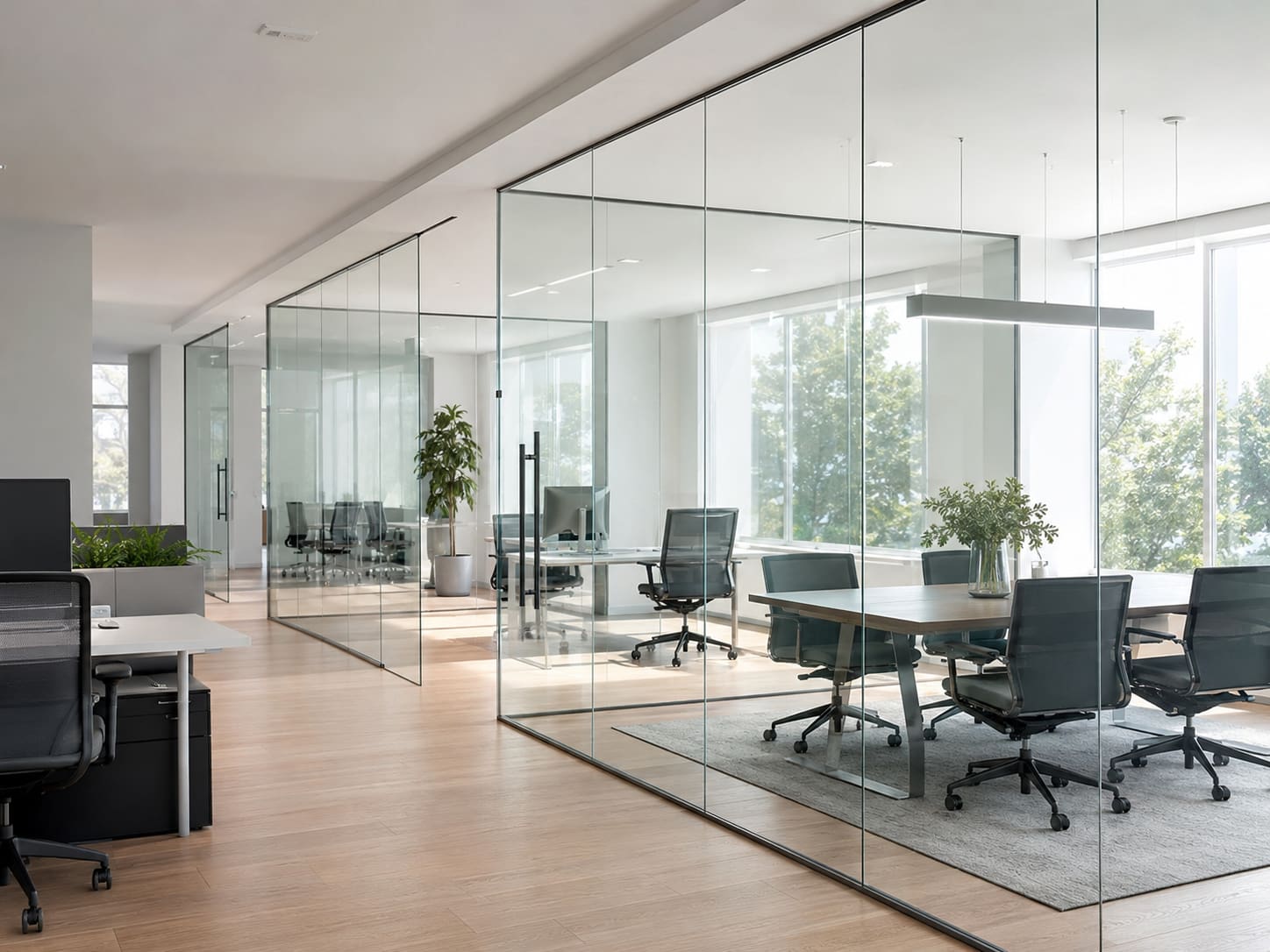
Frosted glass is translucent glass whose surface has been roughened or coated so that it scatters transmitted light, obscuring clear vision through it while still allowing 80-90% of daylight to pass. This light-diffusing effect turns objects behind the glass into soft, indistinct silhouettes, which is exactly why frosted glass is used as a privacy glass in bathrooms, office cabins, doors and windows across Hyderabad and Telangana.
Unlike a mirror, a solid wall or a painted panel, frosted glass never fully blocks light, so it delivers privacy without darkening a room. The frosting can be permanent, achieved by acid etching or sandblasting the raw glass, or reversible, achieved with an applied adhesive film. This makes it one of the most versatile and affordable materials we specify for interior glass partitions and cabin fronts.
In a bright, humid, dust-prone climate like Hyderabad's, frosted glass is especially popular because it keeps interiors well-lit while screening them from direct view, softens harsh afternoon glare, and hides the fingerprints and water spotting that plague clear glass. This guide explains how frosted glass is made, its types, thickness and standards, where it works best, and what it actually costs to install.
How Is Frosted Glass Made?
Frosted glass is made by altering a clear glass surface so it becomes microscopically uneven and scatters light instead of transmitting it cleanly. The base is ordinary clear float glass; the frosting is a surface treatment applied afterwards. There are three primary methods, each with a different cost, feel and durability:
- Acid etching: The glass is treated with hydrofluoric acid, which dissolves a fine, uniform layer to leave a smooth, satin finish. This is the most durable and stain-resistant frosting, and it produces the even, premium look used in high-end offices and homes.
- Sandblasting: High-pressure jets of abrasive grit physically abrade the surface, creating a rougher, more porous matte texture. It is economical and allows custom patterns and logos, but the open texture holds fingerprints and grease more readily.
- Frosted film: A self-adhesive polymer film is applied to ordinary clear glass. It is the cheapest and only reversible option, ideal for rented offices, but less durable than etched or blasted glass and prone to bubbling or peeling over 5-10 years.
Etched and sandblasted finishes are permanent and cannot be wiped off, whereas film can be removed and replaced. For decorative or branded work, we can combine frosting with clear zones, gradients or cut-out logos, which pairs well with our wider specialty glass and mirror fabrication.
Frosted Glass Thickness, Specifications and Standards
Frosted glass comes in the same standard thicknesses as clear float glass, and the correct thickness depends on the application, the span between supports and whether the panel is fixed or a door.
- 4-5 mm: Small fixed windows, cabinet fronts, ventilator panes and decorative inserts.
- 6-8 mm: The most common range for internal doors, office glass cabins, partitions and shower screens.
- 10-12 mm: Large frameless partitions, tall doors and structural glazing where the glass carries its own load.
Frosting itself adds no strength, so anywhere impact, doors or low-level glazing are involved, the glass must be toughened to IS 2553 so it fragments into small, blunt granules instead of dangerous shards. Our toughened glass work covers this heat-treatment step. The National Building Code of India (NBC) 2016 governs glazing safety and human-impact requirements, and IS 875 Part 3 covers wind loads for any external frosted glazing. For frosted panels used in structural silicone facades, ASTM C1401 guides the silicone joint design. Getting these specifications right at the design stage avoids the most common and expensive glazing mistakes.
Where Is Frosted Glass Used?
Frosted glass is used wherever privacy is needed without sacrificing natural light. Common applications include:
- Bathroom and toilet windows, where privacy is essential but daylight and ventilation are still wanted.
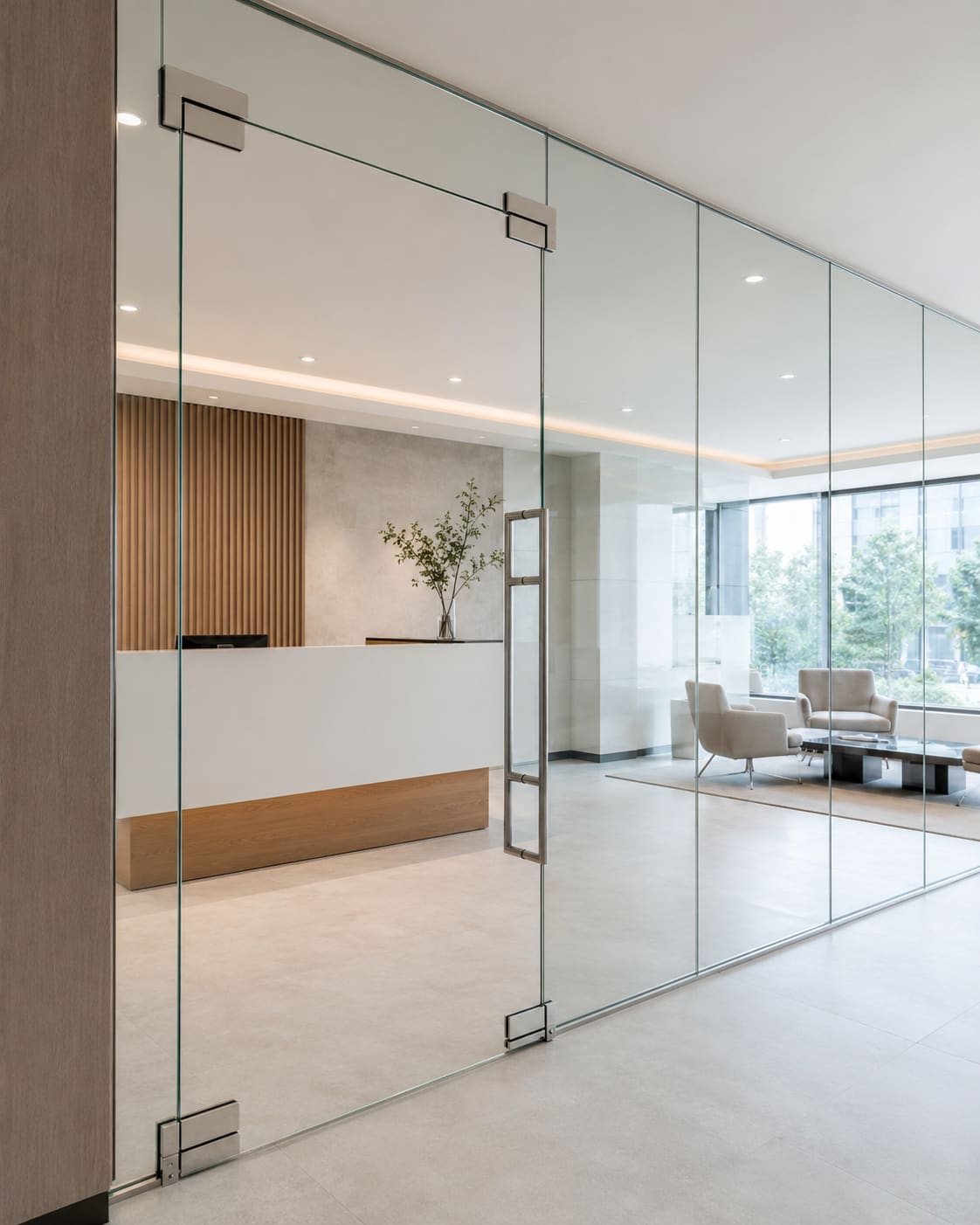
- Office partitions and cabin fronts that need visual separation while keeping workspaces bright, open and modern.
- Frameless shower enclosures, where toughened frosted glass screens the bathing area; see our frameless shower enclosure work.
- Entry doors, internal doors and staircase balustrades that want a soft, contemporary look.
- Meeting rooms and MD cabins where a manager wants daylight but confidential privacy, often combined with an acoustic glass partition for sound control.
- Skylights and facades where diffused, glare-free light is preferred over direct sun.
Across Hyderabad's tech corridor, frosted glass is a default choice in the office fit-outs of Gachibowli, Madhapur, Hitec City, Kondapur and the Financial District, where open floor plates need private cabins that still feel light and airy. You can see examples of glazing we have delivered in our project gallery.
Frosted Glass vs Other Privacy Glass Options
Frosted glass is the most economical permanent privacy solution, but several alternatives serve different priorities, and the right choice depends on whether you need on-demand privacy, heat control or acoustic performance.
- Frosted glass: Permanent, always-on privacy; transmits 80-90% light; lowest cost of the permanent options.
- Tinted glass: Reduces glare and heat and gives some daytime privacy through reflection, but is transparent up close and offers no privacy at night.
- Switchable PDLC smart glass: Turns from clear to opaque at the flick of a switch for on-demand privacy, but costs many times more (often INR 2,500-6,000 per sq ft); see our PDLC smart glass option.
- Fluted or reeded glass: Provides privacy through a ribbed, textured surface with a strong decorative, vertical-line appearance now popular in premium interiors.
- Laminated frosted glass: Combines privacy with safety and useful sound reduction, ideal for facades, staircases and high-traffic areas; this is delivered through our laminated glass work.
For most homes and offices, frosted glass wins on value; where budgets and briefs allow, PDLC and laminated options add convenience and performance.
Does Frosted Glass Reduce Heat and Glare in Hyderabad's Climate?
Frosted glass noticeably reduces glare because its diffusing surface spreads incoming sunlight evenly instead of letting it stream in as a harsh, direct beam. That is a real comfort benefit in Telangana and Andhra Pradesh, where summer sun is intense from March to June and low-angle western sun causes screen glare in offices.
However, a plain frosted finish does not significantly cut solar heat gain by itself, because it still transmits most of the sun's energy. If heat is the priority, the frosting should be combined with a tinted or reflective coating, or specified as an insulated double-glazed unit (DGU), so that glare control and thermal control are handled together. On external and facade applications we usually recommend this combination.
Hyderabad's monsoon and year-round dust add a practical dimension too. Frosted surfaces hide the water spotting and fine dust film that show up so clearly on clear glass, so partitions and doors look cleaner between washes. For balconies and openings that face weather directly, pairing frosted glass with quality aluminium doors and windows keeps the assembly weather-tight through the rains.
How Much Does Frosted Glass Cost in Hyderabad?
Frosted glass is a cost-effective privacy option, and pricing depends mainly on the frosting method, the glass thickness and whether the glass is toughened. Indicative Hyderabad rates (2026) are:
- Frosted adhesive film applied to existing glass: approximately INR 90-180 per sq ft installed.
- Basic acid-etched or sandblasted glass (4-6 mm, non-toughened): approximately INR 150-300 per sq ft.
- Toughened frosted glass (8-12 mm): approximately INR 300-700 per sq ft depending on thickness, edgework and hardware.
Fabricated items such as frameless frosted doors and shower screens cost more once you add patch fittings, hinges, handles and site installation. Full frosted-glass office cabins are usually quoted per running foot of partition rather than per square foot. These are ballpark figures to help you budget; for an accurate, itemised rate for your site you can get a free quote and we will measure and specify the exact glass build-up. As a rule, spending a little more on toughened, acid-etched glass pays back in a finish that stays uniform and lasts decades.
Maintenance, Cleaning and Lifespan
Etched and toughened frosted glass lasts 20-30 years or more with routine cleaning, while frosted film generally lasts 5-10 years before it may discolour, bubble or peel. The glass itself does not fade; only films and adhesives age.
Cleaning is straightforward but the method matters for how good the surface looks over time:
- Wipe with a soft microfibre cloth and mild detergent or a mix of water and a little isopropyl alcohol.
- Avoid abrasive scouring pads and gritty cleaners, which can trap dirt in a sandblasted texture and create shiny worn patches.
- Deal with grease and fingerprints promptly on sandblasted glass, as the open texture absorbs oils more readily than a satin acid-etched surface.
- Do not use hydrofluoric or strong acidic cleaners, which can attack the surface further.
Acid-etched finishes are the easiest to keep looking uniform because their smoother surface resists fingerprints and water marks, which is one reason we recommend etched glass over film for high-touch doors and cabin fronts.
How to Choose the Right Frosted Glass
The best frosted glass for your project comes down to matching the frosting method and thickness to the use, then confirming safety requirements. A simple decision path:
- For a rented or temporary space, choose frosted film for low cost and reversibility.
- For a permanent home or office, choose acid-etched glass for the cleanest, most durable finish.
- For any door, shower or glazing below 1 metre from the floor, insist on toughened glass to IS 2553.
- For meeting rooms and MD cabins, consider laminated or acoustic glass so privacy comes with sound insulation.
- For west-facing or facade positions, add a tint, reflective coating or DGU to control heat as well as glare.
If you are weighing frosted glass against an electric alternative, our comparison of privacy solutions and our interior glass partition service page cover the trade-offs in more detail. When you are ready to move ahead, share your dimensions and we will recommend the exact glass, thickness and finish for your site and give you a free measured quote.