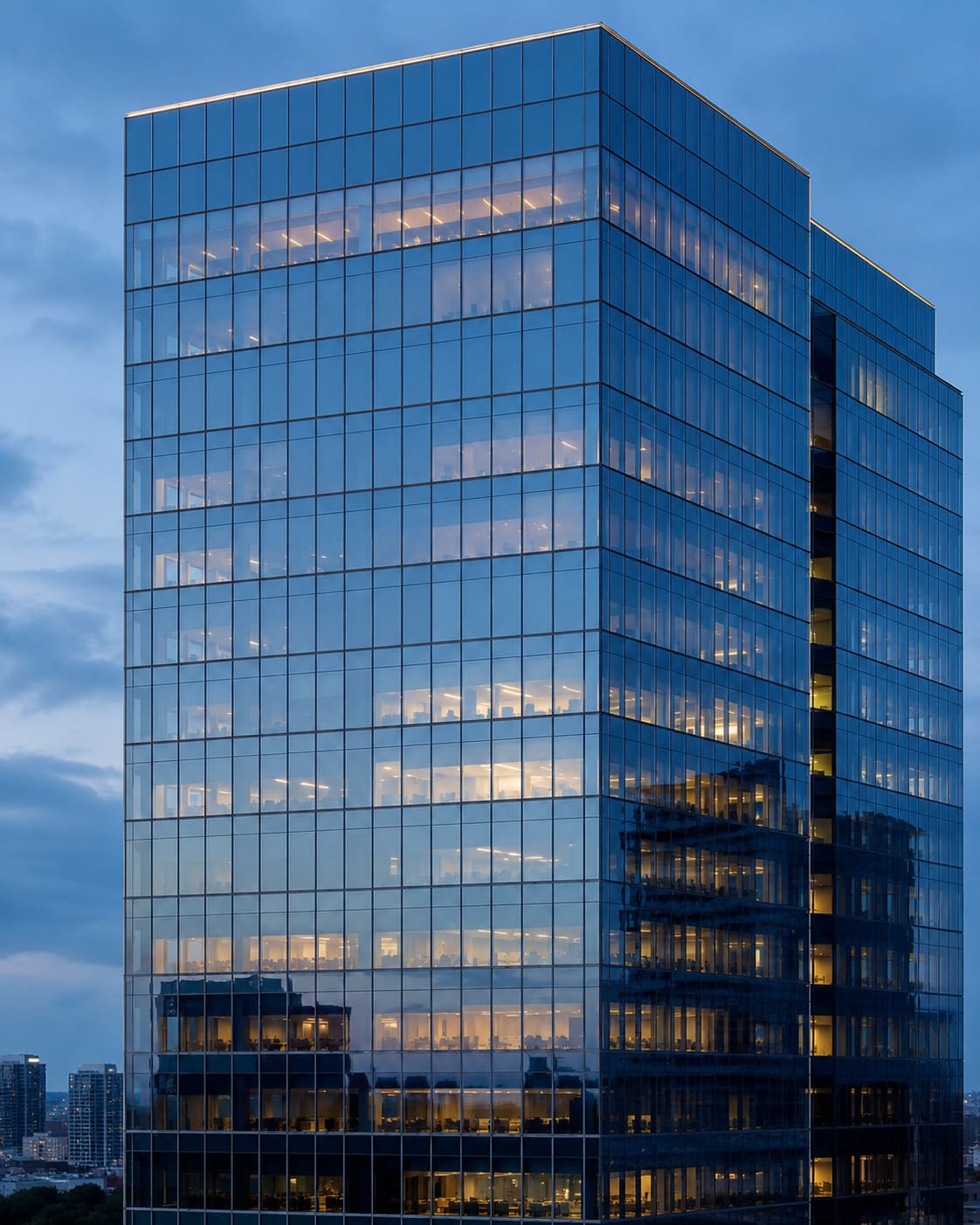
Spandrel glass is the opaque or translucent glass used in the horizontal bands of a curtain wall or facade to conceal the parts of a building you are not meant to see, the floor slabs, edge beams, HVAC ducts, wiring and insulation that sit between one storey's ceiling and the next storey's floor. In plain terms, it is the glass that looks like a window but is actually a mask, letting a tower read as one continuous mirror of glass while quietly hiding its structure and services.
Look closely at any modern glass tower in Hyderabad's HITEC City or along the Financial District and you will notice the facade is not one unbroken sheet of transparent glass. Some panels let you see inside, while others are a flat, uniform colour that hides whatever is behind them. That second type is spandrel glass, and it does far more quiet work than most people realise, typically making up 30 to 40 percent of a glazed elevation.
This article explains what spandrel glass is, how it is made opaque, where it sits in a curtain wall or structural glazing system, how it differs from vision glass, and realistic supply-and-fit pricing for projects across Telangana and Andhra Pradesh. Whether you are an architect specifying a tower in Kokapet or an owner comparing quotes in Gachibowli, this is the detail that decides whether your finished elevation looks seamless or patchy.
What Does Spandrel Glass Do in a Facade?
Every multi-storey building has a zone at each floor line that is structurally busy and visually unattractive: the edge of the concrete slab, the perimeter beam, the fire stopping, the return air plenum, ducts and the raised floor of the storey above. On a traditional building this is hidden behind a concrete or brick spandrel wall. On a glazed building, spandrel glass does the same job while keeping the all-glass appearance intact.
So the core function is concealment without breaking the visual line. The panel sits flush with the vision glass, carries the same or a closely matched finish, and hides everything behind it. From the street the eye reads a smooth glass skin; only from inside, or when the light angle is exactly right, can you tell which panels are opaque.
Spandrel glass is a standard component in most modern facade systems, including unitised curtain walls, stick-system glazing and structural silicone glazing. Wherever glass covers a full floor-to-floor height, the non-vision band is almost always spandrel.
Spandrel Glass vs Vision Glass: The Key Difference
A glazed facade is made of two alternating zones. Vision glass sits at eye level and is transparent so occupants can see out. Spandrel glass sits above and below it, covering the structural and mechanical zone at each floor line, and it is deliberately opaque.
The important detail for architects and owners in Hyderabad is that both types are usually made to look identical from the street. Good spandrel glass matches the colour, reflectivity and finish of the vision glass so the facade reads as one clean, continuous skin even though roughly 30 to 40 percent of it is actually concealing structure.
- Vision glass: transparent, insulated (often double glazed), positioned at window height for daylight and views.
- Spandrel glass: opaque, hides slabs and services, positioned at the floor and ceiling bands.
- Visual goal: a seamless appearance so the join between the two is invisible from outside.
The two are not interchangeable. Vision glass is engineered for clarity, low reflectivity from inside and thermal comfort; spandrel glass is engineered for opacity, heat tolerance and colour consistency. Specifying the wrong one, or mixing coating families, is the single most common reason a finished elevation looks blotchy in daylight.
How Is Spandrel Glass Made Opaque?
Spandrel glass starts as ordinary float glass and is then given an opaque backing so light and views cannot pass through. There are three common methods used by fabricators in Telangana, each with its own cost and durability profile.
- Ceramic frit (fired enamel): a coloured ceramic coating is screen printed onto the glass and permanently fused during tempering. It is the most durable and UV stable option, will not fade or peel, and is the standard for premium towers.
- Back painting: a factory-applied opaque paint or coating on the rear (fourth) surface, cost effective and available in almost any colour to match a design palette.
- Spandrel film or opacifier: an applied film, sometimes combined with insulation, used where budget or lead time is tight, or on retrofit work.
Spandrel glass is almost always heat treated to fully tempered or heat strengthened grade. This matters in Hyderabad's climate because the panel absorbs a lot of solar heat but has no interior view load or air movement behind it, so thermal stress is high and toughening prevents cracking. An insulated shadow box detail is often added behind the panel to hide the slab edge and give the elevation more visual depth. If you want mirror-like consistency across a whole tower, discuss the opacifier choice with your facade consultancy team at the design stage, not after glass is ordered.
Why Does Spandrel Glass Matter for Your Building?
Beyond hiding the ugly bits, spandrel glass delivers real functional value that owners in Secunderabad and the wider AP region should weigh up.
- Clean aesthetics: a monolithic glass facade with no visible concrete bands, which raises the perceived grade and rentability of the building. A crisp elevation directly supports asking rents in markets like Madhapur and Kondapur.
- Concealment of services: floor slabs, ducts and fire stopping stay hidden while remaining fully accessible from inside for maintenance.
- Thermal and energy control: reflective and low-e coated spandrels reduce heat gain into the plenum, easing air conditioning loads through the long Hyderabad summer when ambient temperatures push past 42 degrees.
- Design flexibility: spandrels can carry a different tint or a bespoke colour to create patterns, corporate branding or a two-tone facade, useful for a showroom or corporate front.
For commercial owners, the spandrel band is also where a lot of the facade's fire and safety performance is coordinated, since the slab edge fire stopping sits directly behind it. This is one reason spandrel detailing should never be treated as an afterthought or value-engineered down to the cheapest film without checking the whole assembly. Browse our completed towers on the projects page to see how matched spandrel and vision zones read from the street.
Where Is Spandrel Glass Used Across Hyderabad?
Spandrel glass appears anywhere a building wants an all-glass look but has structure to hide. In Hyderabad you will see it on almost every IT campus, corporate tower and premium residential high-rise.
- Office towers and IT parks in HITEC City, Gachibowli and the Financial District, where full-height reflective glass facades dominate.
- Retail and showroom fronts, where spandrel bands hide the mezzanine slab above a double-height glass shopfront.
- Residential high-rises in Kokapet and Narsingi, where spandrels conceal balcony slab edges and service ducts.
- Mixed-use podiums, hotels and hospitals, where a consistent glass skin is wanted across floors of very different internal use.
The Telangana climate shapes the specification. Intense summer heat argues for reflective or low-e spandrels to cut plenum heat gain, the monsoon demands fully sealed, well-drained glazing pockets, and the region's dust means a smooth, cleanable surface with no peeling film is worth paying for. These are the same performance drivers behind a good DGU facade for the vision zones.
What Is a Shadow Box and Do You Need One?
A shadow box is a detail built behind a spandrel panel to give it depth and hide the slab edge more convincingly. Instead of the panel sitting directly against insulation, a shallow lined cavity, often with a matt back pan and insulation, is created so the glass appears to have a recessed, three-dimensional quality rather than a flat painted look.
Shadow boxes solve two problems. First, they improve appearance: a plain back-painted spandrel can look dead and flat next to a reflective vision glass, whereas a shadow box adds subtle depth that reads as genuine glazing. Second, they help manage heat and condensation in the concealed cavity, which is useful in Hyderabad's humid monsoon months.
- Use a shadow box on premium elevations where the spandrel sits right beside high-reflectivity vision glass.
- Add insulation in the box to reduce plenum heat gain and control condensation.
- Skip it on budget or low-rise work where a matched back-painted panel is acceptable.
Shadow boxes add cost, so they are a design decision, not an automatic inclusion. On a corporate headquarters in the Financial District they are usually worth it; on a warehouse office they usually are not.
How Much Does Spandrel Glass Cost in Hyderabad and Telangana?
Pricing depends on the glass thickness, the opacifying method, coatings and whether a shadow box is included. The figures below are indicative supply-and-fit rates for the Hyderabad and Telangana market and should be confirmed against a measured site quote.
- Back painted spandrel glass (6 to 8 mm tempered): roughly INR 180 to 320 per sq ft.
- Ceramic frit spandrel glass (heat strengthened): roughly INR 350 to 550 per sq ft.
- Coated or reflective spandrel to match high-performance vision units: roughly INR 500 to 800 per sq ft.
- Shadow box assembly with insulation and back pan: add roughly INR 150 to 400 per sq ft.
For a typical commercial curtain wall in HITEC City, spandrel zones make up around a third of the facade area, so specifying them correctly has a genuine impact on both the budget and the long-term look of the building. We recommend matching the spandrel coating family to the vision glass early in design to avoid a mismatched, patchy elevation later. If you are pricing a project, get a free quote with your elevation drawings and we will break out the spandrel and vision zones separately so the numbers are transparent.
How to Specify Spandrel Glass Correctly
Most spandrel problems are specification problems, not manufacturing faults. A few decisions made early prevent the common failures of colour mismatch, thermal cracking and peeling coatings.
- Match the coating family: choose the spandrel opacifier and any reflective coating to sit within the same colour and reflectivity band as the vision glass, ideally from the same manufacturer.
- Always heat treat: insist on heat strengthened or fully tempered glass for every spandrel panel, never annealed, because of the trapped-heat thermal load.
- Confirm the fourth-surface finish: back painting sits on surface four, so it must be protected within the sealed insulated glass or curtain wall assembly, not exposed.
- Coordinate the slab-edge fire stopping and any shadow box as one detail with the facade contractor.
- View a physical sample on site in daylight, not just a swatch, because reflectivity changes dramatically with sky and sun angle.
Getting these right is the difference between a facade that still looks sharp after ten Hyderabad summers and one that shows a blotchy grid of mismatched panels within a couple of years. If your project also involves matched interior work, the same colour discipline applies to any glass partitions that share sightlines with the facade.