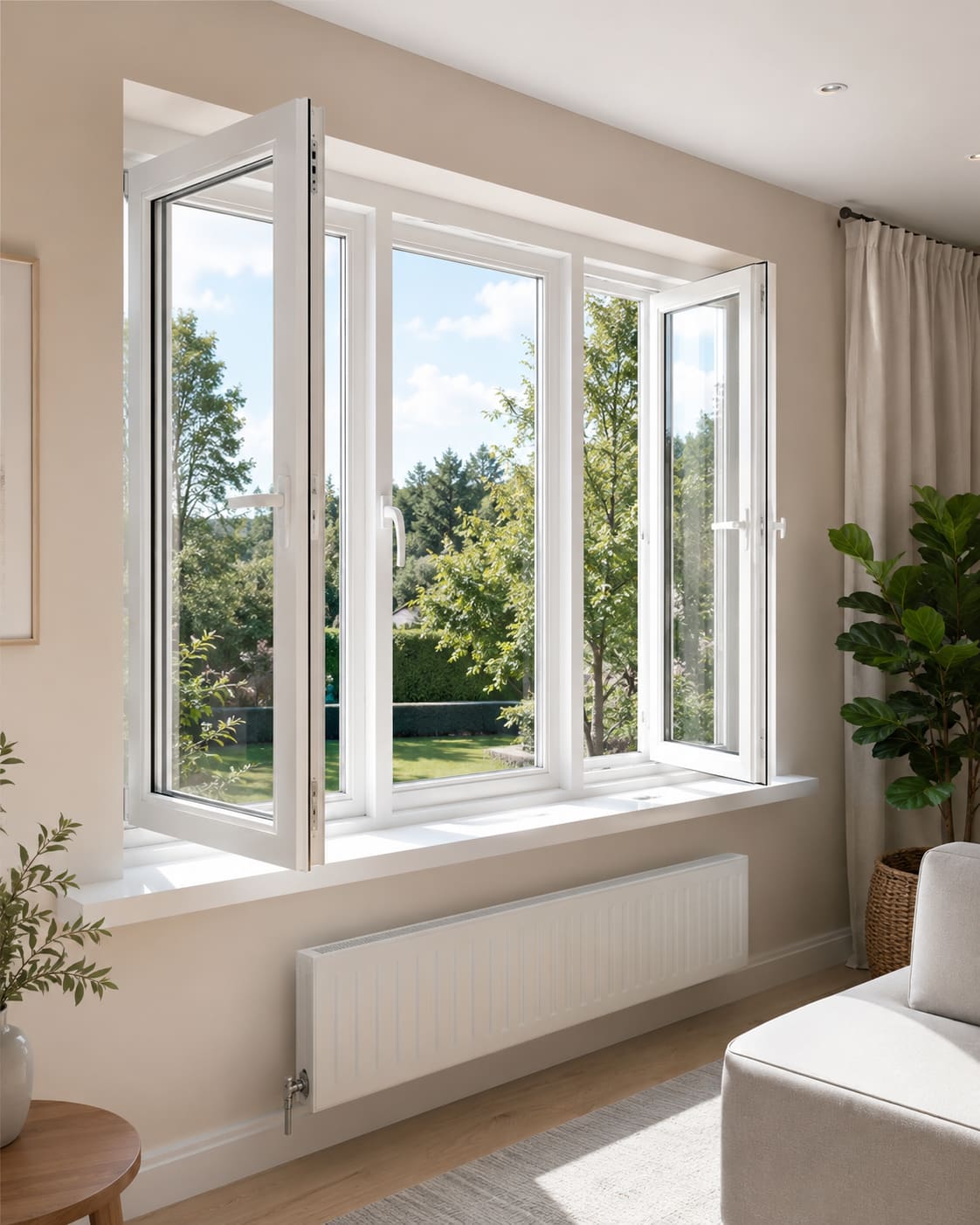
U-value in windows is the measure of how much heat passes through a window per square metre for every one-degree Kelvin of temperature difference between inside and outside, expressed in watts per square metre kelvin (W/m2K). A lower U-value means the window insulates better and loses or gains less heat, so a window rated 1.4 W/m2K conducts far less heat than one rated 5.8 W/m2K. U-value (also called U-factor or thermal transmittance) is the single most important number describing a window's insulating ability and is the mathematical inverse of R-value, which measures resistance to heat flow.
For a hot-climate city like Hyderabad, U-value governs how quickly outdoor heat conducts indoors through the glass and frame, directly affecting air-conditioning loads and monthly electricity bills. The whole-window U-value combines the performance of the glass, the spacer, the gas fill and the frame, so a window is only as thermally efficient as its weakest component. A premium insulated glass unit set into an un-broken aluminium frame will still leak heat at the frame, which is why the frame system matters as much as the glass itself.
Understanding U-value helps homeowners, architects and facade specifiers choose glazing that meets the Energy Conservation Building Code (ECBC) and delivers genuine comfort through Telangana summers. Whether you are specifying aluminium doors and windows for a Gachibowli apartment or a full structural glazing facade for a Financial District office tower, the U-value number tells you how hard your HVAC system will have to work. This guide breaks down the definition, the typical ranges, and the practical choices that actually move the number.
How Is U-Value Defined and Measured?
U-value quantifies the total heat transfer through a window assembly by conduction, convection and radiation combined, measured in W/m2K under standardised test conditions. It is calculated across the whole window, not just the glass, so it accounts for the frame, edge seals and the centre-of-glass performance together. The lower the number, the slower heat moves through the window in either direction.
- U-value units: watts per square metre kelvin (W/m2K); lower is better.
- U-value is the reciprocal of R-value (R = 1/U); a U-value of 2.0 equals an R-value of 0.5 m2K/W.
- Whole-window U-value (Uw) blends centre-of-glass (Ug), edge-of-glass and frame (Uf) U-values weighted by area.
- Testing follows international protocols such as ISO 10077 and NFRC 100 for rated, comparable figures.
- Ratings are quoted at a standard temperature difference so products can be compared like-for-like across brands.
The distinction between centre-of-glass and whole-window U-value trips up many buyers. A glass supplier may quote a Ug of 1.1 W/m2K, but once that glass sits in a real frame with real edge seals, the whole-window Uw can rise to 1.6-1.8. Always ask which number a quotation refers to, and insist on the whole-window figure when comparing systems.
What Are the Typical U-Value Ranges by Window Type?
U-value ranges vary widely by glazing configuration, from around 5.8 W/m2K for basic single glazing down to below 1.0 W/m2K for high-performance triple glazing. The list below gives representative whole-window figures used in Indian and international practice, so you can benchmark any quotation you receive.
- Single glazing (clear float, 4-6 mm): approximately 5.0-6.0 W/m2K.
- Double glazing (standard air-filled DGU, 6-12-6 mm): approximately 2.7-3.0 W/m2K.
- Double glazing with low-e coating: approximately 1.6-2.0 W/m2K.
- Double glazing with low-e plus argon gas fill: approximately 1.1-1.4 W/m2K.
- Triple glazing (double low-e, argon): approximately 0.6-0.9 W/m2K.
- uPVC and thermal-break aluminium frames lower whole-window U-value versus conventional un-broken aluminium frames, which conduct heat readily.
For most Hyderabad homes and offices, a good double-glazed uPVC or thermal-break window landing in the 1.4-2.0 W/m2K band hits the sweet spot of cost and comfort. Triple glazing rarely pays back in a cooling-dominated climate like Telangana, since we have no long freezing winter to justify the extra glass weight and cost.
What Affects a Window's U-Value?
A window's U-value is driven by the number of glass panes, the gap between them, the gas fill, coatings and the frame material. Each element can raise or lower the final number significantly, and they interact, so upgrading one weak link often unlocks the benefit of the others.
- Number of panes: each added pane and trapped air or gas cavity reduces heat flow.
- Cavity width: an optimal spacer gap of roughly 12-16 mm minimises convection inside the sealed unit.
- Gas fill: argon or krypton between panes insulates better than dry air, cutting U-value by 0.2-0.4 W/m2K.
- Low-emissivity (low-e) coatings: microscopically thin metal-oxide layers reflect radiant heat and can cut U-value by 30-40%.
- Warm-edge spacers: insulating spacer bars reduce heat loss at the glass edge versus conductive aluminium spacers.
- Frame material and design: uPVC multi-chamber frames and thermal-break aluminium sharply reduce frame heat conduction.
This is where frame choice becomes decisive. A plain aluminium frame is essentially a metal bridge that conducts heat straight past your expensive glass. A thermal-break aluminium system inserts a polyamide barrier between the inner and outer frame profiles, while uPVC windows use hollow multi-chamber profiles that trap insulating air. Either choice can shave 0.5-1.0 W/m2K off the whole-window number compared with basic aluminium.
U-Value vs SHGC: Which Matters More in Hyderabad?
In hot Indian climates, U-value and Solar Heat Gain Coefficient (SHGC) are two distinct metrics, and for cooling-dominated cities SHGC is often the more decisive one. U-value controls conductive heat driven by the indoor-outdoor temperature gap, while SHGC (a value from 0 to 1) controls how much of the sun's radiant energy passes through the glass and heats the room directly.
- U-value matters most where there is a large temperature difference, such as air-conditioned interiors against 40-45 degree C Hyderabad afternoons.
- SHGC matters most for blocking direct solar radiation; a lower SHGC (for example 0.25-0.35) keeps interiors noticeably cooler.
- Visible Light Transmittance (VLT) describes daylight passing through and is chosen alongside SHGC for glare control.
- The ECBC prescribes both maximum U-value and maximum SHGC limits by climate zone for compliant buildings.
- For Hyderabad's composite-to-hot climate, glazing with a moderate U-value and a low SHGC delivers the best cooling-load reduction.
Think of it this way: on a Kokapet high-rise with west-facing glass, the afternoon sun pouring through the pane is the bigger enemy than slow conductive creep. That is why a reflective or high-performance low-e coating with a low SHGC often saves more electricity than chasing the last fraction off the U-value. On our glass facade projects, we typically specify both a controlled U-value and a low SHGC together, because in Telangana you are fighting radiant heat and conducted heat at the same time.
How Do You Read U-Value on a Product Label or Quote?
When you receive a window quotation in Hyderabad, the U-value is usually listed alongside the glass make-up, the frame system and the SHGC. Knowing how to read it protects you from paying premium prices for ordinary performance. Look for the specific configuration, not just a marketing headline.
- Check whether the figure is centre-of-glass (Ug) or whole-window (Uw); Uw is the honest, installed number.
- Confirm the glass make-up, written like 6-12-6, meaning 6 mm glass, 12 mm cavity, 6 mm glass.
- Look for the coating type and its emissivity, and whether the cavity is air or argon filled.
- Verify the frame system: plain aluminium, thermal-break aluminium, or multi-chamber uPVC.
- Cross-check the SHGC and VLT so you are not solving heat conduction while ignoring solar gain.
If a supplier cannot produce a rated test certificate or datasheet for the glass and system, treat the quoted U-value as a claim rather than a fact. Reputable insulated glass and system suppliers publish NFRC or ISO-based figures. You can see the kind of specified, documented work we deliver across our completed projects, and if a quote looks too cheap for the U-value promised, the gap is usually a plain aluminium frame hiding behind good glass.
What Standards and Codes Govern U-Value in India?
U-value performance in India is governed primarily by the Energy Conservation Building Code (ECBC) and referenced within the National Building Code of India (NBC) 2016, alongside glass safety standards. These frameworks set the benchmarks that architects and facade specifiers must meet for larger buildings.
- ECBC: sets maximum window U-value and SHGC by climate zone for commercial and large buildings, supporting Bureau of Energy Efficiency (BEE) goals.
- NBC 2016: the National Building Code references energy efficiency and glazing performance for building design across India.
- IS 2553: the Indian Standard for safety and toughened glass used in windows and facades.
- IS 875 Part 3: covers wind load design, relevant to selecting glazing thickness for high-rise facades in wind-exposed zones.
- ASTM C1401: the standard guide for structural sealant glazing used in curtain wall and facade assemblies.
Hyderabad falls within a composite-to-hot ECBC climate context, so commercial projects in Hitec City, Madhapur and the Financial District are typically specified against ECBC's U-value and SHGC caps. For large towers this usually means insulated DGUs in a unitised or curtain-wall glazing system, where both thermal performance and wind-load compliance are engineered together rather than bought off the shelf.
What Does Better U-Value Cost, and Is It Worth It?
Improving U-value costs money up front but returns it through lower cooling bills and better comfort, and the payback in Hyderabad's long cooling season is usually reasonable. Prices vary with brand, size and hardware, but the ranges below give a realistic feel for the Telangana market in 2026.
- Basic single-glazed aluminium window (around 5.5 W/m2K): roughly INR 350-550 per square foot.
- Standard uPVC double glazing (around 2.7-3.0 W/m2K): roughly INR 600-900 per square foot.
- Low-e double glazing in uPVC or thermal-break aluminium (around 1.4-1.8 W/m2K): roughly INR 900-1,500 per square foot.
- Argon-filled low-e high-performance units: add roughly 10-20% over the low-e price.
The step from single glazing to a low-e DGU typically cuts the heat conducted through that glazing by more than half, which shows up directly in AC runtime. For a west-facing Kondapur flat or a glass-fronted showroom, that difference is felt within the first summer. The right specification depends on your orientation, floor level and budget, so it is worth getting a system-specific recommendation rather than a generic price. You can get a free quote and site assessment from our team, and if you want the background on glazing types, our guide comparing uPVC and aluminium windows is a useful next read.
Practical U-Value Recommendations for Hyderabad Buildings
The best U-value for your project depends on the building type, orientation and how the space is cooled. Rather than chasing the lowest possible number, match the glazing to the real thermal demand of the room and the climate it faces.
- Air-conditioned homes and offices: aim for a whole-window U-value of 1.4-2.0 W/m2K paired with an SHGC of 0.25-0.40.
- Naturally ventilated or occasionally cooled rooms: a standard DGU around 2.7-3.0 W/m2K with good shading is often sufficient.
- West and south-facing glass in Gachibowli and Kokapet high-rises: prioritise low SHGC first, then a moderate U-value.
- Commercial facades under ECBC: specify to the code's climate-zone caps for both U-value and SHGC, verified by datasheet.
- Monsoon and dust exposure: choose well-gasketed uPVC or thermal-break systems that also seal against water and Telangana dust.
In practice, most residential clients in Hyderabad are well served by a low-e double-glazed uPVC or thermal-break aluminium window in the 1.4-1.8 W/m2K band, with a low-SHGC coating tuned to the facade orientation. For towers and commercial fronts, the glazing should be engineered as a system alongside the facade and structural glazing design so that thermal, wind-load and waterproofing performance all meet the brief together.