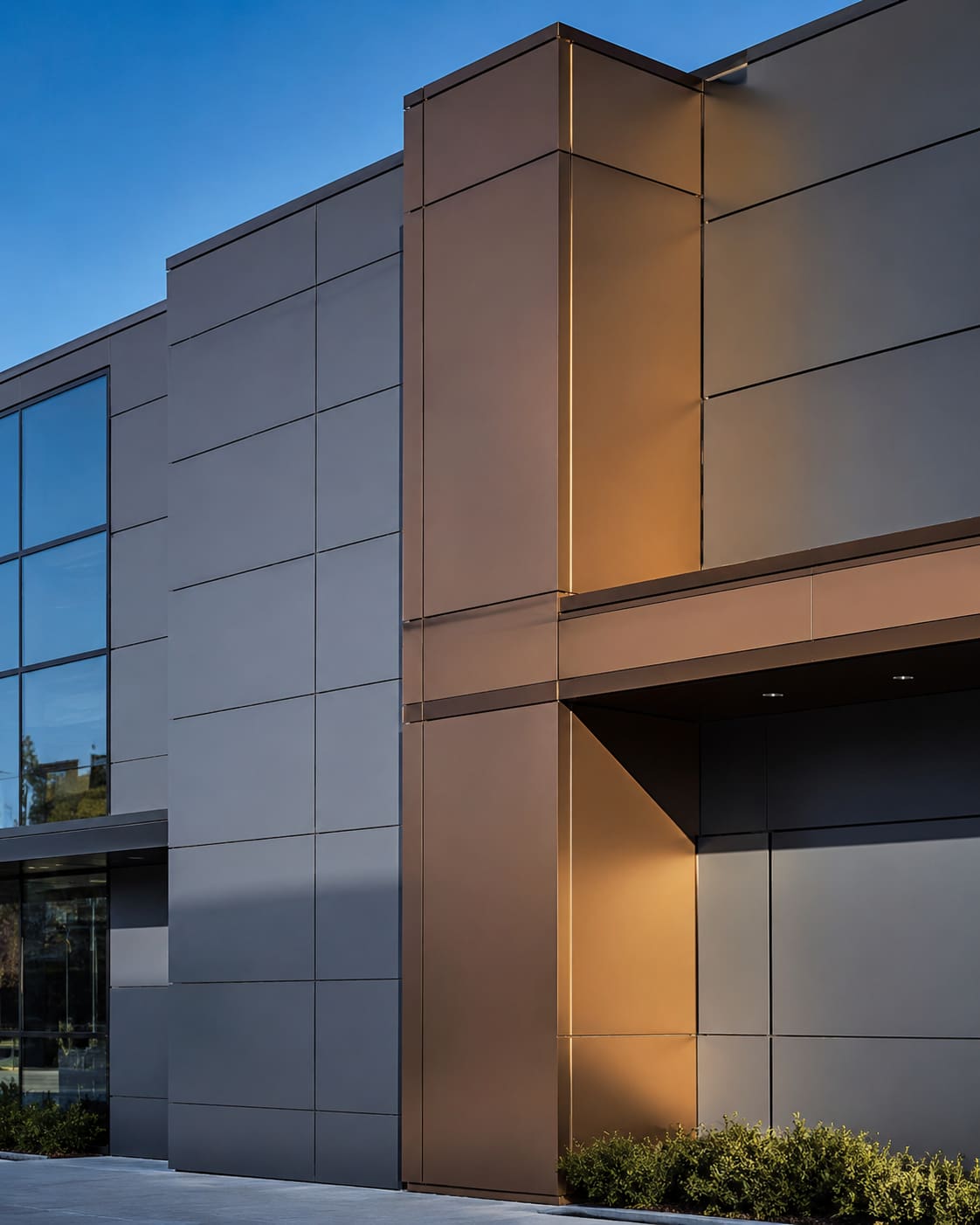
The best ACP cladding for most buildings in Hyderabad is a 4mm PVDF-coated exterior panel with a genuine 0.25mm aluminium skin, upgraded to fire-retardant (FR) grade wherever the building's height or occupancy demands it. That single specification settles most arguments on a site, but the reason this ACP cladding buying guide exists is that the market is flooded with grades, coatings and brands that look identical on a small sample board and behave completely differently once they are hanging on a real facade in the Telangana sun.
Aluminium Composite Panel (ACP) has become the default skin for showrooms, offices, hospitals, petrol pumps, banks and homes across Hyderabad and Secunderabad. It is lightweight, fast to install, easy to shape and gives a crisp, modern elevation at a fraction of the cost of stone or curtain glass. But choosing the wrong panel is an expensive mistake you look at every single day: the gap between a genuine 4mm fire-retardant sheet and a cheap 3mm economy sheet can be 40 to 50 percent in price and several years in lifespan.
This guide breaks down the core, skin gauge, coating, grades, trusted brands, 2026 prices and installation details so buyers in Telangana and Andhra Pradesh can specify with confidence and avoid the delamination, fading, oil-canning and warping that plague poorly chosen cladding in our climate. If you would rather hand the whole job to a specialist, our ACP cladding service covers supply and installation end to end, and you can get a free quote at any point in your decision.
What ACP Cladding Actually Is: Core, Skin and Coating
ACP is a sandwich panel: two thin aluminium skins bonded under heat and pressure to a mineral or polyethylene core. Three things decide whether a panel performs for 15 years or fails within five - the core, the aluminium skin thickness and the top coating. Understand these three variables and you can cut through almost any sales pitch, because everything else on the spec sheet is secondary.
- The core determines fire behaviour and rigidity. Polyethylene (PE) cores are cheapest and give a flat panel, but they are combustible; mineral-filled FR and A2 cores resist flame spread and satisfy fire authorities.
- The aluminium skin gives the panel its strength, flatness and dent resistance. A genuine exterior panel uses a 0.21mm or 0.25mm skin; cheaper sheets pad the core to hit the 4mm number while using a paper-thin 0.10mm to 0.15mm skin that oil-cans, dents and shows wave patterns in raking light.
- The coating protects the colour. PVDF (also branded Kynar 500) is the exterior standard; polyester (PE paint) is an interior-only coating that chalks and fades quickly outdoors.
A useful rule: never buy on the overall 3mm or 4mm figure alone. Two sheets can both measure 4mm on a caliper while one has a strong 0.25mm skin and the other has a 0.12mm skin buried in extra core. Insist on the true aluminium skin gauge in writing, because that single number separates a durable facade from a disposable one.
Understanding ACP Grades: Economy, PVDF, FR and A2
The grade decides where you can legally and safely use the panel, so fix the grade before you ever discuss colour or texture. There are four grades worth knowing for Hyderabad and Secunderabad projects, and they map directly to building type and height.
- Economy / PE grade: a polyethylene core with a low aluminium skin (0.10 to 0.18mm). It is the cheapest option and fine for interiors, signage, kiosks and low boundary walls, but it should never be used on tall or public buildings.
- PVDF exterior grade: a PVDF top coat over a 0.21mm to 0.25mm skin that resists intense UV and monsoon without chalking. This is the workhorse for shopfronts, showrooms and mid-rise elevations.
- FR grade (fire-retardant): a mineral-filled core rated to limit flame spread, mandatory for high-rise, hospital and commercial facades under NBC 2016. It carries a modest price premium that is non-negotiable on the buildings that need it.
- A2 grade: a near non-combustible core for premium and institutional projects where fire performance is formally audited by the authorities and insurers.
If your building pairs a bold elevation with cladding, coordinating the grade and panel colour with your 3D elevation design early avoids costly re-specification and material wastage later. It is far cheaper to change a panel on a drawing than after it is cut and hung.
PVDF vs Polyester: Why the Coating Decides Lifespan
The coating is the part of the panel your building shows to the street, and it is where most buyers are quietly cheated. PVDF (Polyvinylidene Fluoride, sold as Kynar 500) and polyester (PE) coatings can look identical on the day of installation, then diverge dramatically over the first two monsoons.
- PVDF: engineered for exteriors, it holds colour and gloss for 10 to 15 years even under Hyderabad's brutal summer UV, and it resists chalking, dust adhesion and pollution staining.
- Polyester (PE paint): a low-cost interior coating that begins chalking and fading within 3 to 5 years outdoors, showing patchy colour and a dull surface that no amount of cleaning restores.
A common trap is a supplier quoting a PVDF price but delivering a polyester-coated sheet, because the two feel the same to the touch. Ask for the coating type on the invoice, confirm it is Kynar 500 or equivalent fluoropolymer, and match it to the warranty certificate. On any surface that sees the sky, PVDF is the only sensible choice in our climate - polyester belongs strictly indoors.
Fire Safety and NBC 2016 Compliance in Telangana
Fire-retardant ACP is not optional marketing - it is a legal and life-safety requirement for many building types. After several high-profile facade fires across India, enforcement of the National Building Code (NBC 2016) has tightened throughout Telangana and Andhra Pradesh, and municipal and fire-NOC authorities in Hyderabad now scrutinise cladding specifications before granting an occupancy certificate.
- Buildings above 15m in height generally require FR or A2 grade cladding.
- Hospitals, malls, hotels, schools and assembly buildings require FR grade regardless of height.
- Panels near escape routes, staircases, lift lobbies and refuge areas should always be non-combustible.
- Standard PE-core panels are acceptable only for low-rise residential and interior use.
Ask your supplier for the fire test certificate (typically to an IS or EN classification) matched to the exact batch you are buying. A genuine FR panel comes with documentation; a relabelled PE panel does not. When fire compliance is audited, missing or mismatched certificates can stall your occupancy certificate entirely - a delay that costs far more than the FR premium ever would.
Trusted ACP Brands in the Indian Market
Brand matters because it signals consistent coating quality, verified fire testing and a warranty you can actually claim. In Telangana and Andhra Pradesh projects, the commonly specified and reliably available names fall into three broad tiers, and mixing tiers within a single facade is usually a false economy.
- Domestic mainstream - Alstrong, Aludecor and Eurobond: strong Indian brands offering full PVDF and FR ranges with 10 to 15 year coating warranties, widely stocked in Hyderabad and easy to source in matching batches.
- Premium imported - Alucobond and Alpolic: landmark-grade panels used on corporate headquarters and flagship facades where budget and specification allow.
- Value brands - Timex, Viva and Alucomax: economical sheets suitable for mid-range commercial and residential work, best specified in PVDF exterior grade rather than bare economy.
Always cross-check the warranty certificate against the actual batch number printed on the sheet, and buy through an authorised dealer. Grey-market and relabelled sheets are common in the region and are the single biggest cause of premature colour fade on local facades. A 10-year warranty is worthless if the sticker does not match the coating in the sandwich - you can see the results of correct specification in our recent projects.
Thickness, Application and 2026 Indicative Pricing
Thickness should follow the application, not the lowest quote. 3mm suits interiors, signage and small cladding runs; 4mm is the standard for building exteriors because it stays flat over large spans without oil-canning or waviness. For most Hyderabad elevations, 4mm is the only defensible choice.
Indicative 2026 supply rates in Hyderabad, per square foot of panel:
- Economy 3mm PE interior grade: INR 90 to 130 per sq ft.
- 4mm PVDF exterior grade: INR 160 to 240 per sq ft.
- 4mm FR grade: INR 260 to 380 per sq ft.
- Premium imported (Alucobond / Alpolic): INR 400 to 650 per sq ft.
Installation - including the aluminium framing, fasteners, structural sealant, cutting, grooving and labour - typically adds INR 120 to 220 per sq ft, so a finished PVDF facade lands around INR 320 to 480 per sq ft. Always compare quotes on installed rates, not panel-only rates, so you are comparing like with like. A cheap panel bolted to an under-built sub-frame will always cost more over the life of the building than a properly specified system installed once.
Installation, Sub-Frame and Hardware That Make or Break a Facade
ACP is only as good as the aluminium structure behind it, so never let a low panel price tempt you into an under-engineered sub-frame. Panels that fail early almost always fail because of poor framing, wrong fasteners or bad sealant - not because of the panel itself. The visible sheet gets the credit, but the hidden grid does the work.
- Sub-frame: a properly designed aluminium grid with the correct member size and spacing keeps panels flat and lets them expand and contract with temperature swings without buckling.
- Fastening: rivets and screws must be aluminium or stainless steel to avoid galvanic corrosion streaks that bleed down the facade during the monsoon.
- Joints: use a compatible structural or weather sealant and keep consistent groove widths for a clean, deliberate shadow-line finish.
- Interfaces: plan carefully where cladding meets glazing, doors and windows, because these junctions are where water ingress and ugly detailing usually begin.
For mixed facades that combine ACP with glass, panels frequently sit alongside structural glazing and spider fittings, so the cladding, glazing and hardware should be planned as one envelope rather than three separate trades. Browsing our services shows how facade, glazing and elevation work are coordinated on a single project rather than bolted together on site.
Common Mistakes That Ruin ACP Facades
Most ACP failures in Hyderabad are predictable and preventable, and nearly all of them trace back to a decision made at the buying stage rather than the site stage. Avoid these and you eliminate the large majority of complaints we are called to fix.
- Buying on total thickness alone and ignoring the aluminium skin gauge, which leads to oil-canning and dents within months.
- Accepting a polyester-coated sheet at a PVDF price, then watching the colour fade within a few summers.
- Skipping FR grade on a building that legally needs it, risking both safety and the occupancy certificate.
- Under-designing the sub-frame or using mild-steel fasteners that rust and streak the facade in the first monsoon.
- Sourcing from grey-market traders with no batch-matched warranty or fire documentation.
- Mixing panels from different batches or brands, which produces visible colour variation across the elevation under sunlight.
Every one of these is a purchasing decision, which is exactly why an hour spent on specification saves years of regret. When in doubt, spec up rather than down - the extra cost is small against the price of re-cladding.
Maintenance, Warranty Claims and Lifespan in Our Climate
A well-specified PVDF facade needs very little maintenance, which is precisely why the upfront grade decision matters so much. In Hyderabad's cycle of heat, dust and monsoon, a genuine 4mm PVDF panel can stay crisp for 15 years, while an economy sheet can fade or delaminate within five.
- Cleaning: a wash with mild soap and water twice a year removes dust and pollution film; never use abrasive pads or strong solvents that attack the coating.
- Inspection: check sealant joints and fasteners every couple of years, especially after heavy monsoons, and reseal any joints that have opened up.
- Warranty: keep your invoice, batch certificate and warranty card together, because a fading or delamination claim needs all three to be honoured.
- Repairs: individual damaged panels can usually be swapped without reworking the whole elevation, provided the sub-frame is sound and matching batch stock is available.
Spending a little more on grade and installation pays back through a facade that stays sharp for 15 years instead of failing in five - and that is the entire economic case for buying right the first time.
How to Buy Right: A Quick Checklist
Use this checklist before you sign off any ACP order in Hyderabad, Secunderabad or anywhere in Telangana and Andhra Pradesh. It compresses the whole guide into the decisions that actually protect your money.
- Confirm the fire grade required by your building's height and use before you shortlist any panels.
- Ask for the actual aluminium skin gauge in writing (0.21mm or 0.25mm), not just the total thickness.
- Choose PVDF (Kynar 500) coating for any exterior surface in our high-UV climate.
- Verify the brand warranty against the batch number and buy only from an authorised source.
- Insist on a properly designed aluminium sub-frame with corrosion-resistant fasteners.
- Get installed rates, not panel-only rates, so competing quotes are genuinely comparable.
When you are ready, our team can supply genuine, warranty-backed panels and install them through our ACP cladding service, coordinate the look with a matching 3D elevation design, or simply get a free quote and we will specify the whole system for you.