For most projects the ACP vs HPL cladding decision comes down to budget versus lifespan: ACP is the cheaper, lighter, faster-to-install panel with the widest finish range, while HPL is the denser, tougher, longer-lasting board that resists impact, scratching and heat better. Both are proven exterior cladding materials, both look sharp when detailed well, and both are used on facades across Hyderabad, Secunderabad and the wider Telangana and Andhra Pradesh markets - yet they behave very differently once you weigh cost per square foot, fire safety, weathering and long-term maintenance.
Aluminium Composite Panel (ACP) is a lightweight sandwich of two thin aluminium skins bonded to a mineral or polymer core, while High Pressure Laminate (HPL) is a dense solid board of resin-impregnated kraft paper compressed under heat and pressure. That single structural difference drives almost everything else - price per square foot, fire behaviour, how the panel ages under the Deccan sun, and how it is fixed to the building. This guide breaks down where each material wins, with realistic installed pricing, so you can match the panel to your building, budget and location. If you would rather skip straight to a specification, you can get a free quote and we will size the system for your facade.
At Hakimi Aluminium and Glass we both supply and install cladding and act as authorised hardware dealers for Taiton, Enox and Ozone, so this comparison is written from real project experience across Hyderabad - not brochure claims. Whether you are cladding a retail showroom on Road No. 36, an office block in Gachibowli or a hospital wing in Secunderabad, the right choice depends on the details below.
ACP vs HPL Cladding: The Core Structural Difference
The reason ACP and HPL perform so differently is that they are built differently. ACP is a composite panel, typically 3mm to 4mm thick, with a coil-coated aluminium face over a mineral or polyethylene core. That construction gives you glossy, matte, metallic, wood, stone and mirror finishes; it is light, easy to bend and route into clean corners, and quick to install - which is exactly why it dominates commercial signage and shopfronts across Hyderabad and Secunderabad.
HPL is a homogeneous solid laminate, usually 6mm to 8mm thick, that is self-supporting and extremely hard-wearing. It resists impact, scratches and abrasion far better than ACP, making it a strong choice for high-traffic zones, schools, hospitals and premium residential facades. Because it is solid through its full thickness, a knock that would dent an ACP skin barely marks an HPL board.
- ACP: lightweight (about 5.5 kg/sqm for 4mm), flexible, huge finish range, fast to fit
- HPL: dense (roughly 9 to 11 kg/sqm for 8mm), rigid, self-supporting, tougher surface
- ACP bends and folds for parapets, coping and signage boxes; HPL is cut and drilled but not folded
Both materials belong in a broader facade strategy. Cladding often sits alongside glazed elements and framing, so it pays to plan the whole envelope together rather than choosing panels in isolation. We supply and fit both ACP cladding and HPL cladding systems, and you can browse our services to see how cladding, glazing and framing tie into one buildable package.
Cost Comparison: Indicative INR Pricing in Hyderabad and Telangana
Budget usually decides the ACP vs HPL question. In Hyderabad, Secunderabad and across Telangana and Andhra Pradesh, ACP is the more affordable option per square foot, while HPL commands a premium because of its density and durability. Here is a realistic material-only breakdown at 2026 rates:
- ACP (economy grade, PE-core): around INR 120 to 180 per sq ft material
- ACP (premium / A2 fire-rated mineral core): around INR 220 to 400 per sq ft material
- HPL (exterior grade, 6mm): around INR 280 to 420 per sq ft material
- HPL (exterior grade, 8mm): around INR 420 to 550 per sq ft material
Installed rates including the aluminium sub-frame, brackets, fasteners, sealant and labour typically run INR 220 to 480 per sq ft for ACP and INR 380 to 750 per sq ft for HPL, depending on panel grade, facade height, cavity depth and site access. A tower needing swing-stage or scaffold access, or heavy cutting for a detailed rainscreen pattern, will push toward the top of each range, while a low-rise showroom with easy ground access sits nearer the bottom.
Do not forget the hidden line items - the aluminium carrier system, structural brackets, rivets or undercut anchors, sealants and edge trims are separate from the headline panel rate and can add 30 to 45 percent to a bare material figure. For most Hyderabad commercial projects ACP keeps the budget lean, while HPL suits owners prioritising a 20-year lifecycle over upfront savings. To see how these numbers translate into finished facades, look through our recent projects or ask us to get a free quote with a measured take-off.
Fire Safety: A2, FR and Why the Core Matters
Fire performance is the single most important differentiator, and it has been front-of-mind for Indian specifiers since high-rise cladding fires made global headlines. Standard PE-core ACP has a combustible polyethylene core and should never be used on tall or occupied buildings. Always specify A2 (limited combustibility, mineral-core) or FR (fire-retardant) ACP for any facade above two storeys.
Exterior-grade HPL is naturally more fire-resistant and many boards carry a Euroclass B or better fire-reaction rating, which is why HPL is frequently preferred for hospitals, schools and institutional buildings across Telangana. That said, a good A2 mineral-core ACP and a fire-rated HPL board can both be code-compliant - the real danger is cheap PE-core ACP quietly substituted on site to save money.
- Never accept unbranded PE-core ACP on a multi-storey facade
- A2 ACP has a non-combustible mineral core rated to limited combustibility
- FR-grade HPL boards typically achieve Euroclass B-s2,d0 or better
- Insist on test certificates, brand markings and batch traceability before installation
If your project is a hospital, school or campus in Hyderabad or coastal Andhra Pradesh, treat fire reaction as a hard specification, not a preference. When you specify ACP cladding with us for anything occupied or multi-storey, we quote A2 mineral-core panels by default and supply the paperwork to prove it.
Durability and Weather Performance Under the Deccan Sun
On durability, HPL clearly leads. It shrugs off knocks, UV and the harsh summer heat of the Deccan plateau, and typically lasts 15 to 20 years with minimal fade. Its solid body means it will not oil-can (ripple) the way a thin ACP skin can when a facade heats past 60C in the May and June peak.
Quality FR-ACP lasts around 10 to 15 years, but cheaper PE panels can delaminate, ripple or fade faster in Hyderabad's intense sun. Coastal Andhra Pradesh sites - think Visakhapatnam or Kakinada - add salt-laden humidity, where HPL's sealed edges and dense body hold up better than a poorly sealed ACP joint.
- HPL: excellent impact, UV and abrasion resistance; ideal for high-traffic entrances and plinths
- ACP: good UV resistance with a genuine PVDF coating, but softer and more dent-prone
- Both need a ventilated cavity and correct drainage to shed monsoon water
- Colour consistency: HPL holds tone longer; premium PVDF ACP is close but not equal
Whichever panel you pick, the sub-frame and workmanship decide half the outcome. A well-detailed cavity, correct expansion gaps and quality fasteners matter as much as the board itself - most cladding failures we are called to fix in Hyderabad trace back to framing and sealing shortcuts, not the panel material.
Installation, Framing and Fixing Systems
Both systems hang on an aluminium sub-structure fixed back to the building, but the fixing philosophy differs. ACP is commonly fitted as cassettes with routed-and-folded returns, or with a tray-and-clip system, giving crisp shadow-gap joints. HPL is usually face-fixed with colour-matched rivets or secret-fixed with undercut anchors, which suits a cleaner rainscreen look with no visible fasteners.
The carrier system must be isolated from dissimilar metals to avoid galvanic corrosion, and both panel types need room to move. Aluminium and HPL expand and contract differently across a 30-degree summer-to-winter swing, so expansion gaps and slotted fixings are not optional - they are what stop a facade from buckling or cracking around its fixings.
- Sub-frame: extruded aluminium carrier system, thermally isolated and packed off the wall
- ACP fixing: cassette or tray-and-clip, riveted, or structural glazing fix (SGF)
- HPL fixing: face-fixed rivets or undercut-anchor secret fix
- Allow a 20mm to 50mm ventilated cavity behind both panel types for drainage and airflow
For projects that combine cladding with glazed walls, we detail panel-to-glass transitions so the water and air seals stay continuous around the building. Getting the framing, cavity and flashings on the drawing early avoids ugly site improvisation later - see how we integrate these details across our recent projects.
Finish, Aesthetics and Design Flexibility
If visual variety is your priority, ACP wins. The coil-coated aluminium face is available in hundreds of solids, metallics, mirror, brushed, timber and stone-effect finishes, and because ACP folds it can wrap curves, parapets and signage boxes without visible joints. For a colourful, brand-led showroom or retail frontage in Hyderabad, ACP is hard to beat on value and impact.
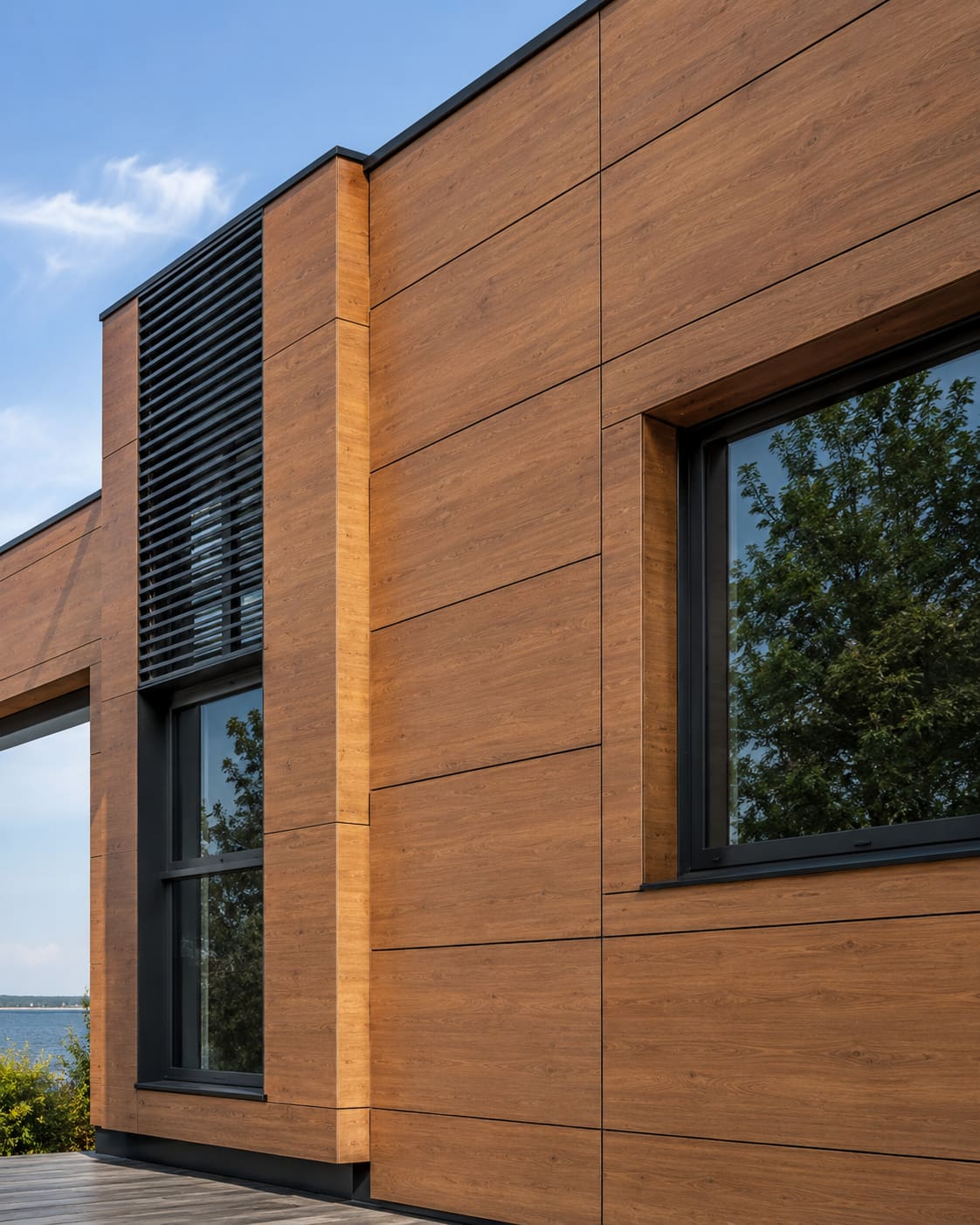
HPL offers a more natural, matte, architectural palette - realistic timber grains, solid colours and stone tones with a warm, non-reflective surface that reads as premium. It cannot fold, so curves are handled with faceting, but flat rainscreen facades in HPL look understated and high-end, which is why villas, campuses and boutique hospitals often favour it.
- ACP: widest colour and effect range, foldable, best for signage and bold facades
- HPL: natural matte tones, timber and stone realism, premium rainscreen look
- Both: available in fire-rated grades without sacrificing finish quality
Aesthetics should follow function: choose the finish family first, then confirm the fire and durability grade your building code and building height demand. A striking finish on a non-compliant core is a false economy.
Maintenance, Cleaning and Lifecycle Cost
Both panels are low-maintenance compared with paint or plaster, but they age differently. HPL is close to fit-and-forget: a periodic wash with mild detergent removes Hyderabad's dust and pollution film, and its solid body means minor surface scuffs rarely show. ACP needs a little more care - the coated skin can be scratched, and a dented panel usually has to be replaced rather than repaired because you cannot sand a composite face flat again.
Over a 15-to-20-year horizon this evens out the price gap. HPL costs more up front but typically needs zero panel replacement in that window, whereas a cheaper ACP facade may see individual panels swapped after impact, storm debris or delamination. Sealant joints on both systems are the real maintenance item and should be inspected every few years and re-run before they fail.
- Clean both with mild detergent and water; avoid abrasive pads and solvents on ACP
- Inspect sealant joints and drainage paths every 2 to 3 years, especially after monsoon
- Keep a few spare panels from the original batch for future colour-matched repairs
- Factor lifecycle cost, not just install cost, when comparing an ACP and an HPL quote
When you weigh a 15-year picture, the HPL premium often narrows or disappears. If you want a lifecycle comparison for your specific building, ask us to get a free quote that lays out both options side by side.
Common Cladding Mistakes to Avoid
Most cladding problems we are asked to rectify in Hyderabad and Secunderabad are avoidable, and they rarely come down to the choice between ACP and HPL. They come down to specification, sealing and workmanship. Watch for these traps before you sign a contract:
- Accepting PE-core ACP on a tall or occupied building to shave the budget - a serious fire risk and increasingly a compliance failure
- Skipping the ventilated cavity, which traps monsoon moisture behind the panel and causes warping, staining and corrosion
- Under-sizing expansion gaps, so panels buckle or crack around fixings in peak summer heat
- Mixing dissimilar metals without isolation, inviting galvanic corrosion at the brackets
- Comparing quotes on panel rate alone while ignoring sub-frame, sealant and fixing costs
- Choosing on colour before confirming the fire grade the building code requires
A cheap headline rate that omits the carrier system or specifies the wrong core is not a saving - it is a liability. Insist on a written specification that names the panel brand, core type, fire rating, sub-frame and cavity detail. Browse our services to see the full-scope way we quote so nothing critical is hidden below the line.
Which Cladding Should You Choose in Hyderabad and Secunderabad?
Pick ACP when you want a cost-effective, colour-rich facade for showrooms, offices, signage and mid-rise commercial buildings - and specify an A2 or FR fire-rated core for anything above two floors. It keeps budgets lean and installs fast, which matters on the tight commercial timelines common across Hyderabad and Secunderabad.
Pick HPL when durability, impact resistance and a premium natural finish matter more than upfront cost - villas, hospitals, educational campuses, high-traffic entrances and coastal Andhra Pradesh sites. The higher panel rate is offset by a longer lifecycle and lower maintenance over 15 to 20 years.
- Tight budget, bold colours, fast install, signage: choose fire-rated ACP
- Long lifecycle, impact zones, premium matte finish, institutions: choose HPL
- Mixed facade: many buildings pair ACP feature bands with HPL rainscreen fields at ground level
At Hakimi Aluminium and Glass we supply and install both ACP cladding and HPL cladding across Hyderabad, Secunderabad and the wider Telangana and Andhra Pradesh region, and we help clients match panel grade, fire rating and budget to the specific building before committing. Tell us the building height, use and budget and we will recommend the right system - get a free quote to get started.