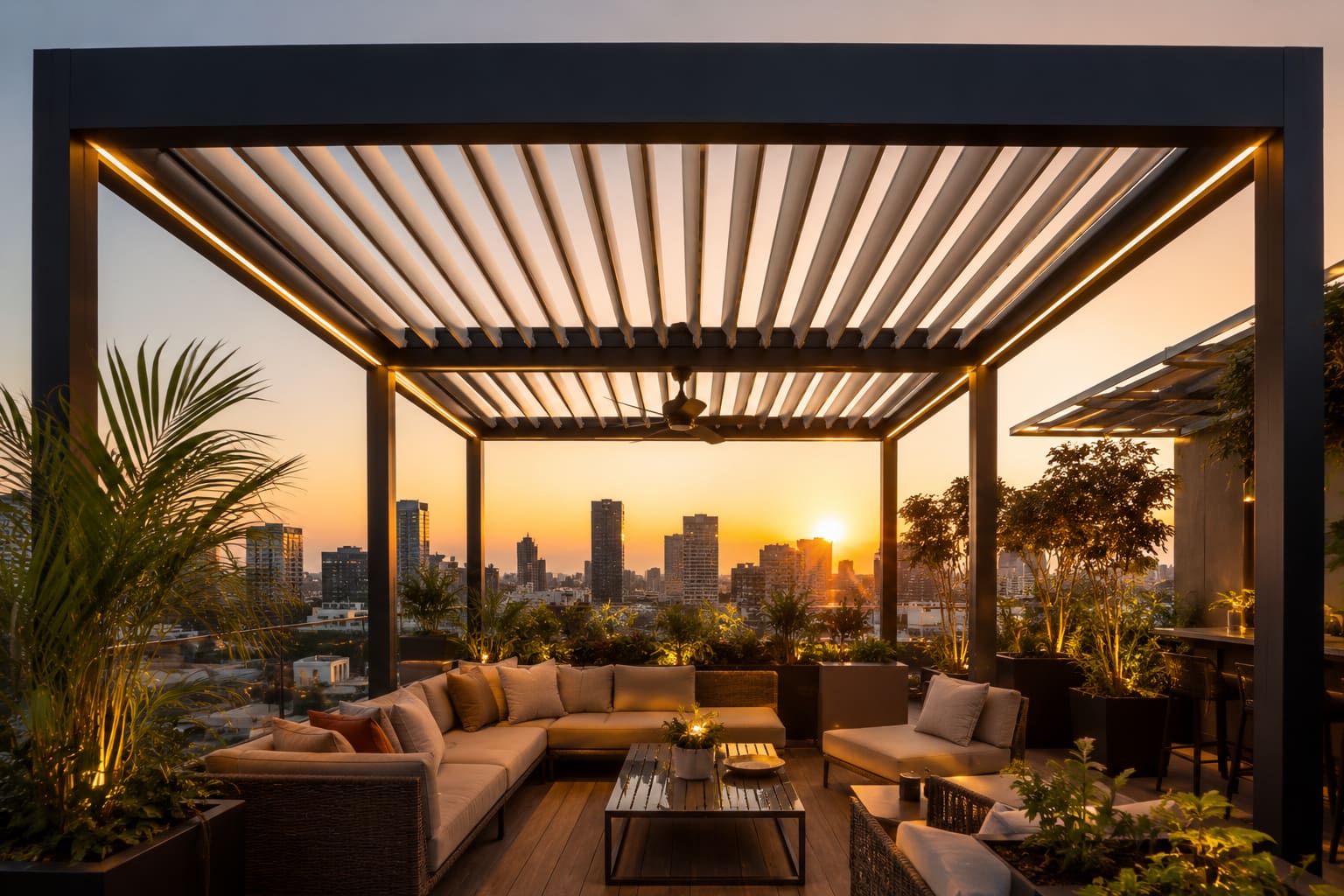
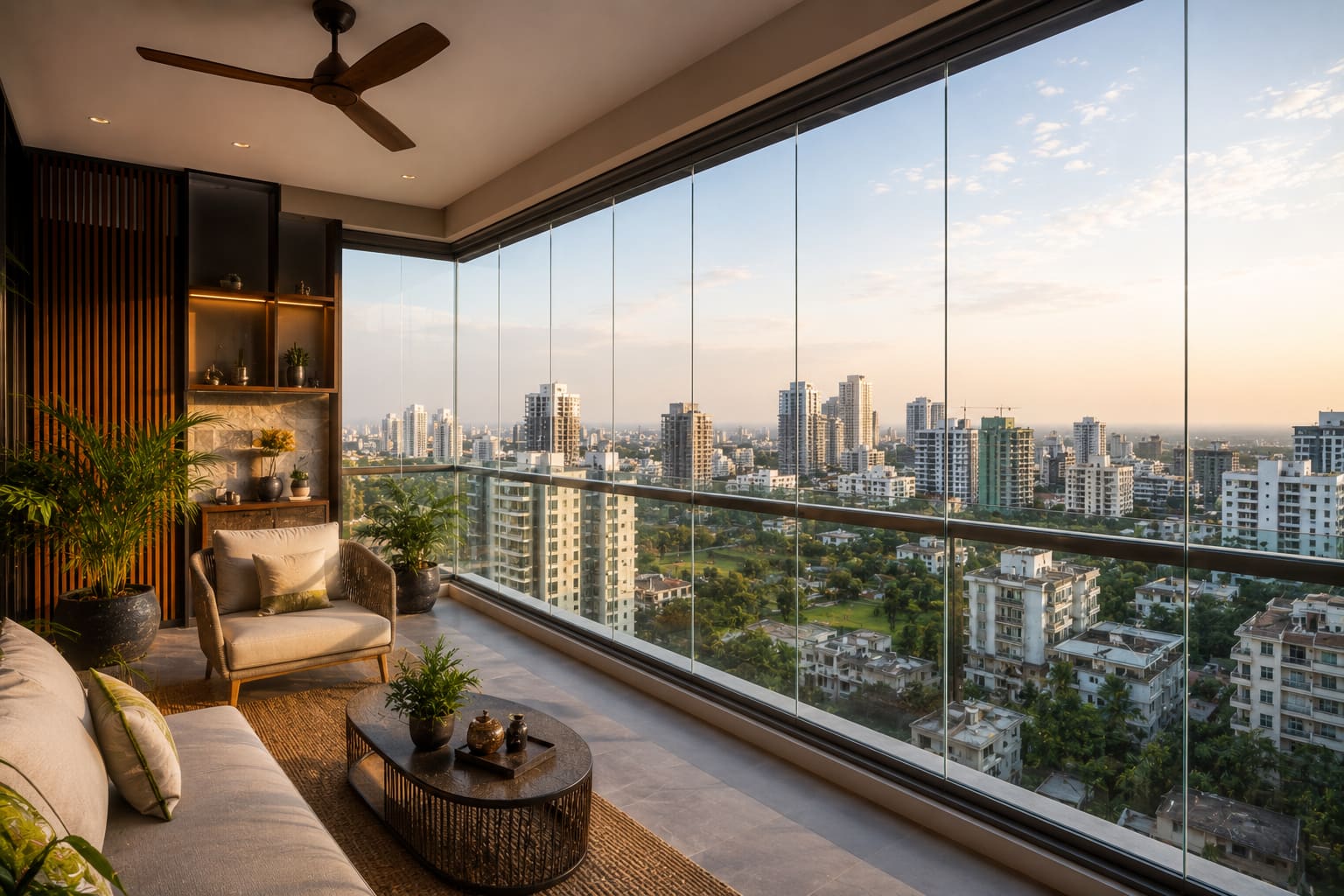
The best balcony glazing ideas for apartments combine slim aluminium sliding or frameless folding glass, toughened panels of 8mm to 12mm and openable mesh vents to convert an unused ledge into a clean, quiet, all-weather room for roughly INR 450 to INR 1,400 per sq ft installed. A balcony is usually the most wasted square footage in an apartment: left open it collects road dust, monsoon spray and traffic noise, but enclosed thoughtfully it becomes a reading nook, a compact home office, a spill-proof play area or simply a lounge you can use through both the summer and the rains. Good balcony glazing is a balancing act between light, weather protection, ventilation and a view you actually want to keep.
In Hyderabad, Secunderabad and across Telangana and Andhra Pradesh, demand for balcony enclosures has climbed fastest in high-rise gated communities in Gachibowli, Kokapet, the Financial District, Narsingi, Kondapur and Tellapur, where fine construction dust and harsh west-facing afternoon sun are daily problems. Coastal towns like Visakhapatnam and Vijayawada add salt-laden humidity that punishes cheap hardware. Whether you want a fully openable glass wall that disappears to one side or a sealed sliding enclosure that pairs with a matching glass railing, the right choice depends on ledge depth, floor height, wind exposure and your society's rules.
This guide walks through the glazing systems that genuinely perform in Indian apartment conditions, the glass and hardware that keep them running for years, realistic INR budgets with an itemised cost breakdown, the mistakes that cause leaks and jammed panels, and the design details that make the finished space liveable. It is written for owners who want to enclose a balcony once and never redo it.
What Balcony Glazing Actually Is (and Why It Pays Off)
Balcony glazing means enclosing an open balcony with glass panels held in aluminium tracks or minimal frames, so the space is protected from dust, rain, wind and noise while still flooding with daylight. It is not the same as replacing a window: the panels are designed to slide, stack or fold so you can open the balcony fully in pleasant weather and seal it during a dust storm or a downpour.
The payoff is threefold. First, you reclaim usable floor area, effectively adding a small room without changing the building's footprint or paying for new construction. Second, you cut cleaning: an enclosed balcony stays free of the fine grey dust that coats every open ledge in Hyderabad within days. Third, you gain comfort, blunting the west-sun heat and the road noise that make many open balconies unusable for half the day.
There is a resale angle too. In gated communities across Telangana, a neatly glazed, uniform balcony reads as a finished, premium unit, whereas a patchwork of mismatched grilles and netting drags down perceived value. Done to society standard, glazing is one of the few apartment upgrades that both improves daily life and protects the flat's market appeal.
Balcony Glazing Ideas That Work in Real Apartments
Not every glazing style suits every balcony. Ledge depth, wind load on higher floors and society NOC rules all shape the choice. These are the systems installed most often across Hyderabad and Secunderabad, and where each one earns its place:
- Frameless folding (bi-fold / stackable) glass: Toughened panels slide and fold flat to one side, giving a fully open balcony when you want it and a sealed one during rain. Ideal for view-facing balconies in high-rise towers. Roughly INR 850 to INR 1,400 per sq ft, and it depends on precision hardware to stay smooth.
- Slim-profile aluminium sliding glazing: 2, 3 or 4-track powder-coated frames with clear or tinted glass. The workhorse choice for dust and noise control at a lower cost, around INR 450 to INR 750 per sq ft, and the most society-friendly because the frame colour is easy to standardise.
- Openable glass with mosquito mesh: Sliding glass paired with a mesh track so you can ventilate without insects, a practical pick for humid Hyderabad evenings and Andhra coastal towns where mosquitoes are relentless after dusk.
- Fixed picture glazing: A single large fixed pane for balconies you treat as a pure extension of the living room, best combined with at least one openable vent so the space still breathes.
- Louvered or top-hung ventilators: Adjustable glass louvres above a fixed lower pane, useful on shallow utility balconies where you want airflow without a full sliding wall.
If your balcony doubles as a safety edge, pair the glazing with a toughened glass railing so the parapet, balustrade and enclosure read as one clean design instead of three mismatched add-ons. You can see how these combinations look on real facades in our recent projects.
Choosing the Right Glass, Frames and Finish
The glass specification matters more than most buyers expect, because it decides both safety and comfort. For any balcony above the second floor, use toughened (tempered) glass of 8mm to 12mm depending on panel size, both for impact safety and for wind resistance on exposed high-rise faces. Larger folding panels typically move up to 10mm or 12mm.
- Tinted or reflective glass cuts heat and glare on west and south-facing balconies, which matters given Telangana summers that regularly cross 42 degrees Celsius and turn a clear-glass enclosure into a greenhouse.
- Frosted, fluted or lacquered lower panels add privacy on ground and lower floors without blocking daylight, and hide the clutter that tends to accumulate on a utility balcony.
- Double-glazed units (DGUs) are worth the extra cost only where noise from a main road or an ORR-facing tower is genuinely severe, since they add roughly 30 to 40 percent to the glass bill and most of the acoustic benefit comes from good seals rather than the second pane alone.
- Laminated glass is worth considering for ground-floor balconies where security matters, as it holds together when struck.
For frames, powder-coated aluminium in matte black, champagne, bronze or off-white ages well and resists coastal humidity in Visakhapatnam and Vijayawada far better than untreated sections. If you want a near-invisible look, minimal-frame systems hide their fixings to maximise the view, though they demand more precise installation and stricter tolerances. Always confirm the powder-coat is a genuine architectural-grade finish rather than a thin cosmetic spray, because that coating is what stands between the aluminium and years of dust, rain and salt air.
Hardware: The Detail That Decides Longevity
Glazing lives or dies on its moving parts. A beautiful frameless wall that jams after one monsoon is a failure, and the difference is almost always the rollers, guides, interlocks and locks rather than the glass. Reputable installers spec hardware to the actual panel weight instead of to the cheapest wheel that fits the track.
- Heavy toughened panels need load-rated stainless rollers and matching tracks; under-spec wheels flat-spot and start dragging within a year, and the whole panel then binds.
- Interlocks and meeting-stile seals control how tightly panels close, which in turn controls dust and rain ingress far more than the glass thickness does.
- Reliable multi-point locks keep ground-floor and low-rise balconies secure without spoiling the slim look, and give the enclosure a reassuring, solid feel.
- For frameless folding walls with a swing panel, a well-rated floor spring keeps the door self-closing and level, so it does not sag out of alignment over time.
- Corrosion-resistant handles and gaskets matter most in coastal Andhra, where salt air destroys ordinary mild-steel fittings within a couple of seasons.
Investing an extra INR 3,000 to INR 8,000 in branded hardware on a typical balcony is cheap insurance against a full re-fit later. When you get a free quote, ask the installer to name the specific roller, lock and spring brands in writing rather than accepting a vague line for 'imported hardware'.
Indicative Costs and What Drives Them
As a planning figure, a standard 40 sq ft apartment balcony in Hyderabad typically runs between INR 25,000 and INR 55,000 for aluminium sliding glazing, and INR 45,000 to INR 90,000 for a frameless folding system, installation included. Larger or double-height balconies in premium Kokapet, Narsingi and Financial District towers can run well beyond that.
Roughly, the cost of a job splits like this: glass 35 to 45 percent, aluminium sections or frameless clamps 20 to 30 percent, hardware 10 to 20 percent, and labour plus site handling 15 to 25 percent. The biggest single swing factors are glass thickness, whether the system is framed or frameless, the number of tracks, the hardware brand and whether mosquito mesh is added.
- Get a site measurement before trusting any quote; balcony widths vary even within the same tower and floor plan, and a rate quoted per running foot can hide a large difference in real area.
- Check your society and builder NOC rules early, as some gated communities mandate a specific exterior colour and profile, and non-standard glass can force a costly redo.
- Budget separately for teardown and disposal of any existing grille, netting or old aluminium, which many quotes quietly leave out.
- Confirm whether GST and transport are included, since headline per-sq-ft rates sometimes exclude them and inflate the final bill by 18 percent.
- On higher floors, difficult crane, hoist or scaffolding access can add meaningfully to labour, so ask how the panels will actually reach your floor.
For a written, itemised estimate with no hidden extras, ask for a floor-wise breakdown for your specific balcony rather than a single lump sum, so you can compare quotes line by line.
Design Tips to Make the Space Genuinely Usable
Glazing is only half the project. To make the balcony truly liveable, plan the interior alongside the glass rather than as an afterthought, because retrofitting flooring or power points after the enclosure is sealed is awkward and expensive.
- Keep at least one full openable section for cross-ventilation and so you can clean the outer glass face safely from inside, never leaning out over a high-rise edge.
- Pair glazing with a low-maintenance floor like anti-skid tiles or WPC decking that shrugs off the occasional rain ingress and does not warp in humidity.
- Use light window treatments; roller blinds or sheer curtains behind the glass tame the afternoon sun without a heavy visual load or trapping heat against the pane.
- If you want greenery, plan a narrow planter ledge with proper drainage before glazing, so water never sits against the aluminium frame and corrodes it.
- For a home-office balcony, run a power point and network cable during the work, and size any furniture to the ledge depth so the enclosure earns its space year-round.
- Consider a slim internal glass partition if you want to separate a work corner from a lounging corner without blocking light across the space.
- Match the frame colour to your window frames and railing so the balcony reads as part of the home, not a bolted-on box.
Ventilation, Drainage and Monsoon-Proofing
Hyderabad gets sharp pre-monsoon dust storms followed by heavy short bursts of rain, so a sealed enclosure must still breathe and drain. The most common complaint installers are called back to fix is condensation and water pooling in badly detailed jobs, and almost every case traces back to a missing weep hole or a floor that slopes the wrong way.
- Specify weep holes in the bottom track and a slight outward floor slope, so any driven rain drains away from the room instead of collecting inside.
- Add EPDM gaskets and brush seals at panel meeting points to block dust while still letting the mesh vent do its job.
- On sealed picture-glass balconies, plan a trickle vent or an openable top light so the space does not turn into an oven in May and June.
- Silicone-seal only the outer perimeter; over-sealing the tracks traps water inside and defeats the drainage the system relies on.
- Service the tracks twice a year; a five-minute vacuum and a silicone wipe keeps grit from grinding the rollers and the seals supple.
Getting these small details right is what separates a professional balcony glazing installation from a leaky retrofit that needs redoing after two seasons.
Common Mistakes to Avoid
Most balcony glazing regrets come from a handful of avoidable errors. Knowing them upfront saves both money and a second round of work.
- Skipping the society NOC and then being ordered to redo the frame in the approved colour, or worse, to remove the enclosure entirely.
- Choosing thin, untoughened glass to save a few thousand rupees on a high floor, which is both unsafe and often not permitted.
- Buying on headline price alone, then discovering the hardware is generic and the panels drag within a year.
- Sealing the balcony completely with no openable vent, leaving no way to ventilate, clean the outer glass or release summer heat.
- Ignoring drainage detailing, so the first heavy shower pools water against the wall and stains the flooring.
- Forgetting to route power and drainage before the enclosure goes up, forcing ugly surface conduits later.
- Hiring a fabricator who vanishes after payment; insist on a firm that offers a written workmanship warranty and can come back to service the tracks.
Safety, Society Rules and Warranty in Telangana
Balcony glazing changes a building's external face, so approvals and safety are not optional extras. In most Hyderabad and Secunderabad gated communities, the association or builder must sign off on the design before work begins, and a growing number publish a standard glazing specification for exactly this reason.
- Confirm the approved frame colour, glass tint and profile with your society office in writing; retrofitting the wrong shade usually means a costly redo at your expense.
- Never glaze over the only firefighting or refuge access without checking local high-rise fire norms, as this can be both illegal and dangerous.
- Insist on toughened glass certified to IS 2553 and ask for the hardware brand warranty on paper, not just a verbal assurance.
- A reputable installer offers at least a one-year workmanship warranty on top of the manufacturer's glass and hardware cover, and stays reachable for servicing.
Explore our services to see how balcony glazing sits alongside facade, railing, structural glazing and partition work, so a single team can own the whole exterior detail and stand behind it. That single-vendor accountability is what keeps the enclosure looking and working like the day it was fitted, season after Telangana season.