Sustainable facade materials are exterior cladding and glazing systems selected for high recycled content, long service life, low embodied and operational energy, and end-of-life recyclability, with the main options being recycled aluminium, low-emissivity insulated glass, High Pressure Laminate (HPL), terracotta, and fibre cement. A facade is judged sustainable when it lowers a building's lifetime energy use, is durable enough to avoid frequent replacement, and can be recovered or recycled rather than sent to landfill.
In India's warm climates, and specifically in the hot semi-arid conditions of Hyderabad and Secunderabad, the facade is the single largest driver of cooling load, so material choice directly affects electricity bills and carbon output. On the glass-heavy towers rising across Gachibowli, Kokapet, the Financial District and Hitec City, the difference between single clear glass and a solar-control double-glazed DGU facade can swing air-conditioning demand by 20 to 35 percent.
Selection is governed by the National Building Code (NBC) 2016, the Energy Conservation Building Code (ECBC) for energy performance, and material-specific standards such as IS 2553 for safety glass and IS 875 Part 3 for wind load. This guide breaks down each material, its measurable sustainability metrics, realistic Hyderabad pricing, and how to combine them for the local climate. If you are planning a project, our team can help you get a free quote tailored to your elevation.
What makes a facade material sustainable?
A facade material is sustainable when it combines low embodied energy, long service life, and recoverability at end of life, so its environmental cost is spread across decades rather than replaced repeatedly. Sustainability is not a single label but a set of measurable numbers you can compare across quotes. The four measurable criteria are:
- Recycled content: the percentage of the material made from post-consumer or post-industrial scrap (recycled aluminium can exceed 75%).
- Operational performance: thermal transmittance (U-value, W/m2K) and Solar Heat Gain Coefficient (SHGC), which govern cooling energy.
- Service life: the years before replacement is needed; aluminium and glass systems commonly exceed 30 to 40 years.
- Recyclability: whether the material can be recovered rather than landfilled; aluminium and glass are both infinitely recyclable.
The Energy Conservation Building Code (ECBC) and green rating systems such as IGBC and GRIHA reward facades that meet strict U-value and SHGC thresholds. A whole-life view matters more than upfront price: a cheaper facade that fades, delaminates or must be replaced in ten years usually costs more in embodied carbon and rupees than a durable system specified once and maintained lightly.
Recycled and low-carbon aluminium
Recycled (secondary) aluminium is the most sustainable metal facade material because it uses about 95% less energy to produce than primary aluminium while retaining identical strength and finish. Architectural aluminium extrusions can be re-melted indefinitely with no loss of mechanical properties, making it a true closed-loop material, and its high scrap value means it is almost always recovered rather than dumped.
- Recycled content: commonly 30% to 75%+ depending on supplier and alloy.
- Service life: 40+ years with anodised or powder-coated (PVDF) finishes.
- Finish durability: PVDF/Kynar coatings resist UV fading in Hyderabad's high solar exposure and dust-laden monsoon air.
- Fully recyclable at end of life with high scrap value, incentivising recovery.
Aluminium framing carries almost every sustainable facade type: it is the backbone of curtain wall glazing, the substructure behind ACP cladding, and the sightline of modern aluminium doors and windows. Pairing it with insulated glass balances strength, weight and thermal performance, and specifying thermal-break windows further stops heat conducting straight through the metal into air-conditioned interiors.
Low-emissivity and insulated glass
Low-emissivity (low-e) insulated glazing is the key sustainable glass technology, reducing heat transfer with a microscopically thin metallic coating that reflects infrared while admitting daylight. A double-glazed low-e unit typically achieves a U-value of 1.1 to 1.8 W/m2K, compared with about 5.7 W/m2K for single clear glass, which is the difference between a wall that traps heat and one that resists it.
- SHGC: low-e and solar-control coatings can bring SHGC below 0.30, cutting solar heat gain in hot climates.
- Daylight: high visible-light transmission reduces artificial lighting demand while blocking heat.
- Safety: toughened and laminated safety glass is governed by IS 2553; toughened glass is 4 to 5 times stronger than annealed glass.
- Recyclability: glass cullet is recyclable, and aluminium spacers/frames are recoverable.
For commercial towers, low-e DGUs are usually installed as structural glazing or as a reflective glass facade where daytime privacy and glare control also matter. ECBC sets maximum window U-value and SHGC limits by climate zone, which insulated low-e units are designed to satisfy, and opaque zones at floor slabs are handled with spandrel glazing to keep a continuous glass appearance without wasting energy on solid walls.
HPL, terracotta and fibre cement cladding
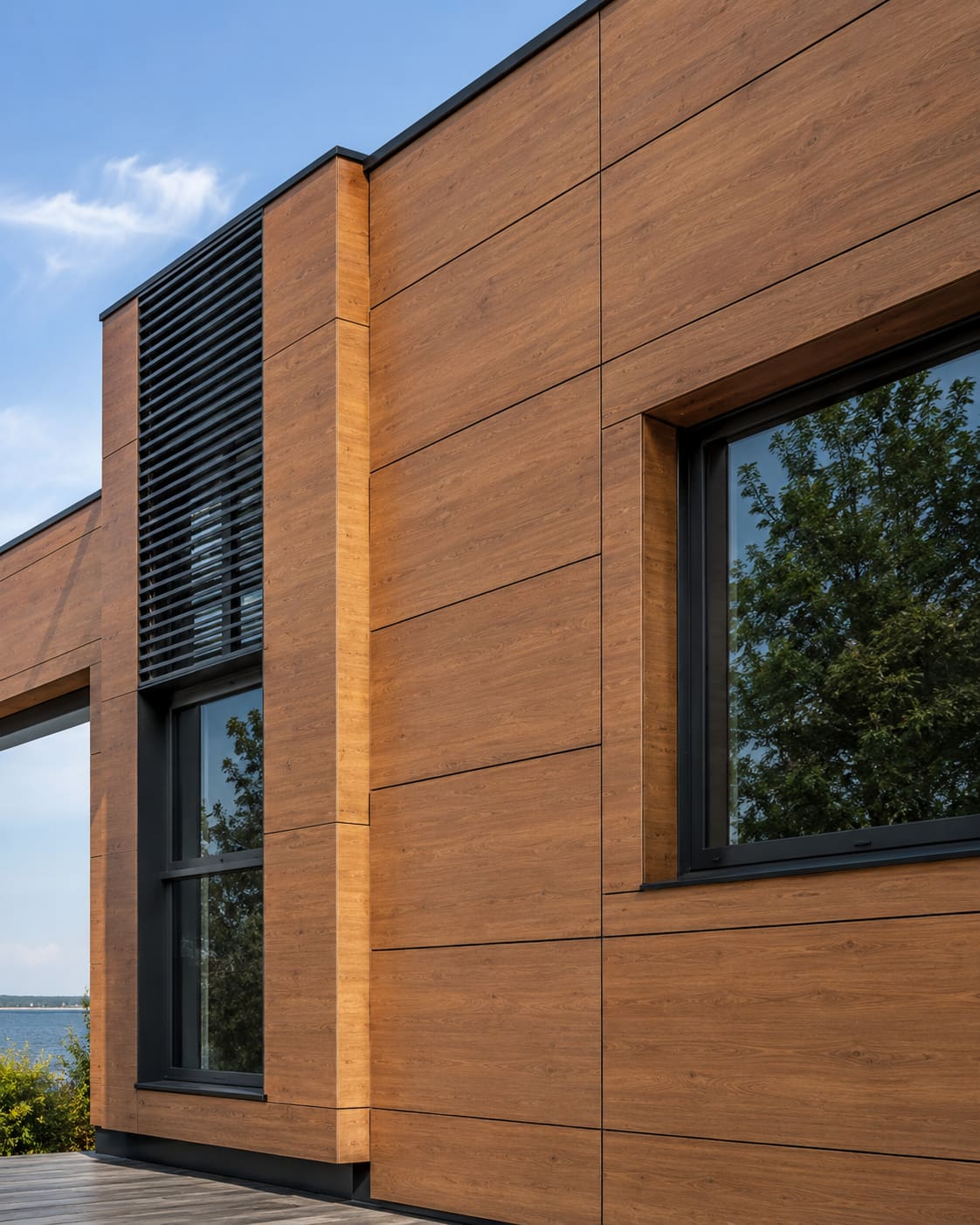
HPL, terracotta and fibre cement are durable rainscreen cladding materials that deliver long life and low maintenance with lower embodied energy than many metal panels. Mounted on ventilated rainscreen systems, they create an air gap that reduces heat gain and improves facade thermal performance, which is especially valuable on Hyderabad's west and south elevations.
- HPL (High Pressure Laminate): thickness typically 6 to 12 mm, service life 25 to 40 years, with limited fire-spread grades available; see our HPL cladding systems.
- Terracotta: fired natural clay, highly durable (50+ years), fully inert and recyclable, with good thermal mass.
- Fibre cement: cement reinforced with cellulose fibres, non-combustible (Class A), 30 to 50 year life.
- Ventilated rainscreen air gap lowers surface heat transfer and manages moisture during the monsoon.
These systems suit Hyderabad facades where sun exposure and monsoon-driven rain demand both UV and moisture resistance. Where a premium exterior-grade panel is wanted, Fundermax cladding offers HPL with a long colour-fastness warranty, and mixing a warm wood-finish HPL band with glass produces a distinctive, low-maintenance elevation for offices and showrooms.
What do sustainable facade materials cost in Hyderabad?
Sustainable facades cost more upfront than plain paint or basic ACP but recover the difference through lower cooling bills and far longer life. As broad supply-and-fit ranges in the Hyderabad market (2026), budget the following per square foot of finished facade, subject to design, height and quantity:
- Standard ACP cladding: roughly Rs 350 to 550/sq ft; fire-rated grades Rs 500 to 700/sq ft.
- HPL / Fundermax rainscreen: roughly Rs 600 to 1,200/sq ft depending on panel and framing.
- Fibre cement and terracotta rainscreen: roughly Rs 700 to 1,600/sq ft.
- Structural glazing with solar-control DGU: roughly Rs 1,200 to 2,500/sq ft; unitised systems more.
- Aluminium windows with DGU: roughly Rs 650 to 1,400/sq ft of window area.
The cheapest quote is rarely the most sustainable one. A thin single-skin ACP that dents and fades in Kokapet's sun will be re-clad within a decade, while a ventilated HPL or terracotta rainscreen specified once can outlast two paint cycles. For an accurate figure you can build a budget around, share your elevation drawings and we will get a free quote with a material-by-material breakdown, or browse completed work in our projects gallery to compare finishes.
Standards, wind load and fire compliance
Sustainable facades in India must comply with the National Building Code (NBC) 2016, which references structural, wind and fire standards alongside the ECBC for energy performance. Compliance is what makes a sustainable facade legally installable and insurable, and it is non-negotiable on any high-rise in the Financial District or Hitec City.
- Wind load: IS 875 Part 3 governs design wind pressures for facade fixings and panels.
- Safety glass: IS 2553 covers toughened and laminated glass for facades and glazing.
- Structural glazing: ASTM C1401 provides the guide for structural silicone sealant design.
- Fire: NBC 2016 Part 4 governs facade fire safety, and cladding fire-spread performance must be documented; specify fireproof ACP cladding or non-combustible panels on tall or occupied buildings.
- Energy: ECBC and BEE frameworks set U-value and SHGC thresholds and support green ratings.
Getting these right at design stage avoids expensive rework, and an independent facade consultancy review of wind pressures, sealant selection and fire class is money well spent on any project above a few floors.
Choosing materials for Hyderabad's climate
For Hyderabad and Secunderabad's hot semi-arid climate, the most effective sustainable facade combines solar-control low-e glazing with recycled aluminium framing and a ventilated cladding rainscreen to minimise cooling load. Prioritising low SHGC on sun-facing elevations delivers the largest energy saving, because peak afternoon sun on a west wall in Madhapur or Kondapur is what drives an air-conditioning plant to its limit.
- West and south facades: low SHGC glass plus shading or opaque cladding to block afternoon heat.
- Framing: recycled aluminium with PVDF finish for UV, dust and corrosion resistance.
- Cladding: HPL, fibre cement or terracotta on a ventilated system for durability.
- Shading: horizontal aluminium louvers or fins cut direct gain without blocking daylight or views.
- Lifecycle: favour materials with 30+ year life and high recyclability to lower whole-life carbon.
Orientation-led design costs nothing extra but saves energy every year the building stands. Hakimi Aluminium and Glass supplies and installs these sustainable facade systems across Gachibowli, Kokapet, Madhapur, Hitec City, Kondapur and the wider Hyderabad and Secunderabad region.
Maintenance, recyclability and whole-life value
The sustainability of a facade is decided as much by how it is maintained and eventually recovered as by what it is made of, so plan for the full life cycle from day one. A well-detailed facade needs little more than periodic cleaning and sealant inspection, and its major components can be recovered at end of life instead of demolished to landfill.
- Cleaning: rinse glass and panels twice a year to clear Hyderabad's construction and traffic dust, which otherwise dulls reflective and low-e coatings.
- Sealant checks: inspect structural and weather silicone every 3 to 5 years; resealing is far cheaper than panel replacement.
- Coating life: PVDF finishes typically hold colour for 20+ years, versus a few years for cheap polyester powder coats.
- End of life: aluminium and glass are recovered for near-full scrap value, and rainscreen panels unclip for reuse or recycling.
Choosing recyclable, repairable systems means the same facade can be refurbished rather than ripped out, which is the single biggest carbon saving over a building's life. For interiors and lobbies that share the same durable, low-waste logic, glass partitions and glass railings extend the sustainable palette indoors while keeping daylight flowing deep into the plan.