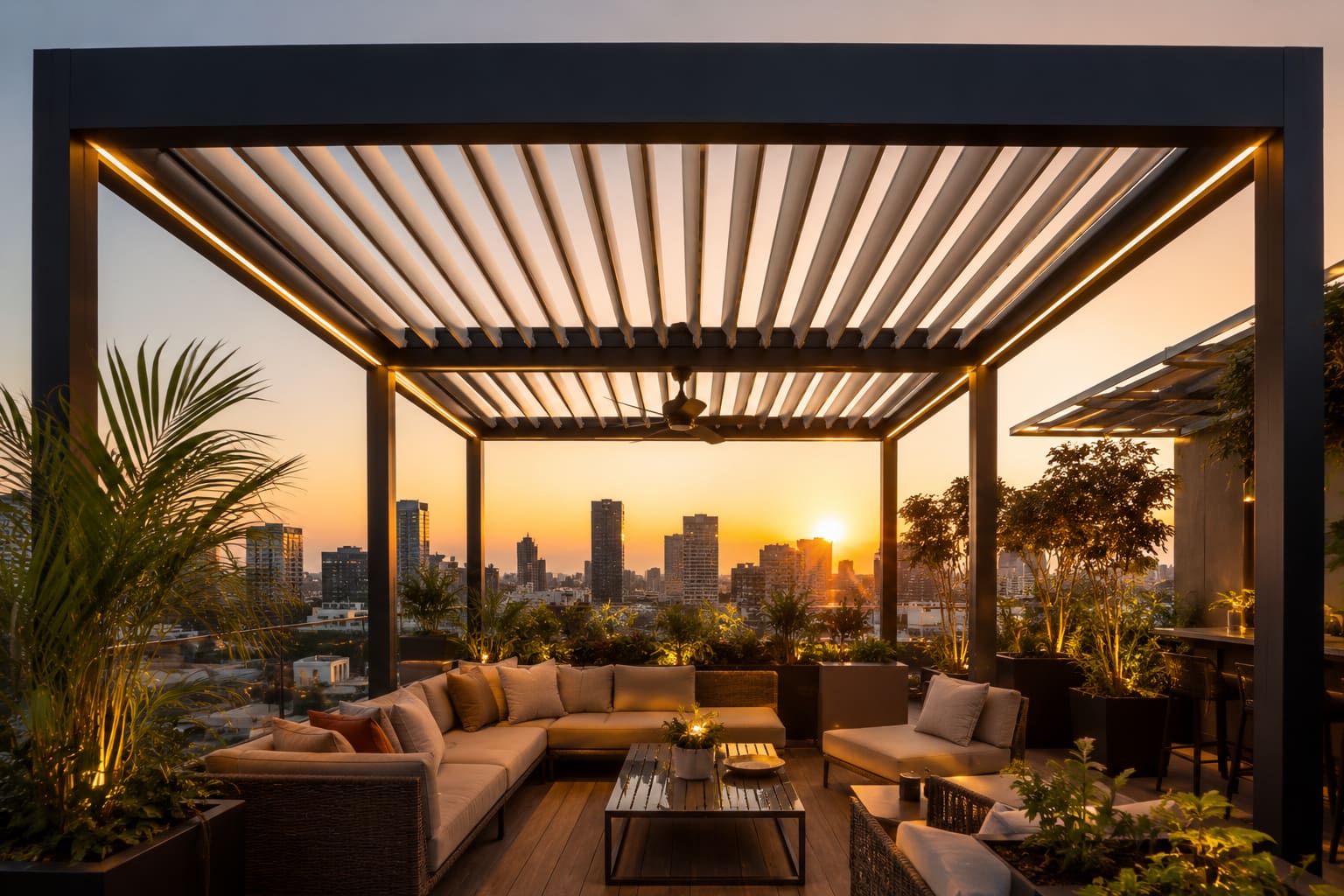
The best pergola design for a Hyderabad terrace is a powder-coated aluminium frame with a motorised louvered roof, because it handles 42 degree summer afternoons, the heavy south-west monsoon and year-round dust with almost no maintenance. If a louvered roof is outside budget, a sloped toughened-glass or polycarbonate roof on an aluminium frame is the next most practical choice. Everything else, timber, steel, fixed rafters, is a trade-off you make around those two decisions.
A bare terrace slab in Hyderabad is one of the most wasted spaces in a home. It bakes for eight months, floods for three, and collects grime the rest of the time. The right aluminium pergola turns that slab into a genuine outdoor room you use every evening, not just a shaded corner you walk past. These pergola design ideas focus on what actually survives the Telangana and Andhra Pradesh climate, not just what photographs well in a catalogue.
Below we break down the frame materials, the roof systems, the finishing details, and realistic INR pricing so you can match a design to how you will really use the space, whether that is dinners in Kokapet, a terrace garden in Kondapur or a rooftop lounge in Gachibowli.
How do you choose the pergola frame: aluminium, steel or wood?
The frame decides how the pergola ages, so it is the first decision, before you even think about the roof. In Hyderabad's dry pre-monsoon heat followed by weeks of humidity, the frame material is what separates a structure that looks new in five years from one that is rusting and warping.
- Powder-coated aluminium: rust-proof, dimensionally stable and near maintenance-free, indicative Rs 550 to Rs 950 per sq ft for the frame alone. It is the right call for any fully exposed terrace and pairs with every roof system below.
- Mild steel with anti-rust treatment: the strongest and cheapest structurally at Rs 350 to Rs 600 per sq ft, useful for very large spans, but it needs repainting every two to three years in monsoon-facing positions or it will bleed rust onto the flooring.
- Timber or WPC: a warm, natural look at Rs 700 to Rs 1,200 per sq ft, best kept to covered or semi-shaded terraces where direct rain exposure is limited, because untreated wood swells and cracks through Telangana's wet-dry cycle.
For the overwhelming majority of residential terraces around Hyderabad we recommend aluminium as the frame and then layering the roof style on top of it. Our custom aluminium fabrication work lets us match the frame profile and colour to your railing and window lines so the pergola reads as part of the building, not a bolted-on afterthought.
Why are motorised louvered roof pergolas the top choice?
The standout pergola design idea for our climate is the aluminium louvered, or opening, roof. Adjustable blades let you open the roof fully for breeze and evening stargazing, tilt them to cut the harsh west-facing afternoon sun, and close them flat when a squall rolls in. Better systems from us include integrated rain sensors that shut the blades automatically and concealed side channels that drain water away without a visible gutter.
This is the most practical option here because a single structure solves both problems Hyderabad throws at a terrace: the summer heat load and the monsoon deluge. You are not choosing between shade and shelter, you get both on demand. Expect indicative pricing of Rs 1,600 to Rs 2,800 per sq ft for a motorised aluminium louvered roof pergola, depending on blade width, motor brand, span and whether you add LED strips, side blinds or rain sensors.
It suits families in areas like Madhapur, Financial District and Kokapet who want to use the terrace right through the year, host dinners regardless of the forecast, and create a real open-air living room rather than a corner that only works on mild evenings. If you want to see how the drainage and motor detailing come together on a finished job, our completed projects gallery shows several rooftop installations across the city.
Glass-topped and hybrid pergola designs
A glass-roofed pergola keeps the terrace bright and fully weatherproof at the same time, which is ideal for a terrace garden, a reading nook or a cafe-style seating zone where you want daylight but not the monsoon on your head. Toughened laminated glass or double-glazed units cut a large part of the heat and UV, and a deliberate slope sheds monsoon water fast so it never pools.
- Toughened glass roof pergola: Rs 1,400 to Rs 2,400 per sq ft, bright and completely rain-proof, though it needs periodic cleaning to stay clear of Hyderabad's fine dust.
- Polycarbonate roof pergola: a lighter, cheaper alternative at Rs 700 to Rs 1,300 per sq ft, good for utility terraces, wash areas or covering a stairwell head.
- Hybrid design: an aluminium pergola carrying a fixed glass roof pergola canopy over the seating zone, with open rafters over the planters, blending sheltered comfort and open sky in one structure.
The main thing to plan for with any glass top is the greenhouse effect during peak Telangana summers. We counter it with heat-cutting specialty glass such as reflective or low-E double-glazed units, plus retractable side screens and planting. Choose your glass build-up with the same care you would for a glass canopy at an entrance, because the roof is doing exactly that job over your living space.
Which pergola design suits your terrace use?
The biggest mistake we see is picking a style from a photo before deciding how the space will be used. Match the design to the actual routine and the pergola earns its cost.
- Year-round outdoor living and entertaining: a motorised louvered roof, because only it adapts to any weather at the touch of a button.
- Bright terrace garden or plant room: a sloped glass roof with open sides, so light reaches the plants while rain is kept off the seating.
- Shaded green corner on a budget: an open aluminium rafter pergola with a climbing plant or shade fabric, the lowest-cost route to usable shade.
- Rooftop lounge or bar: an aluminium frame with a fixed glass canopy over the counter and louvres over the seating, plus integrated lighting for evenings.
- Small balcony extension rather than a full terrace: a lean-to pergola tied into the parapet, often best combined with balcony glazing to make the whole zone weather-tight.
If you are unsure, a quick site visit settles it. Send us your terrace dimensions and orientation and we will suggest the roof system, then you can get a free quote with firm numbers rather than these indicative ranges.
Design touches that make a terrace pergola actually work
The frame and roof are the big structural decisions, but the finishing details are what decide whether the space gets used every evening or forgotten after the first monsoon.
- Integrated LED lighting recessed into the beams for soft evening light without harsh overhead glare; this is the same discreet facade lighting integration approach we use on building elevations.
- ZIP or roller blinds on the open sides to block low-angle western sun and driven rain, effectively giving you a fourth wall when you want it.
- Wood-finish powder coating on the aluminium for the warmth of timber with none of the swelling, cracking or repainting.
- Built-in planters or a green wall to soften the structure, cool the air by a few degrees and screen neighbouring buildings.
- Slip-resistant deck boards or vitrified outdoor tiles rated for heat and moisture, so the floor is safe when wet.
- A matching glass or metal balustrade along the terrace edge; a frameless glass railing keeps the view open while meeting the safety height that rooftop use demands.
A well-planned terrace pergola in Hyderabad typically lands between Rs 1.5 lakh and Rs 6 lakh for a standard 150 to 250 sq ft area, with the roof system being the single biggest cost driver.
Designing a pergola for the Hyderabad climate
Generic pergola advice from cooler regions fails here, because our terrace has three enemies at once: extreme summer radiant heat, a violent short monsoon, and persistent dust. A design that ignores any one of them disappoints.
For heat, orientation matters as much as material. A west-facing terrace in Gachibowli or Hitec City takes brutal afternoon sun, so we angle louvres or add side blinds on the west edge and favour heat-cutting glass over clear. For the monsoon, every fixed roof needs a genuine slope of at least a few degrees and a real drainage path, not just a flat panel that ponds and leaks at the joints.
For dust, the finish is everything. Powder-coated aluminium wipes clean, and smooth glass or polycarbonate sheds grime with the next rain, whereas rough timber and textured fabric trap it. Fixings should be stainless or hot-dip galvanised so the humid months do not leave rust streaks. These are the same durability principles behind our outdoor canopies and skylights work, where a roof over people's heads simply cannot fail in a storm.
One more local point: many Hyderabad terraces sit above occupied rooms, so the pergola also reduces the heat soaking into the slab and the floor below. A louvered or insulated roof can measurably cool the top-floor bedroom underneath, which is a benefit a plain shade net never delivers.
How much does a terrace pergola cost in Hyderabad?
Pricing depends almost entirely on the roof system you choose over the aluminium frame, so it helps to see the ranges side by side before you decide.
- Open aluminium rafter pergola (shade fabric or planting on top): roughly Rs 550 to Rs 950 per sq ft, the entry point.
- Polycarbonate roof pergola: Rs 700 to Rs 1,300 per sq ft, a practical budget cover.
- Toughened or laminated glass roof pergola: Rs 1,400 to Rs 2,400 per sq ft for a bright, sealed room.
- Motorised aluminium louvered roof: Rs 1,600 to Rs 2,800 per sq ft, the premium all-weather option.
For a typical 200 sq ft terrace, that translates to around Rs 1.5 lakh for a simple open frame and Rs 5 to 6 lakh for a fully specified motorised louvered roof with lighting and blinds. Add-ons such as ZIP blinds (Rs 350 to Rs 700 per sq ft of opening), LED integration and premium motors move the number within these bands. Because spans, parapet conditions and access all affect labour, treat these as planning figures and confirm with a measured quote.
Installation, timelines and maintenance
A residential terrace pergola is usually fabricated to your measured dimensions and installed in two to four working days once materials arrive, with motorised louvered systems taking a little longer for the electrical and sensor wiring. The bulk of the lead time is fabrication and the powder-coating cure, so plan for roughly two to three weeks from confirmed order.
Structural anchoring is the part homeowners underestimate. On an exposed terrace the pergola must resist uplift in pre-monsoon gusts, so base plates are chemically anchored into the slab or tied into the parapet, and waterproofing is made good around every fixing to protect the room below.
Maintenance is minimal with the right materials. Aluminium frames and glass or polycarbonate roofs need only an occasional wash to clear dust. Motorised louvre systems benefit from an annual check of the motor, seals and drainage channels. Steel frames are the exception and need repainting on a two to three year cycle. When you want the terrace to feel like a finished room, coordinate the pergola with matching aluminium doors and windows on any terrace access so the whole space reads as one designed unit.