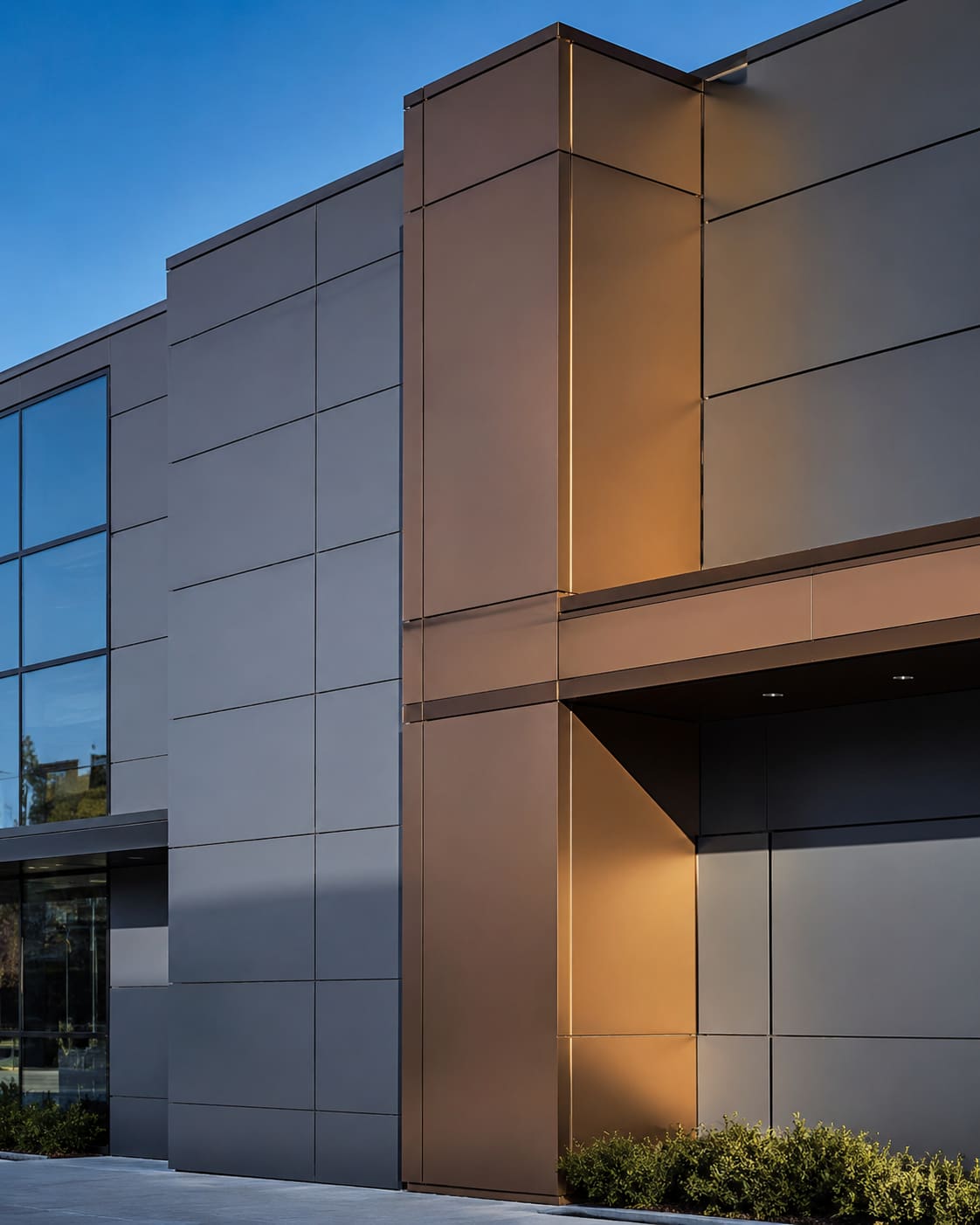
The best ACP cladding contractors in Hyderabad are firms that use branded fire-rated (FR) aluminium composite panels, quote a transparent per-square-foot rate that already includes an engineered aluminium sub-frame, and back the work with a written 8-15 year warranty against de-lamination and colour fade. In the twin cities you should shortlist at least three contractors who can walk you through completed elevations in localities like Gachibowli, HITEC City, Madhapur or Banjara Hills, and who fix panels onto a properly engineered sub-frame rather than gluing them straight onto plaster. If you are weighing our full-service ACP cladding offering against smaller crews, this guide gives you the exact criteria to compare them like for like.
Contractor choice in Hyderabad is more than cosmetic because the local climate is punishing on a facade. Summer surface temperatures on west-facing elevations cross 60 degrees C, the June-to-September monsoon drives water into every panel joint, and year-round construction and traffic dust settles into badly sealed grooves and streaks the finish. A capable contractor answers all three with PVDF-coated FR panels, structural-silicone or stainless-fastened joints, and correctly detailed expansion gaps. That single set of decisions is the difference between an elevation that still looks sharp in 2036 and one that chalks, streaks and bulges within two monsoons.
This guide covers what genuinely separates specialists from cut-rate installers, realistic 2026 ACP cladding prices across Hyderabad, Secunderabad and the wider Telangana and Andhra Pradesh belt, a locality-by-locality view, the framework and sealing details that decide longevity, and a vetting checklist you can use before releasing a single rupee of advance. When you are ready, you can get a free quote and compare it line by line against the benchmarks below.
What separates the best ACP cladding contractors in Hyderabad
The best ACP cladding contractors in Hyderabad combine branded materials, an engineered framework and documented warranties, not just a low headline quote. A cheap price almost always conceals a compromise on coating grade, frame gauge or waterproofing that surfaces two summers later, by which point the crew is long gone. Use these markers to separate genuine specialists from one-off installers:
- Branded, fire-rated panels: insist on FR-grade Alstrong, Aludecor, Eurobond or Alucobond with a PVDF (not PE) coating for any facade exposed to direct Hyderabad sun.
- Engineered sub-frame: 40x40mm or 50x25mm aluminium sections on MS/GI bracket anchoring, not panels adhered onto brick or plaster.
- Weather detailing: structural silicone or grooved stainless-screw joints designed to shed monsoon water and resist dust ingress.
- Proof of work: live sites or photographs of elevations in Kondapur, Kokapet, the Financial District or Kukatpally, with client references you can actually call.
- Documentation: a GST invoice, a written scope of work, and an 8-15 year warranty covering de-lamination, coating fade and joint leakage.
A specialist that also handles structural glazing and detailed 3D elevation work can integrate ACP with glass, louvers and signage inside a single design, which almost always produces a cleaner, better-sealed facade than stitching two separate crews together after the fact. Before you shortlist, it is worth browsing our recent projects to see the standard of joint alignment and finish a serious contractor should be held to.
ACP cladding price in Hyderabad: 2026 rates
ACP cladding in Hyderabad typically costs between INR 180 and INR 420 per square foot fully installed, depending on panel brand, coating grade and framework complexity. These are realistic twin-city ranges for 2026:
- Economy PE-coated panels: INR 180-230 per sq ft, suitable only for interiors or low-exposure signage, not full exterior facades.
- Standard FR PVDF panels: INR 250-320 per sq ft installed, the common choice for shops and offices in Madhapur, Ameerpet and Secunderabad.
- Premium brands and finishes: INR 330-420 per sq ft for wood, mirror, sparkle or metallic finishes on showrooms in Banjara Hills and Jubilee Hills.
- Framework and scaffolding on tall or irregular elevations can add 10-20 percent, so always confirm whether the rate is inclusive or extra.
For a mid-sized shopfront of around 600 sq ft, that puts a properly specified FR PVDF job at roughly INR 1.5-1.9 lakh, while a 2,000 sq ft villa elevation combining ACP with louvers can run INR 6-9 lakh. Prices in tier-two Andhra Pradesh and Telangana towns such as Vijayawada, Warangal, Guntur and Visakhapatnam usually sit 8-12 percent below Hyderabad city rates because labour and scaffolding cost less, though branded panel prices stay broadly the same statewide.
The single most useful habit when comparing bids is to force every quote into the same format: per sq ft, panel brand and grade named, framework and waterproofing explicitly included, and scaffolding stated separately if it is extra. That way you are comparing like with like rather than being swayed by a headline number that quietly excludes the frame. When you get a free quote from us, it is itemised on exactly these lines so nothing is hidden until the invoice.
Fire-rated FR panels vs economy PE: what to specify
For any Hyderabad exterior facade you should specify a fire-rated (FR) core with a PVDF coating, because economy PE panels both fade faster and carry a higher fire risk. The two-letter difference on the datasheet is the single most important line on the whole project, and cut-rate installers count on clients not knowing to ask about it.
- Core: FR (fire-retardant, mineral-filled) cores resist flame spread far better than the standard PE (polyethylene) core, which matters directly for high-rise and commercial elevations under building-safety norms.
- Coating: PVDF (Kynar-based) coating resists the intense UV of the Deccan plateau and holds colour for 10-15 years, whereas cheaper PE/polyester coatings chalk and streak within 3-4 monsoons.
- Thickness: a 4mm total panel with a 0.25-0.30mm aluminium skin is the honest facade standard; some low quotes drop to a 0.18-0.21mm skin that dents easily and oil-cans (ripples) in the heat.
- Branding: named panels such as Alstrong, Aludecor, Eurobond and Alucobond carry batch labels and manufacturer warranties, while unbranded 'local' sheets carry neither.
Ask the contractor to leave one labelled offcut on site so you can verify the brand and grade against the delivery challan, then store it as your warranty reference. If a quote is unusually cheap, the saving is almost always coming out of the core grade, the coating or the panel thickness, in that order.
How to vet and shortlist an ACP contractor
Vet Hyderabad ACP contractors by verifying materials, inspecting real elevations and locking the scope in writing before any advance changes hands. Follow these steps in order:
- Ask for the exact panel brand, core grade (FR) and coating (PVDF), then verify the batch labels on delivery, not just in the quotation.
- Visit one completed and one in-progress site in your area to inspect joint neatness, panel alignment and the sub-frame sitting behind the panels.
- Confirm the crew fabricates the aluminium frame in a workshop or on site and does not skip MS/GI brackets on tall facades to shave cost.
- Get a written quote listing area in sq ft, panel type, framework, waterproofing, timeline and staged payments.
- Keep a retention of 5-10 percent payable only after a post-monsoon joint check, and take the warranty on the contractor's own letterhead.
Reputable firms are comfortable with every one of these requests. If a contractor resists naming the brand, refuses a site visit, or pushes for a large upfront advance with no written scope, treat it as a red flag and move to the next name on your shortlist. A useful cross-check is whether the firm has an established materials supply chain and a portfolio you can review, rather than sourcing panels ad hoc from the nearest wholesaler; you can gauge this quickly by scanning our services and the range of facade work a genuine specialist actually delivers.
Framework, fixings and sealing that make a facade last
A durable ACP facade lives or dies by what sits behind the panels: the aluminium sub-frame, the fasteners and the sealing. Even the best Alucobond panel will fail on a weak or badly anchored frame. The strongest contractors in Hyderabad get these details right without being asked:
- Sub-frame: continuous 40x40mm or 50x25mm aluminium verticals and horizontals, plumbed and levelled, with a ventilation gap behind the panels to release trapped heat.
- Anchoring: galvanised or MS brackets bolted into the structure at engineered spacings, never just adhesive on plaster.
- Fasteners: stainless-steel screws and rivets that survive monsoon humidity without rust-staining the panel face.
- Sealing: structural-grade silicone or weather sealant rated for UV, applied in dry conditions with correct backer rods seated in the grooves.
- Expansion: deliberate expansion gaps so panels can move with 60-degree summer swings without buckling or oil-canning.
Facades that combine ACP with glass elements demand the same hardware discipline used in structural glazing and partitions, which is why contractors who also design and detail glazing tend to produce cleaner mixed elevations. If your project blends panels with glass and feature lighting, a firm that offers integrated 3D elevation work alongside ACP cladding can coordinate the frame, the glass and the panel joints as one system instead of three uncoordinated trades.
Installation process and realistic timeline
A well-run ACP cladding project moves through a predictable sequence, and knowing it helps you spot a contractor who is cutting corners. On a standard twin-city facade the stages are:
- Site survey and measurement: the crew measures the elevation, notes wind exposure and access, and confirms panel colour and finish against a physical sample.
- Framework fabrication and fixing: the aluminium sub-frame is fabricated to size, then plumbed, levelled and anchored to the structure with brackets.
- Panel cutting and grooving: panels are cut and V-grooved to the design so corners fold cleanly and joint lines stay straight.
- Fixing and sealing: panels are riveted or screwed to the frame, joints are backed and sealed with UV-rated silicone, and edges are trimmed.
- Cleaning and handover: the protective film is peeled, the facade is cleaned, and the warranty, invoice and offcut are handed over.
A typical shop or office facade in Hyderabad takes 5-12 working days, while large towers in Gachibowli or the Financial District can run 4-8 weeks depending on area, framework complexity and scaffolding access. Monsoon rain can pause exterior sealing work, so build a little weather buffer into the schedule and insist the timeline is written stage-wise into the quote, not left vague.
Common mistakes to avoid on an ACP project
Most ACP facades that fail early in Hyderabad fail for the same handful of avoidable reasons, and almost all of them trace back to a decision made before the panels ever arrived. Watch for these:
- Choosing on price alone: the cheapest quote usually hides a PE core, a thin skin or a skipped frame, and the saving is wiped out by re-cladding in five years.
- Gluing panels to plaster: without a ventilated aluminium sub-frame the panels trap heat, de-bond and bulge; this is the most common shortcut on residential jobs.
- Ignoring the coating grade: accepting PE/polyester coating on a west-facing wall guarantees chalking and colour fade within a few monsoons.
- No expansion gaps: tight joints with no room to move cause visible oil-canning and stressed rivets once summer heat sets in.
- Paying too much upfront: a large advance with no written scope removes your leverage; stage payments against milestones keep the crew accountable.
- Skipping the post-monsoon check: releasing the full amount before the first monsoon means you carry the risk of any hidden joint leak yourself.
Every one of these is easy to avoid with a written scope, a named brand and a retention clause. The best contractors will have already steered you away from them, because their reputation depends on facades that still look right a decade later.
Localities, project types and long-term value
ACP cladding demand across Hyderabad and Secunderabad splits between corporate facades, retail elevations and independent homes, and the right contractor varies by project scale. Match the contractor to the job:
- Corporate and IT-corridor towers in Gachibowli, HITEC City and the Financial District need firms experienced in structural glazing plus ACP, with rope-access or scaffolding capability and safety compliance.
- Retail and showroom elevations in Kukatpally, Dilsukhnagar, Abids and Secunderabad reward contractors who deliver fast, clean grooved-joint work with minimal disruption to trading hours.
- Independent houses and villas in Kokapet, Kondapur, Jubilee Hills and Banjara Hills often combine ACP with 3D elevation work and louvers, so pick a firm that offers full elevation design, not just panel fixing.
- Institutional and industrial buildings around Uppal, Medchal and the Outer Ring Road usually need larger-format panels and heavier framework to carry wind loads.
- For any west or south-facing facade anywhere in the twin cities, prioritise PVDF panels on a ventilated frame to handle the peak summer heat load.
Viewed over its life, an INR 300 per sq ft FR PVDF facade that lasts 15 years costs far less per year than an INR 200 per sq ft PE job that needs re-cladding in five. That whole-life view is how the best contractors justify their rate, and it is the lens you should use when you compare quotes across Telangana and Andhra Pradesh. Whether the site is in Hyderabad, Warangal, Vijayawada or Visakhapatnam, the non-negotiables never change: FR PVDF panels, an engineered frame, sealed joints and a written warranty.