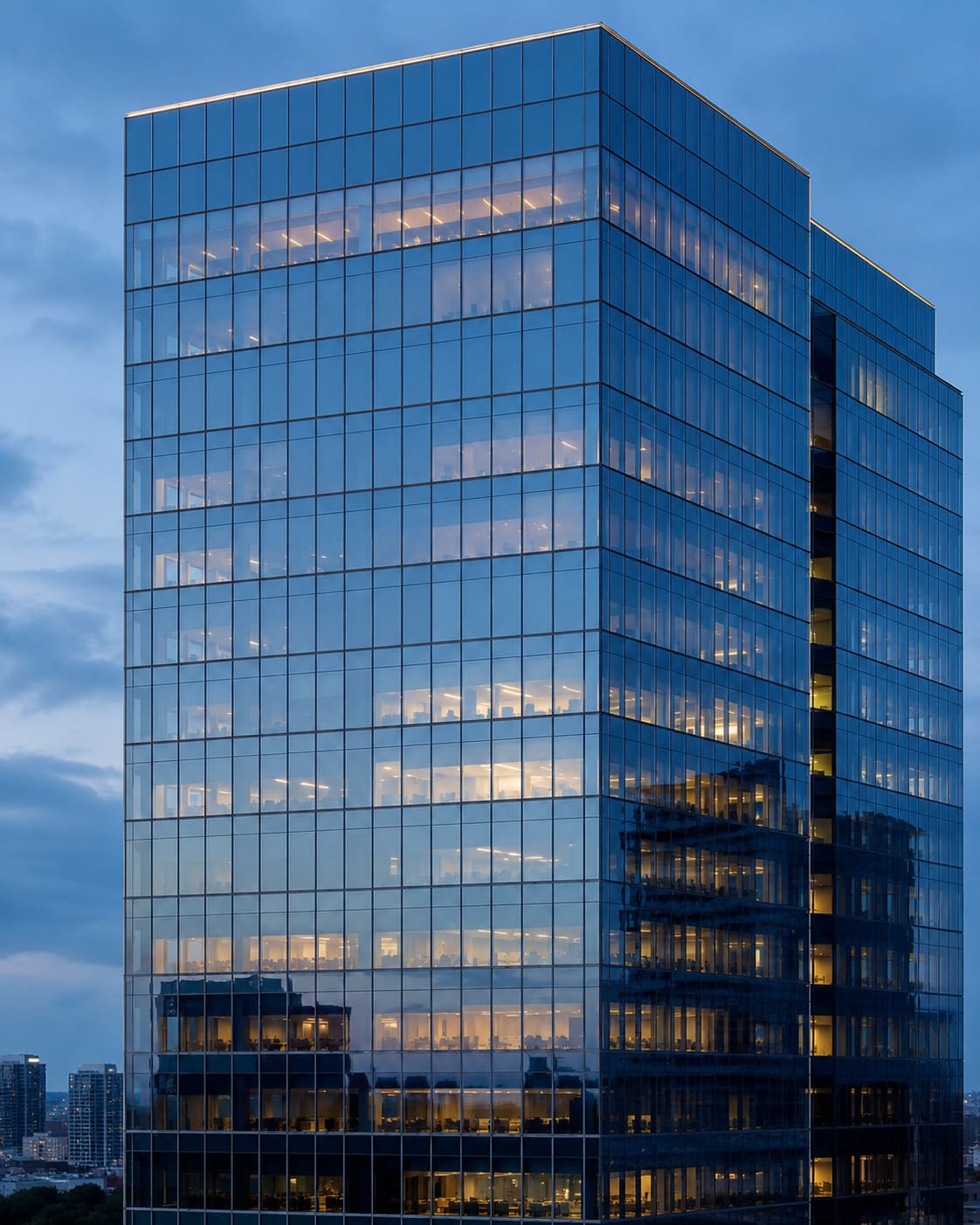
The best curtain wall contractors in Hyderabad are facade specialists who design, engineer, fabricate and install the envelope as one tested system rather than assembling loose aluminium and glass on site. Look for a firm that can hand you stamped structural shop drawings, ASTM or EN test reports for air, water and wind performance, a manufacturer's system warranty in writing, and visitable references across HITEC City, Gachibowli, Madhapur and the Financial District. That combination of proof, not the lowest per-square-foot rate, is what separates a genuine curtain wall contractor from a general fabricator.
Curtain walling is the most demanding glazing work any building faces in the twin cities, so choosing the wrong contractor is painfully expensive to undo. A leaking or de-glazed facade on a twelve-storey tower in Kokapet cannot be patched cheaply - it needs rope access, fresh structural silicone lines and sometimes full panel replacement, all while tenants are inside. That is precisely why serious buyers treat the facade as an engineered curtain wall glazing system with a defined design life, not a commodity bought on rate alone.
This guide explains what makes a curtain wall specialist different from a general aluminium fabricator, what fair 2026 pricing looks like across Telangana and neighbouring Andhra Pradesh, the certifications and documents to insist on, the system choices that suit Hyderabad's hot-dry-then-monsoon climate, and the exact questions to ask before you sign. If your drawings are ready, you can get a free quote and use the checklists below to compare bids like-for-like instead of on headline price.
What makes a good curtain wall contractor in Hyderabad
A good curtain wall contractor in Hyderabad owns the performance of the entire building envelope, not just the supply of aluminium and glass. The twin-city climate is unforgiving - 42C-plus summers, driving monsoon rain from June to September, and year-round Deccan dust - so weak detailing shows up fast as leaks, whistling joints and heat gain. The capabilities that genuinely matter are these:
- In-house or partnered structural and thermal design, with wind-load calculations to IS 875 Part 3 for Hyderabad's basic wind speed and the actual building height
- Genuine system sourcing from established aluminium brands, using thermally broken, unitised or semi-unitised profiles where the specification calls for it
- Documented ASTM or EN test reports for air infiltration, water penetration and structural performance - not just a glossy brochure
- A dedicated facade install crew with rope-access or motorised-cradle capability for towers in Gachibowli, Kokapet and the Financial District
- References you can physically visit across HITEC City, Madhapur, Kondapur and Banjara Hills
The dividing line is simple. A specialist stands behind the whole envelope and its warranty; a general fabricator supplies parts and disowns the leaks the moment the first monsoon arrives. Firms that also handle allied work such as structural glazing for lobbies and atriums usually have deeper detailing know-how, because they solve waterproofing and thermal-movement problems on every job rather than once a year. When you review our recent projects, look for repeat high-rise facade work in the same corridors as your site - that is the clearest signal of real capability.
Curtain wall cost per square foot in Hyderabad (2026 INR)
Curtain wall in Hyderabad typically costs between 750 and 2,200 INR per square foot of facade in 2026, depending on the system, the glass and the building height. Use these bands as a realistic guide for twin-city and nearby Andhra Pradesh projects when you receive quotes:
- Standard semi-unitised aluminium with double-glazed units (DGU): roughly 750 to 1,200 INR per sq ft
- Unitised curtain wall for mid- and high-rise towers: roughly 1,300 to 1,900 INR per sq ft
- High-performance systems (double-silicone, high-selectivity coatings, spandrel glass or complex geometry): 1,900 to 2,200 INR per sq ft and above
- Structural spider glazing for lobbies and atriums is usually quoted separately and often runs higher per sq ft because of the stainless spider fittings and toughened glass involved
Several factors move these numbers. Building height increases both the wind loading and the access cost; premium low-E coatings and thicker DGU stacks add to the glass price; and geometry - curves, sloped glazing, sharp corners and shadow boxes - raises fabrication time. Always insist on a rate that clearly states the glass type and thickness, the aluminium system and finish, the coating, and whether scaffolding or cradle access, sealant, hardware and warranty are included. A 900 INR bid that excludes access and structural silicone is rarely cheaper than an 1,150 INR all-in bid once the job is actually finished and tested. If you send drawings when you get a free quote, a specialist can give you a fixed all-inclusive rate instead of a misleading base number.
Unitised vs semi-unitised vs stick systems
The right curtain wall system depends on building height, site logistics and programme, and the choice materially changes both cost and quality risk. Here is how the three common approaches compare for Hyderabad projects:
- Stick (site-assembled) systems are the cheapest and most flexible for low-rise buildings up to about four floors, but quality depends heavily on on-site sealing and workmanship in dust and heat
- Semi-unitised systems pre-fabricate the mullions and transoms in the workshop and glaze on site, balancing cost and control well for mid-rise towers in Madhapur, Kondapur and Kukatpally
- Unitised systems arrive as fully finished, factory-glazed and factory-tested panels that simply hook onto the slab edge, giving the best water performance and the fastest install for high-rise towers in the Financial District, Kokapet and Nanakramguda
For anything above eight to ten storeys, most reputable facade contractors will steer you toward unitised, because factory glazing removes the biggest variable - on-site sealing exposed to Deccan dust and 40-degree heat. Unitised costs more per square foot up front but often saves on scaffolding, shortens the programme, and dramatically reduces the long-term leak-repair bill, which is where the real money is lost. On a tight urban plot with no room for scaffolding, unitised can also be the only practical way to build safely. You can compare these against your own brief across our full range of facade and glazing services.
Certifications, testing and documents to demand
Never accept a curtain wall bid without written proof that the system has been tested to a recognised standard - the paperwork is what protects you when a leak appears. A credible contractor in Hyderabad or Secunderabad can produce these on request:
- Air infiltration test report (ASTM E283 or EN 12152)
- Static and dynamic water-penetration reports (ASTM E331 and AAMA 501.1, or EN 12155)
- Structural performance under design wind load (ASTM E330 or EN 12179)
- Manufacturer's system warranty for the aluminium profiles and gaskets, in writing
- Sealant compatibility and adhesion reports from the silicone supplier
- Stamped structural shop drawings signed by a qualified engineer
In India, look for aluminium extrusions that meet IS 733 and IS 1285, and glass processed to IS 2553 for toughened and IS 14900 for the relevant grades. Ask specifically whether the DGU spacer, the structural silicone and the weather silicone each carry documented warranties, because a facade is only as strong as its weakest joint and mismatched sealants are a frequent cause of premature failure across Telangana's wide temperature swings. On larger towers, a specialist will also recommend a project-specific mock-up test - a full-scale sample panel water-tested before mass production - which is the single best insurance against a systemic detailing flaw. Firms experienced in curtain wall glazing treat these documents as routine, not as an inconvenience.
How to vet and shortlist contractors
Vet curtain wall contractors in Hyderabad by verifying past projects, test documentation and financial stability before you even discuss price. Follow these steps to build a reliable shortlist of three or four firms you can trust to hold up through two monsoons:
- Ask for three to five completed curtain wall projects in Hyderabad or Secunderabad, and visit at least one in person to inspect the joints and corners
- Request stamped shop drawings and a sample test report from a previous job
- Confirm the aluminium system brand and demand the manufacturer's system warranty in writing
- Check that they carry genuine facade and structural glazing experience, not just windows and partitions
- Ask who actually does the installation: an in-house, trained crew signals far better quality control than a job fully sub-let to daily-wage labour
- Confirm GST registration, a clear payment schedule tied to milestones, and a defect-liability period of at least 12 months
- Ask how they handle safety at height - trained rope-access or cradle crews with proper harnesses are a mark of a professional outfit
Beware the outlier quote. A bid that is 25 to 30 percent below the rest of the pack almost always means thinner aluminium, cheaper glass, an unwarranted sealant, or a plan to sub-let the entire job to the lowest crew - all of which surface as leaks within two rainy seasons. The cheapest facade on paper is very often the most expensive building to own.
Local factors that shape your Hyderabad facade
Local conditions in Hyderabad and Secunderabad should directly shape your glass and system choice, not just the contractor you pick. The twin cities' heat and glare make solar control the single biggest performance decision on the whole envelope:
- Choose high-performance DGU or low-E glass with a solar heat gain coefficient below 0.30 to cut cooling loads on west- and south-facing towers in HITEC City, Gachibowli and Nanakramguda
- Specify structural and weather sealants rated for UV and monsoon exposure, since sealant failure is the most common local defect
- Ensure proper drainage paths and pressure-equalised joints so heavy monsoon rain sheds outward without tracking inside the building
- Factor Deccan dust into the maintenance plan: smooth coatings, self-cleaning glass options and safe cleaning access all reduce long-term upkeep
- For premium residential in Banjara Hills and Jubilee Hills, discuss acoustic laminated glass to cut traffic noise from arterial roads
Solar control is not merely a comfort question. On a large office facade it is one of the biggest levers on the building's lifetime electricity bill, because every unit of solar heat that enters must be removed by the air-conditioning plant. Getting the glass specification right at design stage costs almost nothing extra and pays back for decades in lower running costs and better tenant comfort - a point the best local contractors will raise with you unprompted.
Common mistakes to avoid
Most curtain wall problems in the twin cities trace back to a handful of avoidable decisions made early in the project. Watch for these before you commit:
- Choosing on rate alone: the lowest bid usually hides thinner extrusions, a cheaper coating or an unwarranted sealant that fails within a couple of monsoons
- Skipping the mock-up and water test on larger towers, so a systemic detailing flaw is only discovered after every panel is installed
- Letting the main civil contractor sub-let the facade to whoever is cheapest, with no accountability for the finished envelope's performance
- Ignoring thermal movement and slab-edge tolerance, which causes gaskets to pinch, glass to bow and joints to open over time
- Under-specifying glass to save a little at the outset, then paying for the extra cooling load and glare for the life of the building
- Paying too much too early, leaving no retention to hold the contractor accountable through the first monsoon and the defect-liability period
Avoiding these is mostly about sequencing - pin down the glass and system specification, the test evidence and the payment structure before work starts, not after. A contractor who welcomes that rigour is exactly the kind you want; one who resists it is telling you something important.
Project timeline and payment milestones
A typical curtain wall project in Hyderabad or Secunderabad takes three to eight months from design sign-off to handover, and understanding the stages helps you plan cash flow and avoid disputes. A realistic programme looks like this:
- Design and stamped shop drawings: 4 to 6 weeks, including glass and system selection and any mock-up
- Material procurement and factory fabrication: several weeks, longer for imported coatings or fully unitised panels
- Site installation: phased floor by floor, with monsoon months often slowing external and sealing work
- Testing, snagging and handover: on-site water tests on completed sections before final sign-off
Tie payments to these milestones rather than to the calendar. A common and fair structure is an advance against materials, stage payments against delivered and installed panels, and a retention of 5 to 10 percent released only after the defect-liability period ends. This keeps the contractor motivated through snagging and protects you if a leak shows up in the first monsoon. When your drawings and target dates are ready, get a free quote and a good facade partner will map the programme to your site, sequence the floors around the weather, and give you a written schedule you can hold them to.