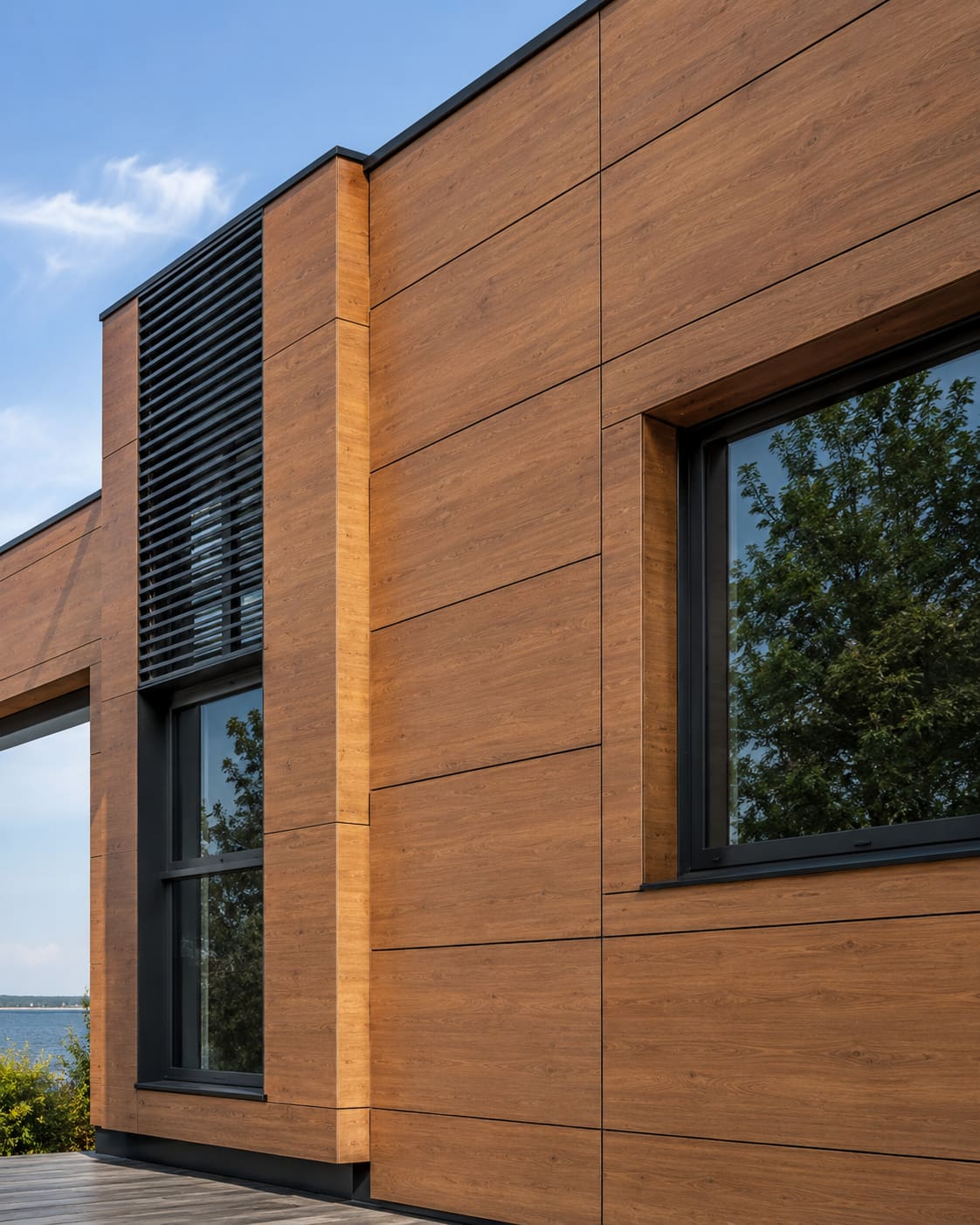
The best HPL cladding suppliers in Hyderabad are established facade specialists and authorised dealers, concentrated around HITEC City, Kukatpally, Balanagar and the Secunderabad hardware belt, who stock exterior-grade EGF (exterior grade fire-retardant) HPL sheets, provide manufacturer test certificates, and offer supply-plus-installation backed by a written warranty. For a genuine exterior job in the twin cities, choose a supplier who sells 6mm compact-grade HPL rated for UV and monsoon exposure over a cheap interior laminate, and who engineers it onto a proper aluminium sub-frame with a documented installation crew rather than gluing sheets to a wall.
This guide is written for homeowners, architects and builders across Gachibowli, Madhapur, Kondapur, Banjara Hills, Jubilee Hills, Kokapet and the Financial District who want a durable, low-maintenance facade that survives Hyderabad's 40-plus-degree summers, heavy June-to-September monsoon and year-round construction dust. HPL is a natural partner to broader elevation work, so many buyers scope HPL cladding alongside windows, railings and entrances in a single package. If you want us to price your elevation, you can get a free quote by sharing your drawings or a simple sketch of the wall area.
Below you will find how to shortlist reliable suppliers, realistic 2026 INR price ranges for Hyderabad and Secunderabad, the fire and durability standards that actually matter, how HPL compares with ACP, the mistakes that cost buyers the most, and clear answers to the questions local buyers ask before booking a facade project across Telangana and Andhra Pradesh.
What is HPL cladding and where does it fit?
HPL cladding is a high-pressure laminate facade panel made by fusing layers of kraft paper and a decorative surface with thermosetting resin under intense heat and pressure, producing a dense, solid sheet that is fixed to a building's outer wall on a metal sub-frame. Unlike a thin decorative laminate, an exterior compact HPL panel is homogeneous all the way through, which is why it can face weather directly without a separate backing board.
In Hyderabad it is used for residential elevations, boutique offices, showrooms, clinics, cafes and the entrance zones of commercial towers, usually where the client wants a realistic wood, stone or concrete look with almost no upkeep. It also reads as a premium material, which is why architects in Banjara Hills and Jubilee Hills specify it for feature walls at eye level even when the upper fields of a building use a cheaper panel.
It rarely stands alone. On most jobs HPL meets glazing, aluminium windows, railings and doors, so it makes sense to treat it as one part of a coordinated facade rather than a standalone product. You can see how it sits within a full elevation in our recent projects, where cladding, glass and aluminium are delivered by a single crew.
What to look for in a Hyderabad HPL cladding supplier
A reliable HPL cladding supplier in Hyderabad should offer exterior-grade sheets with certificates, an engineered metal sub-frame, and their own installation team rather than only selling loose sheets over the counter. Cladding is a system, not a product, so the supplier who takes responsibility for both the panel and the way it is fixed is the one worth shortlisting. Use this checklist when you compare quotes across the twin cities:
- Exterior grade only: insist on EGF/compact HPL, usually 6mm, rated for UV and weather, not 3mm interior laminate that fades and warps in Hyderabad's sun.
- Documentation: ask for the manufacturer's test certificate, fire rating (Class B / EN 13501) and a written product warranty of 8-10 years against delamination and colour fade.
- Sub-structure: a good supplier quotes an aluminium or GI framework and stainless fasteners separately, so you know the facade is engineered, not stuck on.
- In-house installation: prefer suppliers with their own trained crew and Hyderabad project references you can visit in Gachibowli, Kondapur or Kokapet.
- Integration: ask whether they also handle allied facade trades such as windows, glazing and entrances, so responsibility is not split across vendors. Our full range of aluminium, glass and facade services is scoped so cladding is coordinated with everything it touches.
- Stock and lead time: confirm colour availability and a realistic 1-3 week lead time, as premium imported shades are often not on the shelf.
The best suppliers in Secunderabad and Hyderabad will happily show you certificates and completed sites. If a dealer hesitates on paperwork or pushes an unusually cheap 'exterior' sheet, treat it as a warning sign and move on.
HPL cladding price ranges in Hyderabad (2026)
HPL cladding in Hyderabad typically costs between INR 240 and INR 650 per square foot supplied and installed in 2026, depending on sheet grade, thickness, brand and the sub-frame specified. Understanding how the number is built up helps you compare quotes fairly and spot where a low headline rate hides a weak specification. Here is how twin-city pricing usually breaks down:
- Interior-grade HPL sheet (material only): roughly INR 90-160 per sq ft, suitable for lobbies and feature walls, not exteriors.
- Exterior EGF 6mm compact HPL (material only): roughly INR 200-380 per sq ft for reputed Indian and imported brands.
- Aluminium sub-frame, fasteners and fabrication: roughly INR 90-180 per sq ft added on top.
- Fully installed exterior facade: budget INR 240-650 per sq ft all-in; premium wood-finish or metallic imported shades sit at the top of this band.
- High-rise access: sites in the Financial District or Kokapet add scaffolding, hoist or rope-access costs, so ask for a per-project quote rather than a flat rate.
As a worked example, a 1,000 sq ft residential elevation in Kondapur in standard exterior wood-finish EGF HPL might land around INR 3.2-4.5 lakh installed, while the same area in a premium imported metallic shade with high-rise access can cross INR 6 lakh. Always confirm whether GST, transport, edge-trims and cut-outs for windows are included before you sign, and get the figure on paper. For a fast estimate on your own wall area, get a free quote with your measurements.
Grades, thickness, brands and finish options
For Hyderabad exteriors the right specification is a 6mm compact EGF panel from a reputed brand, and getting these variables right matters more than chasing the lowest rate. The grade determines whether the facade survives a decade of monsoons or fails within two.
- Thickness: 6mm compact is the workhorse for facades; 8mm and 10mm are used for larger unsupported spans, louvres and heavy-duty commercial fronts; 3mm is interior only.
- Grade: EGF (exterior grade fire-retardant) for outdoor walls; standard compact grade for balconies and semi-covered areas; interior HPL strictly for indoor feature walls and lobbies.
- Brands: reputed Indian names such as Merino, Greenlam, Century and Virgo, alongside imported ranges like Fundermax and Trespa at the premium end, give the most reliable exterior performance.
- Finishes: realistic wood, natural stone, concrete, solid colours, and metallic or unicolour shades; textured woodgrain finishes are the most popular for twin-city residences.
- Panel sizes: common sheet sizes run around 8ft x 4ft and larger, which affects joint layout and wastage, so ask your supplier to optimise the cutting plan for your elevation.
A dense, homogeneous compact panel holds colour and edge definition far longer than a thin laminate, which is exactly why designers favour it for premium residences and boutique offices where the material has to look sharp for years.
HPL vs ACP cladding: choosing for twin-city projects
For durability and premium finishes exterior-grade HPL is usually the stronger choice, while ACP wins on cost and light weight for large areas. Most experienced Hyderabad buyers do not treat it as strictly either-or; they combine both to balance budget and aesthetics on the same building. Here is how the two compare for local conditions:
- Panel body: HPL is a solid, dense compact panel; ACP is a thin aluminium skin over a polymer core, so HPL resists dents and scratches better.
- Finishes: HPL offers deeper, more realistic wood and stone textures; ACP leans toward flat solids, metallics and mirror finishes.
- Weight and spans: ACP is lighter and easier on very large high-rise fields; HPL is heavier and ideal for feature walls, entrances and lower levels.
- Cost: standard ACP fields are generally cheaper per sq ft than exterior EGF HPL, which is why big commercial elevations often use ACP as the base.
- Fire safety: both must be specified in fire-retardant grade; never accept an ordinary-core ACP or interior HPL on an exterior wall.
A common twin-city strategy is HPL feature elevations at eye level plus ACP on the large upper fields. If you want to weigh both against your budget, our ACP cladding service is scoped alongside HPL so you can compare like-for-like on one quote.
Fire ratings, standards and safety compliance
Exterior HPL for Hyderabad facades should carry a recognised fire rating such as EN 13501 Class B and be supplied as EGF (exterior grade fire-retardant), with a certificate specific to the exact sheet delivered. Fire performance is where cutting corners is most dangerous and least visible, so it deserves hard documentation rather than a verbal assurance.
- Ask for the fire-rating certificate tied to the batch or product code you are buying, not a generic brochure.
- Confirm the reaction-to-fire class (commonly B-s1,d0 or B-s2,d0 under EN 13501) suits the building height and use.
- Ensure the sub-frame is non-combustible aluminium or GI with stainless fasteners, as the fixing system is part of the fire assembly.
- For taller buildings in the Financial District, verify the specification against your architect's or fire consultant's requirement, and against local fire NOC conditions, before ordering.
Standards-backed products cost a little more, but they protect occupants and keep the building insurable and compliant across Telangana and Andhra Pradesh. A supplier who leads with certificates is signalling that they build facades the right way.
Installation, sub-frame and process timeline
A durable HPL facade depends as much on the aluminium sub-frame, fixings and detailing as on the sheet itself, so treat the mounting system as part of the quality decision. The best-looking panel will still fail early if it is fixed to a rusting frame or under-specified fasteners in Hyderabad's humidity. A well-run job also follows a clear sequence:
- Survey and design: site measurement, joint and panel layout, and a material take-off, usually 2-4 days.
- Sub-frame: powder-coated aluminium or hot-dip GI carriers fixed to the wall with a ventilated air gap behind the panel for drainage and cooling.
- Fasteners: stainless steel rivets or screws, never mild steel, to survive monsoon moisture without bleeding rust onto the facade.
- Panel fixing: sheets cut, edges finished, and fixed with consistent shadow-gap or grooved joints and proper expansion allowance so panels do not buckle in summer heat.
- Sealing and handover: junctions with windows and copings sealed, protective film removed, and a final clean before handover.
For a typical 1,000-1,500 sq ft residential elevation, plan on roughly 2-4 weeks from order to handover once material is in stock; imported shades and high-rise access can extend this. Where cladding meets large openings, buyers often combine it with slim aluminium windows and glazing so the facade reads as one coordinated system rather than a patchwork of trades.
Common mistakes to avoid
The most expensive HPL mistakes in Hyderabad come from specification shortcuts that only reveal themselves after a monsoon or two, so it pays to know them before you sign. Avoiding these keeps your facade looking new for a decade rather than needing rework:
- Using 3mm interior laminate on an exterior wall to save money; it warps, delaminates and fades fast in twin-city sun and rain.
- Accepting a sheet-only quote with no engineered sub-frame, then discovering the framework and fasteners are extra and under-specified.
- Skipping the fire certificate for the exact batch and relying on a brochure claim instead.
- Allowing mild-steel fixings, which rust in the monsoon and streak the facade within a season.
- Ignoring expansion gaps and ventilation, causing buckling in summer and trapped moisture behind the panel.
- Choosing the cheapest bidder without visiting a 2-3 year old completed site to see how their work has actually aged.
Get three written quotes on an identical specification, insist on physical samples in daylight, and confirm the warranty covers both product and workmanship. Comparing like-for-like exposes the outlier and tells you who has genuinely engineered the job.
Maintenance and long-term value in the twin cities
Well-installed exterior HPL is low-maintenance and can look sharp for 10-15 years in Hyderabad with only routine cleaning, which is a large part of its long-term value. Because the surface is sealed and non-porous, upkeep is genuinely simple compared with painted render or timber, which struggles in Telangana's swing between dry heat and heavy rain.
- Clean twice a year with water and mild detergent to remove monsoon grime and construction dust; avoid abrasive pads.
- Inspect fasteners and joints annually, especially after the monsoon, and re-seal any opened gaps promptly.
- Keep a few spare panels from the original batch so future repairs match the shade exactly.
- Address any impact damage early; individual panel replacement is far cheaper than letting water track behind the facade.
Factor this low upkeep into the buying decision: a slightly higher upfront figure for genuine EGF HPL and a proper frame usually beats a cheap installation that needs rework within a few monsoons. When you are ready to price a durable, standards-backed facade for your home or building in Hyderabad, Secunderabad or across Telangana, get a free quote from our team.