To choose a shower enclosure, get four decisions right in this order: the glass (always toughened safety glass, 8mm for framed and 10mm to 12mm for frameless), the framing style (framed, semi-frameless or frameless), the layout that fits your bathroom size, and the SS 304 hardware that holds it together. Nail those four and you get a leak-free, easy-to-clean partition that lifts the whole bathroom for a decade. Get them wrong and you get white water spotting, drips onto the floor, and a door that sags within a year.
At Hakimi Aluminium and Glass we fabricate and install shower enclosures across Hyderabad, Secunderabad and the wider Telangana and Andhra Pradesh region, from compact apartment bathrooms in Gachibowli and Kondapur to villa wet rooms in Jubilee Hills and Kokapet. Because we are both a glass and facade specialist and a hardware dealer for brands like Taiton, Enox and Ozone, we can match the right toughened glass fabrication to the right fittings rather than forcing you into whatever a single supplier happens to stock.
This guide walks through each choice in plain language with realistic INR pricing for 2026, so you can budget confidently before you call anyone. Read it end to end, or jump to the section you need: glass, framing, layout, hardware, cost, hard-water design, mistakes to avoid, or installation.
Start with the glass: thickness, safety and coatings
The single most important spec when you choose a shower enclosure is toughened (tempered) safety glass. It is four to five times stronger than ordinary annealed glass and, if it ever breaks, crumbles into small blunt granules instead of long dangerous shards, in line with IS 2553 safety requirements. Never accept a shower enclosure in ordinary annealed glass, whatever the price saving, because it is a genuine injury risk in a wet, slippery space.
The correct thickness depends on how the glass is supported:
- 8mm toughened glass: ideal for framed and semi-frameless enclosures, where an aluminium profile shares the load. Lighter and more economical.
- 10mm toughened glass: the practical default for most frameless doors in apartment bathrooms, balancing rigidity and weight.
- 12mm toughened glass: reserved for tall or wide frameless panels and large walk-in screens where extra stiffness prevents flex and rattle.
- Add a nano / anti-water coating so mineral deposits and soap scum rinse off easily. This matters enormously in Hyderabad, where hard, high-TDS municipal and borewell water leaves stubborn white spotting on untreated glass within weeks.
One detail buyers overlook: every cut-out, hinge notch and hole must be made before tempering. Toughened glass cannot be drilled or trimmed afterwards without shattering, so a proper fabricator templates first and tempers second. If you want the same clarity and strength on a balustrade, canopy or partition elsewhere in the home, our toughened glass work uses the identical grade of tempered safety glass, so finishes stay consistent across the property.
Pick a framing style: framed, semi-frameless or frameless
Framing decides both the look and the day-to-day cleaning effort. There are three broad choices, and the right one depends on your budget and how square your walls are:
- Framed: an aluminium profile runs around the full perimeter. It is the most budget-friendly option and forgiving of slightly out-of-square walls, but the channels trap water and grime and need regular cleaning.
- Semi-frameless: minimal framing with exposed glass edges. A balanced middle option in both cost and aesthetics, and noticeably easier to keep clean than a fully framed unit.
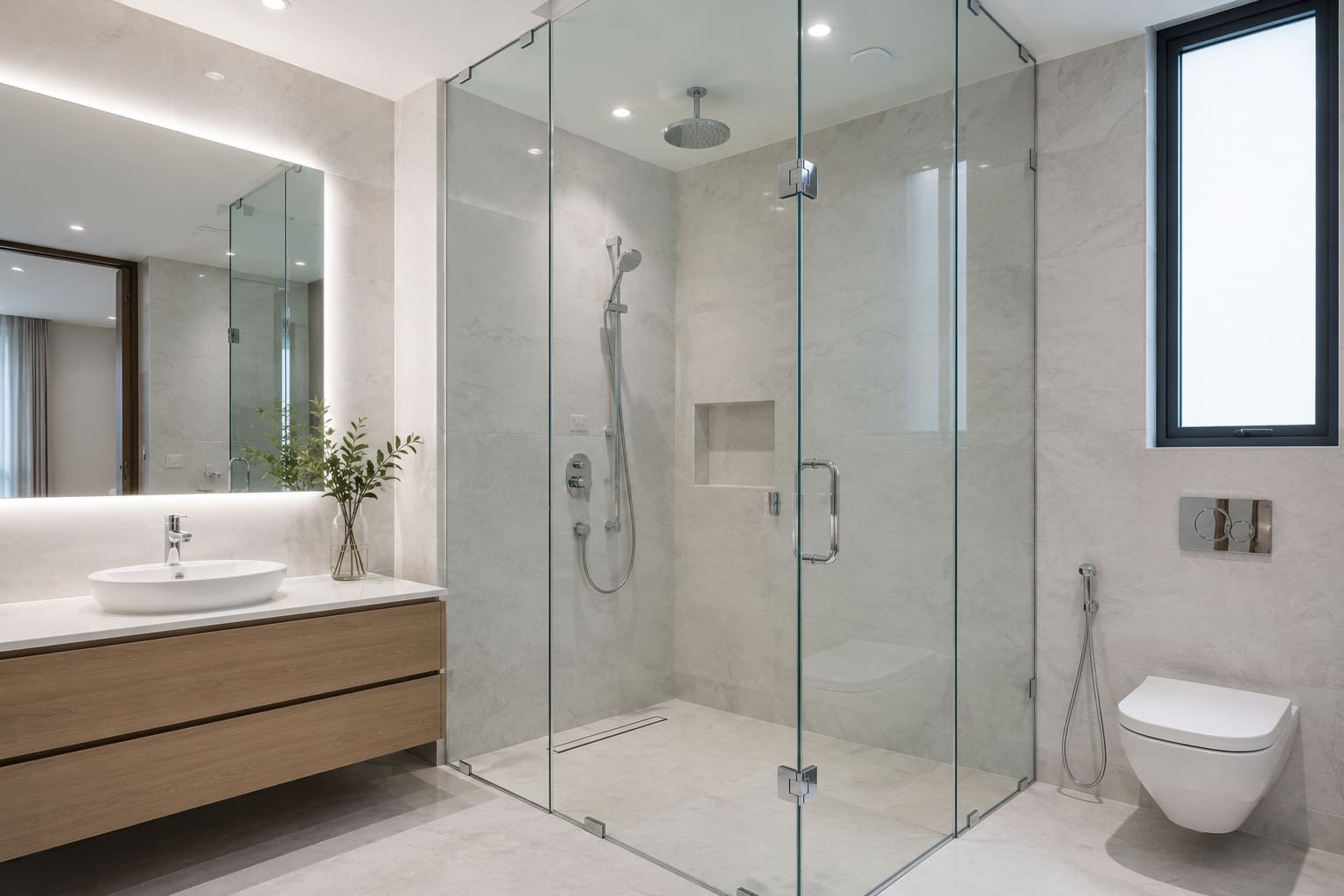
- Frameless: no perimeter frame at all, held instead by discreet clamps, hinges and sometimes a header bar. This is the premium, airy look that makes small bathrooms feel larger and is the easiest to wipe down.
For most modern flats and villas across Telangana we recommend semi-frameless or frameless, because the reduced framing means far fewer places for mould to settle during our humid monsoon months. A true frameless build depends entirely on precision hardware and thicker glass to keep a heavy door aligned and leak-free for years. If you are building a larger walk-in wet room, our frameless shower enclosure service handles the templating, fabrication and fitting as a single job, so nothing falls between a glazier and a plumber.
Match the layout to your bathroom size and door type
Measure your wet area before you fall in love with a design. The most common layouts are the corner enclosure (two panels meeting at 90 degrees), the alcove or inline (a single fixed panel plus a door spanning a niche between two walls), and the walk-in fixed screen with no door at all.
Walk-in fixed screens suit larger bathrooms and need no swing clearance, but they require a well-planned floor slope and a longer dry zone so water does not travel across the room. Hinged doors need swing space in front of the enclosure; sliding doors save that space and work well in tight apartment layouts.
- Under about 35 sq ft: choose a sliding or walk-in configuration to avoid wasting floor space on a door swing.
- 35 to 60 sq ft: a corner hinged enclosure usually gives the best balance of access and dryness.
- Over 60 sq ft (villa wet rooms): a generous walk-in fixed screen looks stunning and is effortless to clean.
A quick rule of thumb for hinged doors: leave at least 550mm of clear swing in front of the opening, and always hinge the door to open outward so water stays inside the tray. If floor space is tight, a sliding or walk-in layout removes that constraint entirely. Browse our recent projects to see how these layouts play out in real Hyderabad bathrooms of different sizes before you commit to one.
Choose the right hardware: hinges, clamps and finishes
Homeowners obsess over the glass and forget the hardware, but the hardware is what fails first. A shower door is opened thousands of times a year, and cheap fittings loosen, drip and rust long before the glass shows any wear.
- Insist on SS 304 stainless steel for all wet-zone hinges, clamps and brackets. It resists the corrosion that destroys zinc-alloy fittings in humid Hyderabad and coastal Andhra Pradesh bathrooms, often within 12 to 24 months.
- For heavy frameless doors, self-closing hydraulic hinges keep the door aligned and gently pull it shut, protecting the seal.
- Match the finish to your taps and fittings: chrome, brushed nickel, matte black and gold-PVD are all readily available from brands like Taiton, Enox and Ozone.
- Add quality wipe seals and a bottom sweep. These inexpensive strips are what actually stop water escaping at the door edge, and they are the first thing to specify, not an afterthought.
We are a hardware dealer as well as a glass fabricator, so we pick fittings rated for the exact weight and thickness of your chosen glass rather than whatever is in the box. Under-specifying the hardware is the single most common reason a good enclosure starts leaking early, and it is the cheapest mistake to prevent up front.
Budget: realistic INR shower enclosure pricing in Hyderabad
Shower enclosures are typically quoted per square foot of glass plus hardware, or as a complete fixed job. As an indicative guide for Hyderabad, Secunderabad and Telangana in 2026:
- Framed 8mm enclosure: roughly Rs 550 to Rs 800 per sq ft of glass.
- Semi-frameless 10mm enclosure: roughly Rs 850 to Rs 1,200 per sq ft.
- Frameless 10mm to 12mm enclosure: roughly Rs 1,200 to Rs 1,800 per sq ft, with premium hinges and nano coatings.
A typical corner enclosure for a standard apartment bathroom lands between Rs 18,000 and Rs 45,000 fully installed, depending on style, glass thickness and hardware brand. A larger villa walk-in wet room in Jubilee Hills or Kokapet can run Rs 55,000 to Rs 1,20,000 or more.
Where should the money go? Invest in the hardware and the coating rather than chasing the thickest possible glass. SS 304 hinges and a nano anti-water treatment add only a modest amount to the bill but dramatically extend the useful life of the enclosure. When you are ready for exact figures for your bathroom, get a free quote with your rough wall measurements and we will price it precisely, including glass, hardware, coating and fitting as one number.
Hard water and humidity: designing for Hyderabad conditions
Hyderabad and Secunderabad bathrooms face two enemies a generic enclosure ignores: hard, high-TDS water and long humid monsoons. Both attack the parts people notice most, the clarity of the glass and the shine of the metal.
- Hard water (often above 500 mg/L TDS from borewells) deposits calcium and magnesium salts that etch untreated glass. A nano hydrophobic coating makes water bead and run off, so a quick squeegee keeps the panel crystal clear.
- Monsoon humidity encourages mould in any trapped channel, which is why frameless and semi-frameless designs age better here than fully framed ones.
- Neutral-cure, anti-fungal food-grade silicone at the joints resists the black mould that ruins ordinary acetic silicone within a season.
These are small specification choices, but in Telangana's climate they are the difference between an enclosure that still looks new after five years and one that looks tired after a single monsoon. If you are matching the enclosure to other glazing in the home, it is worth reviewing our services so the same water-resistant specification carries across every glass element.
Common mistakes to avoid when choosing an enclosure
Most shower enclosure regrets trace back to a handful of avoidable errors. Knowing them in advance saves both money and a second callout:
- Buying on glass thickness alone while skimping on hardware and seals, which is what actually causes early leaks.
- Skipping the nano coating to save a few hundred rupees, then living with permanent hard-water etching that no cleaner removes.
- Choosing a hinged door for a bathroom too small for its swing, leaving it forever bumping the WC or vanity.
- Accepting nominal wall dimensions instead of a proper site template, so the panel does not sit plumb and drips at one edge.
- Using acetic (vinegar-smell) silicone, which grows black mould fast in humid conditions, instead of neutral-cure anti-fungal silicone.
- Mixing metals, for example zinc-alloy clamps with steel screws, which accelerates corrosion at the joint.
Avoid these six and you eliminate the vast majority of complaints we are called out to fix on enclosures other suppliers installed across Hyderabad.
Installation, timeline and after-sales support
Even the best glass fails if the fixing is poor. Insist on proper wall anchoring into tile and masonry, food-grade neutral-cure silicone sealing, and a slight fall so water drains toward the trap. A good installer templates your walls first, because bathroom walls are rarely perfectly plumb; a 5mm error over a two-metre panel is enough to cause a persistent drip.
The typical timeline is straightforward. Day one is measurement and templating; the glass is then toughened and any coating applied, which usually takes about 4 to 7 working days; installation itself is a single half-day visit, after which the silicone should cure for 24 hours before the shower is used.
- Confirm the fabricator templates the actual walls rather than working to nominal dimensions.
- Ask about warranty on hinges and coatings, since reputable hardware carries a multi-year warranty.
- Check that the same local team can service, re-seal or realign the enclosure later.
Local support genuinely matters. A Hyderabad-based team can re-seal or realign a sagging door in a single visit, whereas an out-of-town supplier may leave you waiting weeks. When you have your measurements ready, get a free quote and we will handle templating, fabrication, fitting and after-sales as one accountable job across Hyderabad, Secunderabad, Telangana and Andhra Pradesh.