Cladding materials compared, the four dominant facade options are ACP (aluminium composite panel), HPL (high-pressure laminate), glass and natural stone, and they differ mainly in cost (roughly Rs 130 to Rs 900+ per sq ft installed), weight (5.5 to 80+ kg/sqm), fire behaviour, lifespan (10 to 100+ years) and maintenance. There is no single "best" cladding, only the right material for a given building height, budget, fire-safety class, thermal target and architectural finish. This guide sets the four side by side with realistic Indian pricing so you can shortlist quickly.
Cladding is the non-structural outer skin fixed to a building's facade to provide weather protection, thermal insulation, acoustic control and aesthetics. In Hyderabad and Secunderabad, where summer temperatures cross 42 degrees C and monsoon-driven wind-driven rain is common, cladding selection must balance solar heat gain, water tightness and long-term UV and thermal-cycling durability against upfront cost. The same panel that performs beautifully on a shaded north elevation can chalk, fade or oil-can on a west face under full Telangana sun.
This comparison covers ACP cladding, HPL cladding, glass curtain walls and natural stone, with the Indian standards that govern each. If you already know your finish and just want a figure for your elevation, you can skip to the comparison section below or get a free quote for your specific building.
What Cladding Is and Why Material Choice Matters
Cladding is the weatherproof, decorative skin hung off a building's structural frame; it carries its own weight and the wind load acting on it, but it does not support the building. Because it is the layer that faces sun, rain and pollution for decades, the material you choose dictates thermal comfort, fire risk, maintenance cost and how the building ages. A cheap panel can look identical to a premium one on handover day and then diverge completely within three summers.
Three factors drive almost every cladding decision:
- Weight, which decides the sub-frame, anchors and structural allowance the building must carry.
- Fire performance, which is legally constrained by NBC 2016 for anything above the ground floor.
- Whole-life cost, which combines the installed rate with repainting, resealing and replacement over 20 to 50 years, not just the day-one price.
Every system below is mounted on an aluminium or MS sub-frame using engineered profiles and brackets, so the framing behind the panel matters as much as the panel itself. Get the sub-frame wrong and even premium stone or glass will leak, rattle or fail at the fixings. Browsing our recent projects shows how the same material can look entirely different depending on jointing, framing and detailing.
ACP (Aluminium Composite Panel): Lightest and Most Affordable
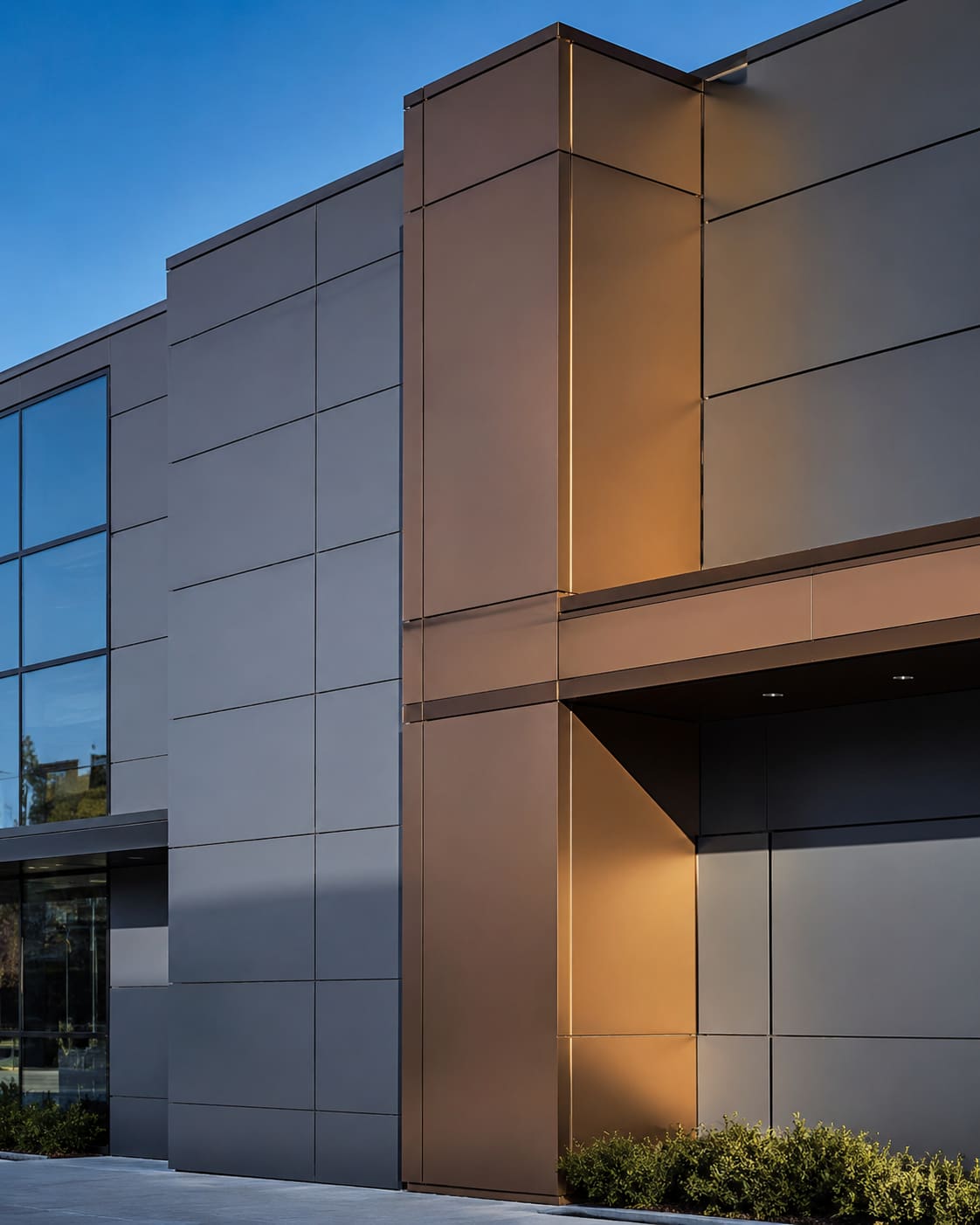
ACP is a sandwich panel of two 0.3 to 0.5 mm aluminium skins bonded to a polyethylene (PE) or fire-retardant mineral core, typically 3 mm or 4 mm total thickness and weighing about 5.5 kg/sqm at 4 mm. It is the workhorse of Indian facades because it is light, fast to install and easy to rout and fold into crisp corners, curves and shadow lines. For value-driven commercial and retail work across Secunderabad, it is usually the default starting point.
- Cost: approximately Rs 130 to Rs 450 per sq ft installed, depending on brand, coating and core.
- Coating: PVDF (Kynar 500) coatings resist UV and colour fade for 15 to 20 years; cheaper polyester (PE) coatings chalk and fade far sooner in Hyderabad sun.
- Fire: choose FR/A2 mineral-core ACP (EN 13501-1) for any facade above ground-floor level; PE-core ACP is combustible and restricted under NBC 2016 for tall buildings.
- Best for: signage, ventilated rain-screen facades, quick large-area coverage and curved or routed feature forms.
- Lifespan: 15 to 20 years with a quality PVDF coating.
The main trap with ACP is buying on rate alone: a quotation can quietly swap an FR mineral core for a combustible PE core and a PVDF coat for polyester, and the panel will look identical on day one. Our ACP cladding service covers panel selection, fabrication and the ventilated sub-frame that keeps the wall dry, with the core and coating specified in writing.
HPL (High-Pressure Laminate): Solid, Impact-Resistant Panels
HPL is a solid, dense panel of kraft-paper layers impregnated with thermosetting resins and compressed under high heat and pressure, typically 6 to 12 mm thick and weighing around 8 to 15 kg/sqm. Unlike ACP, it is self-supporting and has no separate core to delaminate or oil-can, which makes it the tougher panel where knocks, trolleys and public traffic are a factor.
- Cost: approximately Rs 180 to Rs 550 per sq ft installed.
- Durability: exterior-grade HPL (EN 438) is UV-stable, impact-resistant and self-supporting, with strong scratch and graffiti resistance.
- Finishes: available in convincing woodgrain, stone and solid colours, offering a natural-timber look without the sanding and repainting of real wood.
- Fire: standard exterior HPL is combustible; specify FR-grade (Euroclass B-s2,d0) for high-rise applications.
- Lifespan: 10 to 15 years.
- Best for: ventilated facades, balconies, soffits, and mid-rise commercial, hospital, school and IT-campus buildings.
HPL is the pick when a client wants the warmth of timber on a facade without seasonal upkeep. Compare finishes and detailing on our HPL cladding page, and note that it needs a properly ventilated cavity behind it, both for drainage and to let the panel move with temperature.
Glass Cladding and Curtain Walls: Daylight and Transparency
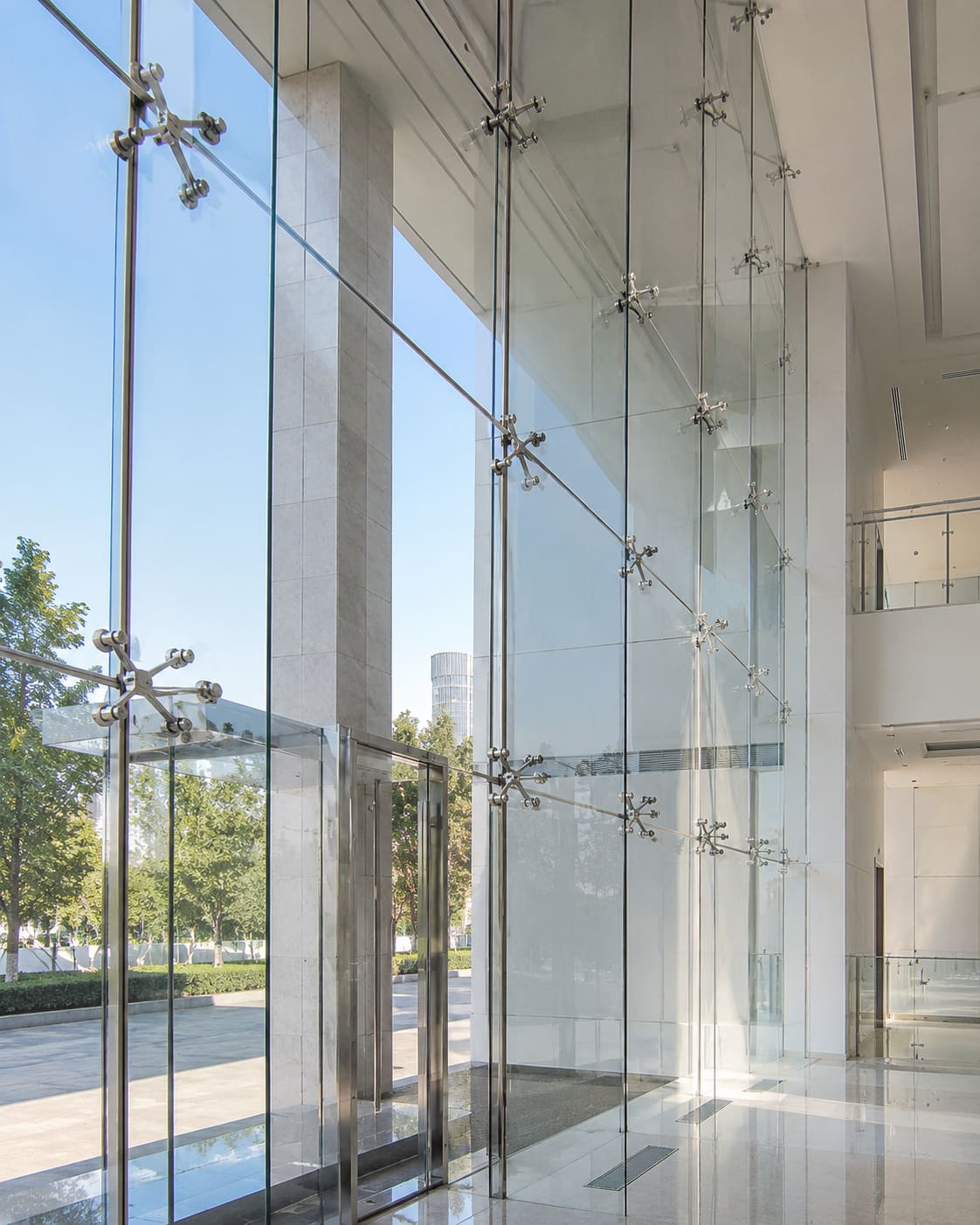
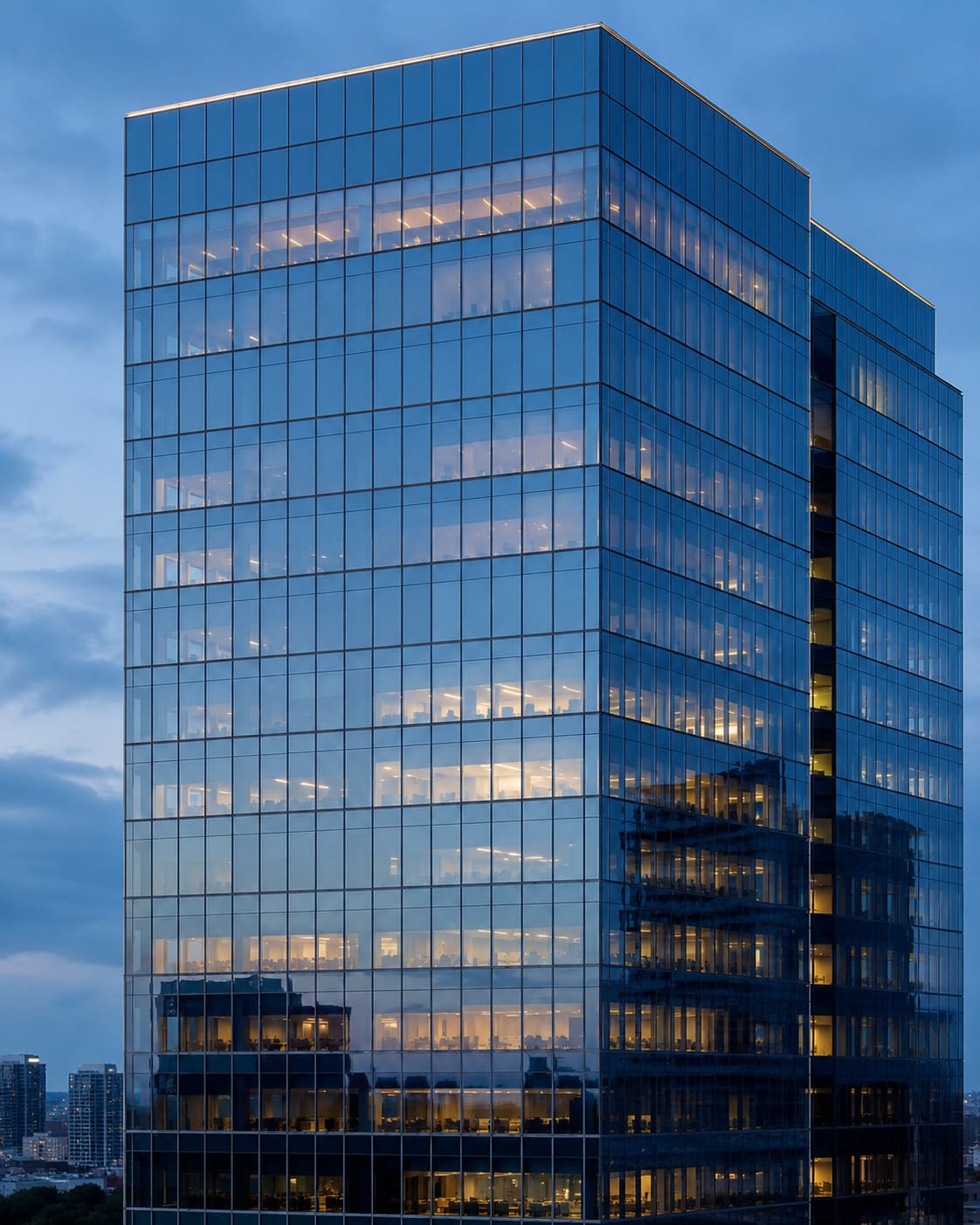
Glass cladding uses toughened, laminated or insulated glass in structural glazing (SSG) or unitised curtain-wall systems to create sleek, transparent or spandrel facades. It is the language of corporate towers, showrooms and hotel lobbies where daylight and a frameless look matter, and it is the most performance-tunable of the four materials.
- Toughened safety glass must conform to IS 2553; laminated glass adds safety, security and acoustic performance.
- Structural silicone glazing joints are engineered to ASTM C1401 so wind load transfers safely into the aluminium frame.
- Thermal: double-glazed units (DGU) with low-E coatings cut solar heat gain substantially, lowering U-values and supporting ECBC and BEE-rated energy targets in hot Hyderabad conditions.
- Cost: approximately Rs 350 to Rs 900+ per sq ft installed for high-performance DGU curtain walls.
- Lifespan: 25 to 30+ years, with periodic sealant inspection and glass cleaning.
- Best for: corporate towers, showrooms, hotel lobbies and daylight-driven architecture.
Glass facades live or die on their fittings and sealant joints, not the glass itself. Spider-glazed, bolted and frameless assemblies rely on precision hardware and correctly designed structural silicone; skimping there is the fastest route to a leaking or whistling wall. If daylight and energy control are priorities, glass with a low-E DGU is hard to beat, and you can weigh it against the other finishes across our services.
Cost, Weight and Lifespan Compared Side by Side
The right cladding depends on prioritising fire class, budget, weight tolerance and design intent rather than any single material being universally best. Read the numbers below as ranges, because coating grade, glass make-up and stone type swing them widely.
- Installed cost per sq ft: ACP Rs 130 to 450, HPL Rs 180 to 550, glass DGU Rs 350 to 900+, stone Rs 250 to 900+.
- Weight: ACP about 5.5 kg/sqm (4 mm), HPL 8 to 15 kg/sqm, glass DGU roughly 25 to 45 kg/sqm, stone 40 to 80+ kg/sqm.
- Lifespan: ACP 15 to 20 years, HPL 10 to 15 years, glass 25 to 30+ years, stone 50 to 100+ years.
- Lightest structural load: ACP; heaviest: stone.
- Lowest day-one cost and fastest install: ACP; lowest whole-life cost: stone.
- Best natural or timber look without upkeep: HPL; best daylight, transparency and energy control: glass with a low-E DGU.
A useful rule of thumb: budget-led large-area projects lean ACP, impact-prone or timber-look facades lean HPL, daylight and prestige office towers lean glass, and legacy or institutional buildings that must last generations lean stone. For every system, design the wind load to IS 875 Part 3 and verify fire compliance under NBC 2016 before finalising the panel.
Fire Safety and Indian Standards You Must Meet
Fire performance is the single most legally sensitive cladding decision in India, and it is non-negotiable above the ground floor. After several high-rise facade fires internationally, authorities have tightened enforcement of the core-material class on tall buildings, and municipal approvals increasingly ask for it explicitly.
- NBC 2016 governs fire and construction safety and restricts combustible PE-core ACP on tall buildings; specify A2 or FR mineral-core panels instead.
- IS 2553 covers toughened and heat-treated safety glass for facades.
- ASTM C1401 governs structural silicone glazing joint design, so glass transfers wind load safely into the frame.
- IS 875 Part 3 sets wind load, essential for exposed high-rise sites in Hyderabad and cyclone-influenced coastal Andhra Pradesh.
- ECBC and BEE ratings drive glazing performance targets for energy compliance on larger commercial buildings in Telangana.
Never let a quotation win purely on rate if it silently substitutes a PE core for an FR core, or an untested laminate for an FR-grade one, the price gap is real but so is the fire and legal exposure. Ask for the core certificate and the fire class in writing, and keep them on file for the completion approval.
How to Choose the Right Cladding for Your Project
Work through four questions in order, because each one eliminates options before you ever compare finishes. Getting the sequence right prevents the most expensive mistake in facade work: falling in love with a look the building cannot legally or structurally carry.
- How tall is the building? Anything above the ground floor forces FR-grade cores and fire-rated glass, which reshapes the ACP and HPL shortlist immediately.
- What can the structure carry? A frame sized for ACP cannot take stone; confirm the structural allowance before promising a heavy finish.
- What is the exposure? West and south elevations under full Telangana sun need better coatings and low-E glass than a shaded courtyard face.
- What is the whole-life budget? A low installed rate that needs recoating in five years can cost more than a dearer finish that lasts twenty.
Mixing materials is not only allowed, it is often the smart answer: glass at the entrance and public floors, ACP or HPL on the upper repetitive floors, and stone at the base where impact and prestige matter most. If you are unsure which mix suits your elevation and budget, get a free quote and we will size it against your structure and fire class.
Installation, Common Mistakes and Maintenance
Cladding fails at junctions, not in the middle of a panel. Sound installation depends on a correctly engineered sub-frame, allowance for thermal movement, and the right sealants and fixings at every interface with windows, doors and parapets. A typical mid-rise facade runs four to ten weeks from sub-frame to final panel depending on area, material and access.
- Sub-frame: aluminium or MS carriers designed for thermal expansion, with a ventilated, drained cavity behind the panel.
- Common mistakes: no ventilation gap behind rain-screen panels, missing movement joints, sealing over drainage paths, and mixing dissimilar metals that corrode at contact points.
- Maintenance: ACP and HPL need periodic washing; glass needs sealant inspection and cleaning; stone may need resealing. Budget a facade inspection every 2 to 3 years.
- Warranty: insist on documented coating, glass and workmanship warranties, and retain the core and glass certificates.
Hakimi Aluminium and Glass supplies and installs ACP, HPL, structural glazing and natural stone cladding across Hyderabad, Secunderabad and wider Telangana, matching the material to your height, structure, fire class and budget rather than pushing a single product. To scope your facade and get a per-sq-ft figure for your elevation, get a free quote.