Clear glass is fully transparent and best for maximum daylight and unobstructed views, frosted glass is translucent and best for privacy while retaining light, and tinted glass is coloured to reduce solar heat and glare, making it best for sun-facing facades and hot climates. The right choice in the clear vs frosted vs tinted glass decision comes down to a single question: is your priority visibility, privacy or heat and glare control? All three are available as toughened or laminated safety glass and can be mixed within the same building, even the same elevation.
This guide compares the three glass types in depth across light transmission, privacy, thermal performance, thickness, applicable Indian standards and realistic 2026 cost, so you can confidently specify the correct glazing for windows, glass partitions, doors and facades. In Hyderabad and Secunderabad, where intense summer sun and glare are major design factors, the decision blends aesthetics with the Energy Conservation Building Code (ECBC), thermal comfort and long-term running cost, not just the sticker price of the panel.
Whether you are fitting out an office cabin in Gachibowli, a villa in Jubilee Hills, or a showroom on the Secunderabad side, matching the glass to the room's job is what separates a comfortable, low-glare space from one that overheats or feels exposed. If you would rather skip straight to a specification, you can get a free quote and share your elevation, and our team will recommend the glass, thickness and processing for each opening.
Clear Glass: Maximum Light and Visibility
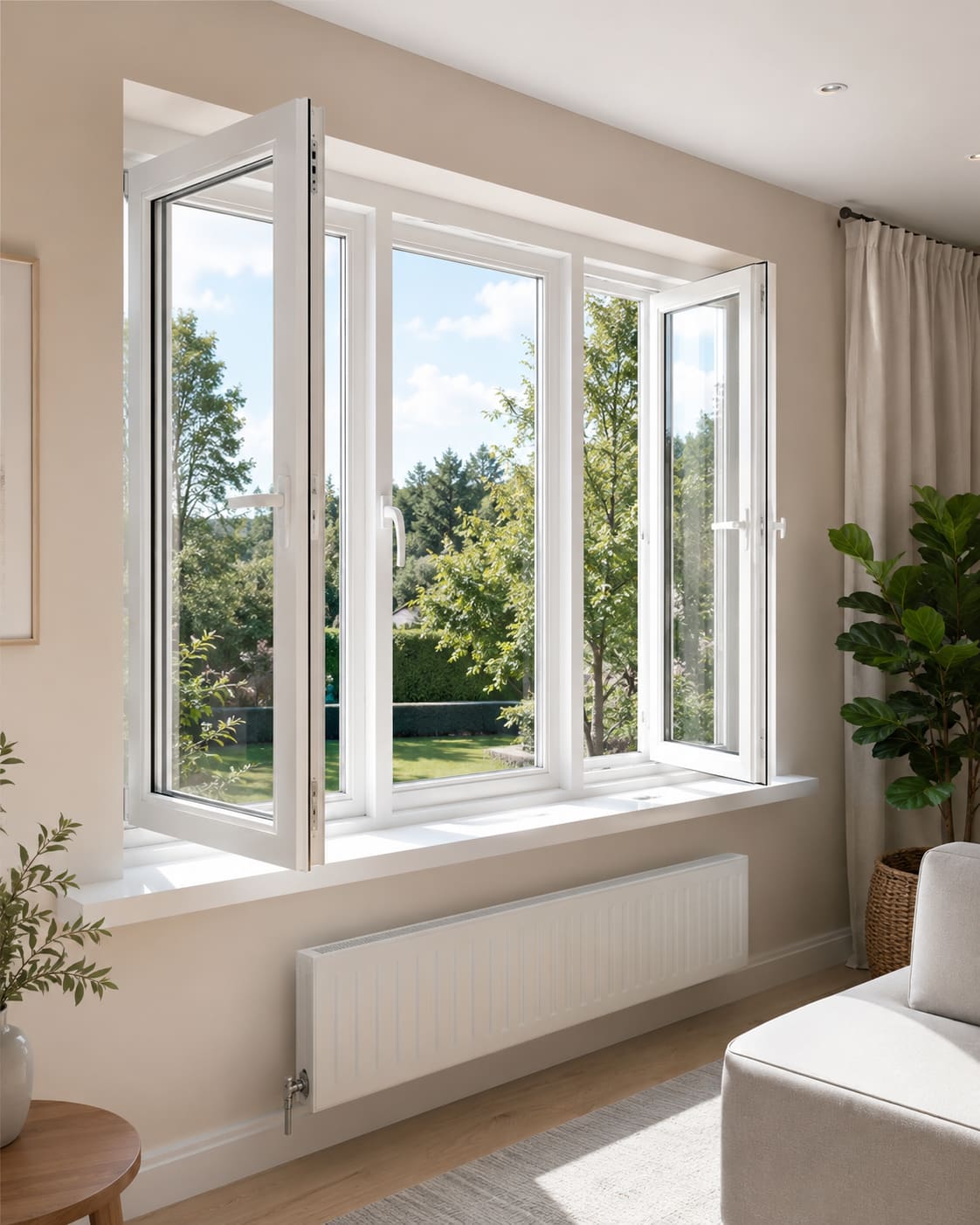
Clear float glass is the standard transparent glazing that transmits about 80-90% of visible light and offers unobstructed views, making it the default for windows, showrooms, balustrades and display fronts where brightness and clarity matter most.
It is manufactured by the float process to IS 14900 for transparent float glass and is optically flat with minimal distortion, so reflections stay crisp and merchandise or interiors read clearly from the street. Because it does almost nothing to block solar radiation on its own, clear glass on a sun-facing wall in Hyderabad can turn a room into a greenhouse by mid-afternoon unless it is paired with a low-E or reflective coating.
- Visible light transmission: approximately 80-90% at 5-6 mm
- Privacy: none, fully see-through in both directions
- Solar heat control: minimal unless combined with low-E or reflective coating
- Typical thickness: 4 mm and 5 mm for windows, 6-12 mm for doors, partitions and facades
- Best for: retail fronts, view windows, glass railings and any area needing brightness
For safety-critical spans, clear glass should be toughened to IS 2553 (safety glass) or laminated, which is effectively mandatory for doors, large panels and overhead glazing. Frameless clear doors and shopfronts also depend on quality patch fittings and floor springs that carry the weight and control the swing smoothly over years of daily use, so the hardware specification should be locked in at the same time as the glass.
Frosted Glass: Privacy Without Losing Daylight
Frosted glass is translucent glass that scatters light to obscure direct vision while still allowing 70-85% of daylight through, making it the standard solution for privacy in bathrooms, meeting-room partitions and cabin fronts. It is the only one of the three types designed primarily around privacy rather than light or heat.
The frosted effect is produced by acid etching or sandblasting one surface, or by applying a durable frosted film to clear glass. The result is a uniform matte finish that hides fingerprints, softens glare from downlights and screens, and gives interiors a clean, contemporary look. Etched and sandblasted finishes are permanent; film is cheaper and reversible but can peel at the edges in wet areas if it is not applied well.
- Visible light transmission: approximately 70-85%, fully diffused
- Privacy: high, blocks a clear view while passing daylight
- Solar heat control: similar to clear glass unless additionally tinted or coated
- Typical thickness: 5-6 mm for partitions, 8-12 mm for frameless toughened doors
- Best for: bathrooms, office cabins, conference rooms, entrance doors and staircases
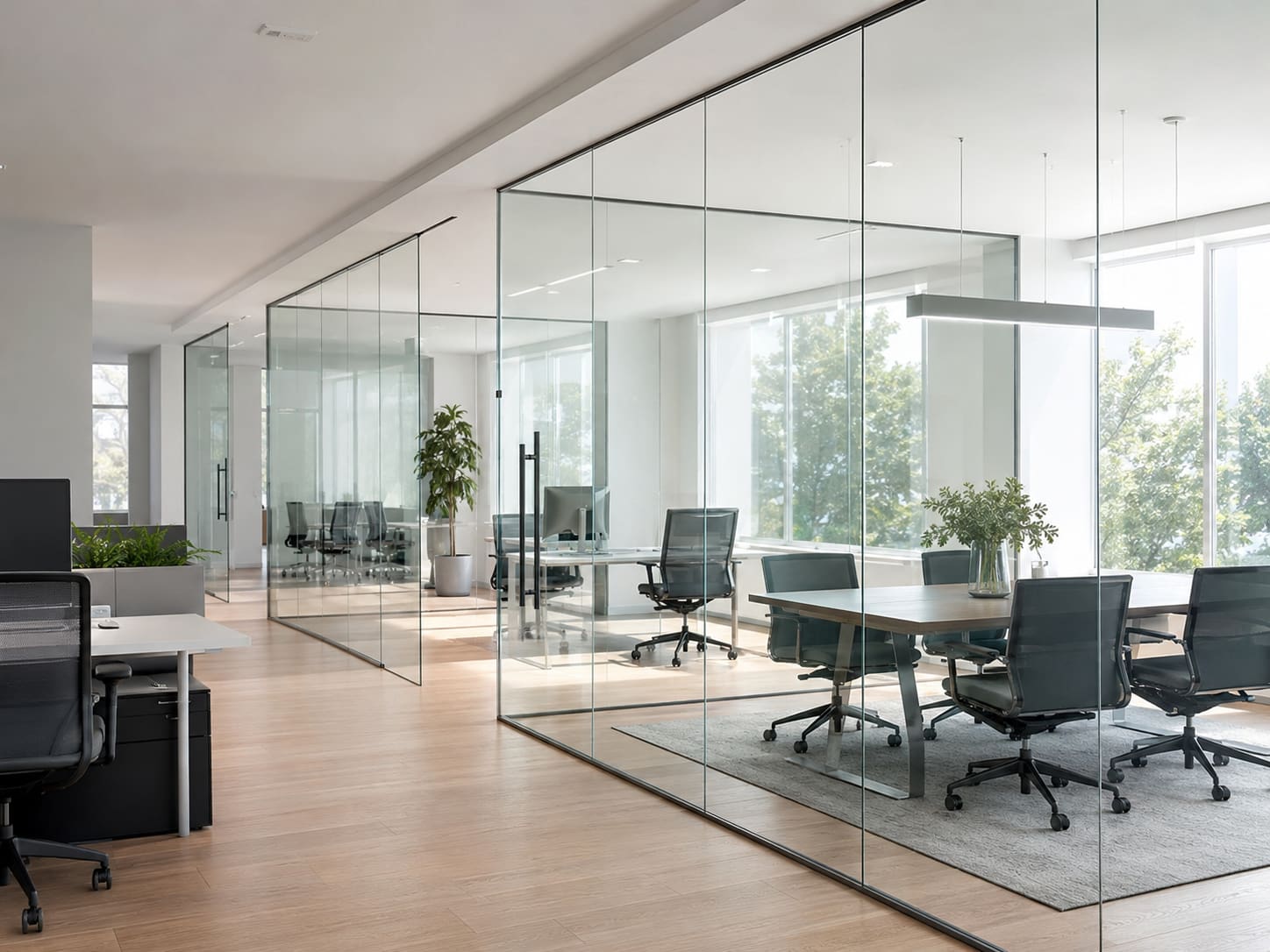
Frosted glass should be toughened before etching to meet IS 2553 safety requirements, because you cannot cut or process toughened glass afterwards. A frosted band at seated height is a popular treatment on office glass partitions, combining privacy below the sightline with an open, collaborative feel above. In washrooms, frosted panels create a bright but private wet area without the closed-in feeling of a solid wall.
Tinted Glass: Heat and Glare Reduction
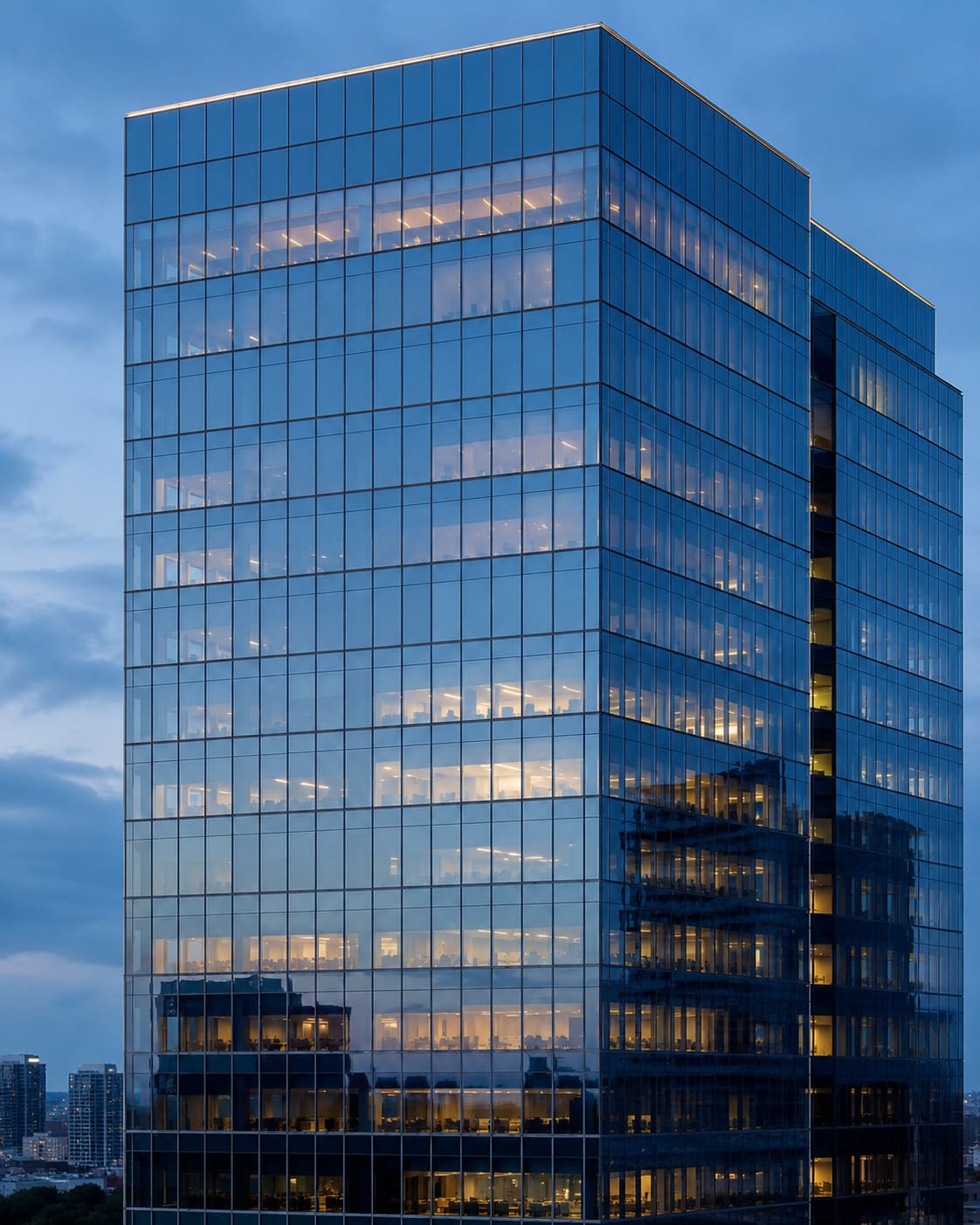
Tinted glass is float glass with colourants added to the melt, typically bronze, grey, green or blue, that reduce visible light transmission to about 45-75% and cut solar heat gain by 20-55%, making it the best choice for sun-exposed facades and hot climates. It is the workhorse of large glazed elevations across Telangana and Andhra Pradesh for exactly this reason.
The tint absorbs part of the solar spectrum, lowering the Solar Heat Gain Coefficient (SHGC) and glare, which directly supports the cooling-load and SHGC targets set by the ECBC for commercial buildings. One trade-off to plan for: because darker tints absorb rather than reflect heat, the glass itself gets hot and is more prone to thermal stress, which is why toughening is routinely specified on tinted facade panels in strong sun.
- Visible light transmission: approximately 45-75% depending on colour and depth
- Privacy: moderate daytime privacy that increases with darker tints
- Solar heat control: good, noticeably reduces heat gain and glare
- Typical thickness: 5-6 mm for windows, 8-12 mm for facades and curtain walls
- Best for: west and south facades, curtain walls, sunrooms and car porches in Hyderabad
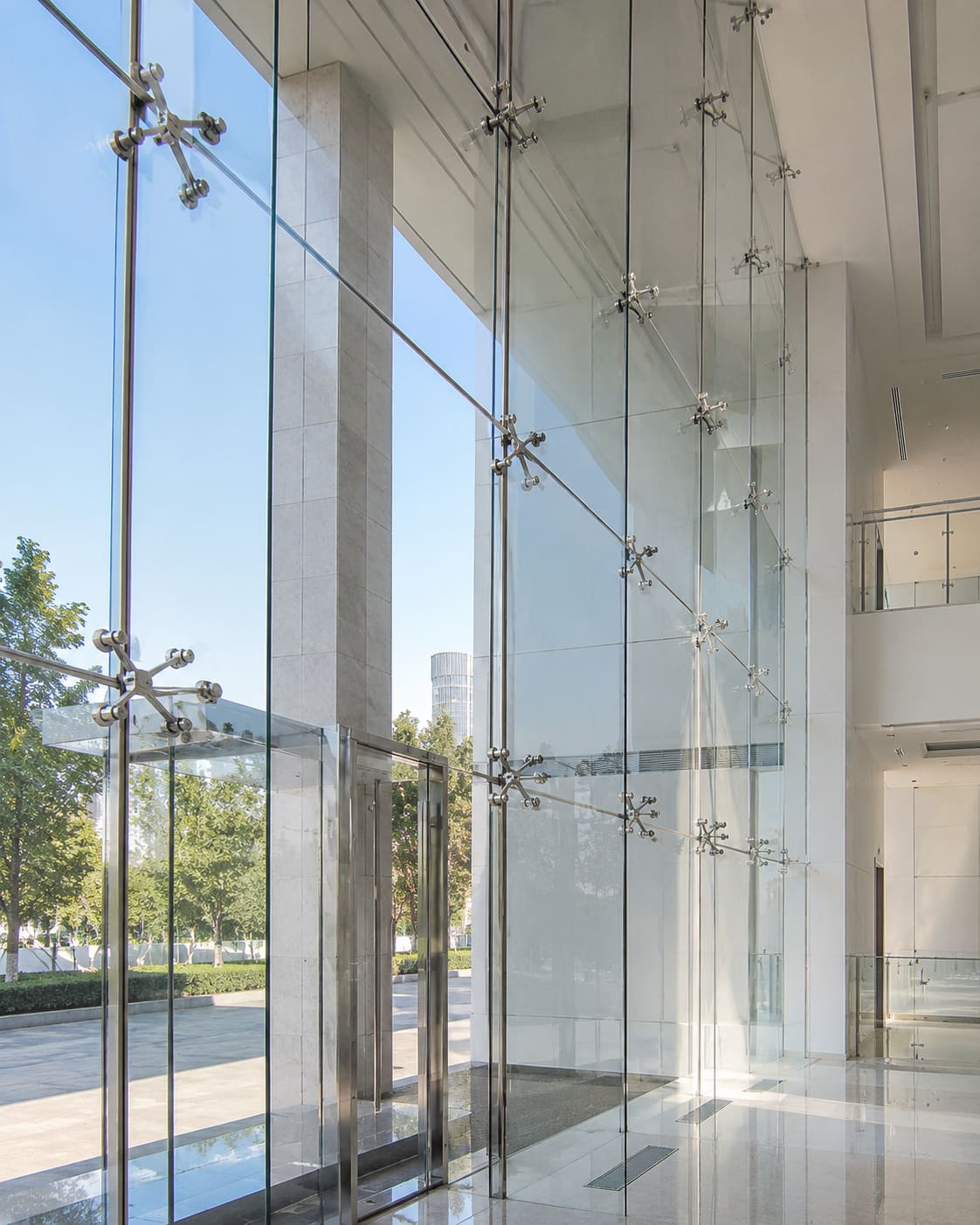
Tinted glass can be combined with reflective or low-E coatings and toughened per IS 2553. On large elevations it is frequently installed as part of a glass facade system with structural silicone and concealed spider fittings; you can see how tinted and reflective glazing performs in the field on our recent projects across the twin cities.
Light, Privacy and Heat: A Side-by-Side Comparison
Clear glass wins on light and view, frosted glass wins on privacy, and tinted glass wins on heat and glare control, so the correct pick simply follows the room's primary function. If you can name the room's single most important requirement, the glass almost chooses itself.
- Light transmission: clear 80-90%, frosted 70-85% diffused, tinted 45-75%
- Privacy: clear none, frosted high, tinted moderate and daytime only
- Heat and glare control: clear low, frosted low, tinted high
- Typical Hyderabad cost per sq ft: clear INR 60-120, frosted INR 90-160, tinted INR 110-200 before toughening
- Toughening or lamination adds roughly INR 40-90 per sq ft and is advised for every safety-critical panel
One important nuance on tinted glass and privacy: it only works one way and only in daylight. When the interior is brighter than the outside, at night with the lights on, a tinted or reflective pane becomes see-through from the street, so never rely on tint alone for genuine privacy. For high-performance envelopes, insulated glass units (double glazing) can pair a tinted or low-E outer pane with a clear inner pane to balance daylight, views and thermal comfort, which is increasingly common on premium office towers in HITEC City and the Financial District.
Combining and Upgrading: Coatings, Lamination and Double Glazing
You are not limited to one plain product, because clear, frosted and tinted glass can be combined with coatings, films and lamination to hit a specific performance target that no single base glass reaches on its own.
Reflective and low-E coatings can be applied to clear or tinted glass to cut solar heat further while keeping high daylight, which is often the smartest option for glare-sensitive offices that still want a bright interior. Laminated glass bonds two panes with a PVB interlayer, adding safety, security and up to around 99% UV reduction that protects flooring, furniture and merchandise from fading in Hyderabad's harsh sun.
- Low-E coating: keeps light high while lowering heat, ideal for view windows
- Reflective coating: strong heat and glare control with a mirrored daytime look and added privacy
- Laminated glass: safety, acoustic damping and UV protection for facades, skylights and railings
- Frosted film on toughened clear: privacy without ordering pre-etched panels
Double-glazed units also improve acoustic comfort near busy roads such as the ORR and inner-city corridors, cutting traffic noise appreciably. If you are unsure which upgrade actually pays back for your orientation and use, browse our services or send us the details of each opening and we will model the sensible options rather than over-specifying.
How to Choose for Your Application
Choose based on the dominant need: clear for daylight and views, frosted for privacy, and tinted for heat and glare on sun-facing elevations. When two needs compete, such as a bright bathroom that also faces the sun, combine products rather than compromising with one.
- Bathrooms and WCs: frosted glass for privacy with retained daylight
- Office cabins and conference rooms: frosted or partially frosted glass partitions
- Living-room and view windows: clear glass, optionally low-E for heat
- West and south facades in Hyderabad and Secunderabad: tinted or reflective glass to cut solar load
- Shopfronts and showrooms: clear toughened glass for display clarity
- Balustrades, doors and overhead glazing: any type, but must be toughened or laminated to IS 2553
Wind load on facade glazing should be checked to IS 875 Part 3, and overall building glass selection should align with the National Building Code of India (NBC) 2016 and, for commercial projects, the ECBC and BEE benchmarks. Remember that the framing, sliding gear and locking matter as much as the glass itself; a premium tinted panel in a flimsy frame will still leak air, rattle and underperform, so specify the aluminium system and hardware at the same time as the panels.
Common Mistakes to Avoid
The most expensive glass mistakes are not about choosing the wrong colour, they are about processing, orientation and safety, and every one of them is avoidable at the specification stage.
- Using clear glass on west and south facades and then fighting the heat with extra air-conditioning for the life of the building
- Relying on tinted glass for night-time privacy, when it becomes transparent from outside once interior lights are on
- Ordering annealed (non-toughened) glass for doors, railings, shopfronts or overhead panels, which is unsafe and non-compliant with IS 2553
- Trying to cut, drill or edge-polish glass after toughening, which is impossible; all processing must be done before tempering
- Applying frosted film in showers or wet areas without proper edge sealing, leading to peeling within a year or two
- Skipping the SHGC and light-transmission values on the quote, so the glass cannot be verified against ECBC or compared like-for-like
A reliable fabricator will flag these before you order. Getting the specification right on paper is far cheaper than replacing installed glass, which means paying for the panel, the processing and the site work all over again.
Cost, Standards and Local Buying in Hyderabad
Budget for glass in three layers: the base product, the processing, and the hardware and installation, because the panel price alone rarely reflects the finished cost. It is common for processing and fitting to add as much again as the glass itself.
As a working guide for Hyderabad and Secunderabad in 2026, clear float runs about INR 60-120 per sq ft, frosted about INR 90-160, and tinted about INR 110-200, all before toughening or lamination which adds roughly INR 40-90 per sq ft. Reflective and low-E coated glass sits higher again, and double-glazed units are typically quoted per unit rather than per square foot.
- Base glass: driven by type, thickness and colour
- Processing: toughening, lamination, edge polishing, holes and cut-outs
- Hardware: hinges, patch fittings, handles, closers and channels
- Site work: measurement, transport, fixing and silicone sealing
Insist on IS 14900 float glass and IS 2553 safety processing, and ask for the SHGC and light-transmission values on tinted or coated glass so the specification is verifiable against the ECBC. Prices also move with GST, sheet size and quantity, so a small order of oversized panels can cost more per square foot than a large one of standard sizes. For a fitted price on your exact openings across Telangana and Andhra Pradesh, get a free quote with sizes and elevations and we will break the number down line by line.