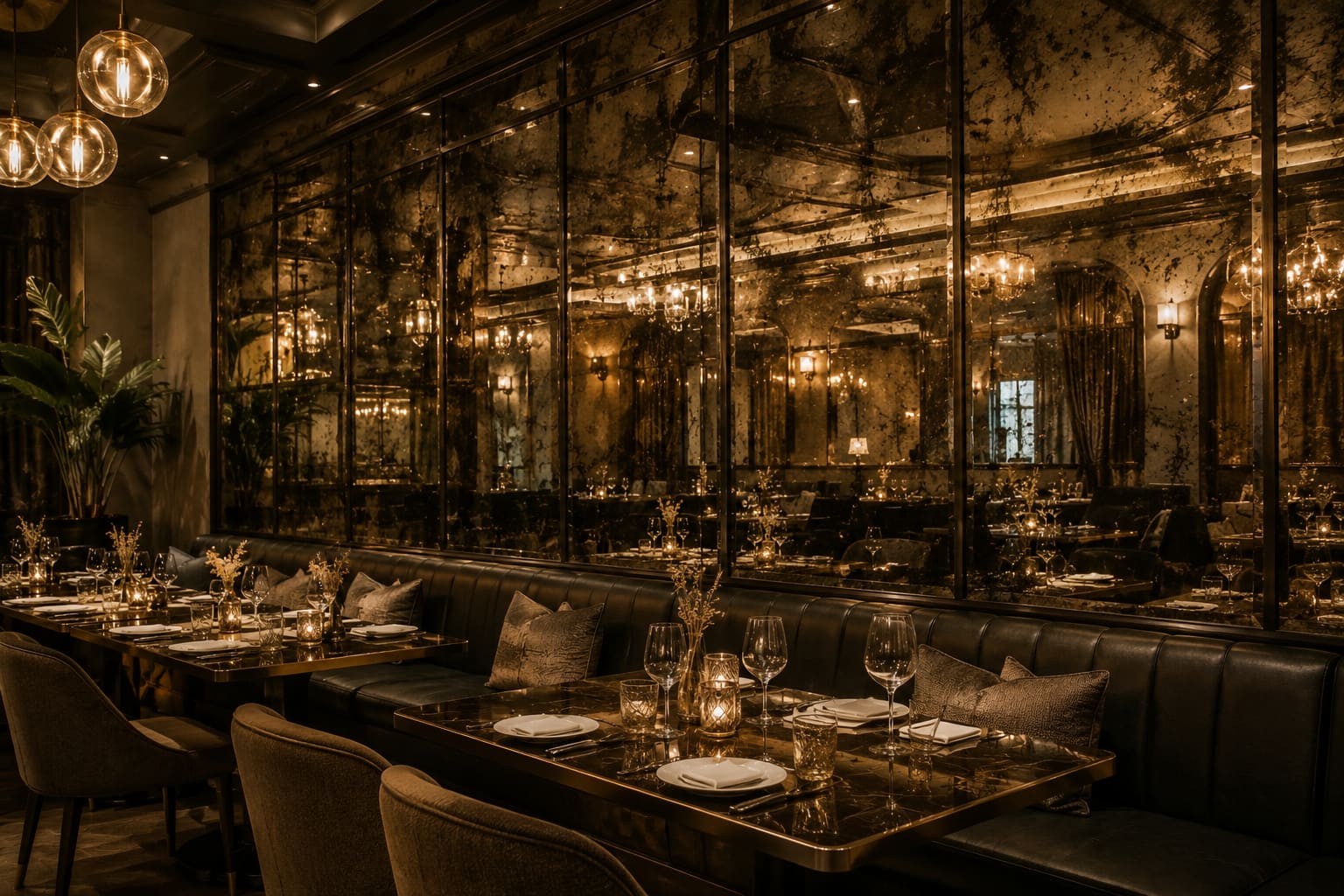
The best decorative mirror wall ideas turn a plain plaster surface into the visual centrepiece of a room while making the whole space feel larger, brighter and more expensive than it really is. A full-height decorative mirror wall reflects light and depth back into the room, so it can make a compact 2BHK feel almost double its size, bounce daylight into a north-facing drawing room and add a designer polish that photographs beautifully. Across Hyderabad and Secunderabad, interior designers now treat mirror as a deliberate architectural material rather than a functional afterthought, using it the way they use panelling, wallpaper or stone, and a purpose-built decorative mirror wall is one of the most cost-effective feature finishes you can add.
The secret is matching the right style, tint, thickness and mounting method to the room. A gym, wardrobe or dance studio wants clear, distortion-free glass; a living room, restaurant or boutique almost always looks richer with antique, bronze or grey-tinted panels that soften the reflection and hide fingerprints. Get the pairing wrong and a mirror wall reads as cheap and glary; get it right and it becomes the surface everyone notices first.
This guide walks through the most popular decorative mirror wall ideas for Indian interiors, what each style suits, the exact glass and hardware specifications to insist on, and realistic INR pricing for homes and commercial spaces across Telangana and Andhra Pradesh. Whether you are refreshing a single accent wall or fitting out a showroom, you can get a free quote once you know which style fits your space, and browse our recent projects for finished examples.
What Makes a Mirror Wall Different from a Plain Mirror
A decorative mirror wall is not simply a big mirror hung on a nail. It is a designed surface, usually running floor to ceiling or filling one full elevation, in which the mirror itself becomes a finish material like tile, wood veneer or stone. That shift in intent changes everything about how it is specified and fitted.
A bathroom vanity mirror only has to reflect a face at close range, so distortion, silvering grade and fixing method rarely matter much. A mirror wall, by contrast, is viewed from across the room at an angle, in changing light, often alongside expensive furniture. Any wave in the glass, any mismatch in tint between panels, or any visible clip becomes obvious. That is why the same square footage of mirror can cost three or four times more when it is treated as a feature wall rather than a utility mirror.
- It spans a full elevation, so panels must be planned around joints, sockets, switches and skirting.
- It is seen at a distance and an angle, which exposes any distortion or tint mismatch.
- It carries real weight over a large area, so the fixing method is a structural decision, not an afterthought.
- It sets the mood of the room, so tint and texture are chosen for atmosphere, not just reflection.
Understanding that difference is the first step to a result that looks built-in rather than bolted on, and it is why a mirror wall is worth specifying with a glass professional rather than a general carpenter.
Popular Decorative Mirror Wall Styles and Where They Work
The style you choose sets the mood of the entire room, so match it to the function of the space and the light it already receives. These are the decorative mirror wall ideas we install most often across Hyderabad, Secunderabad and the wider Telangana market:
- Full-length clear mirror: seamless, distortion-free reflection ideal for bedrooms, wardrobes, home gyms and dance studios. It is the most budget-friendly option and the easiest to keep clean.
- Antique or smoked mirror: subtly aged, mottled glass that hides fingerprints and adds warmth. A favourite for feature walls in living and dining rooms where a raw clear reflection would feel too clinical.
- Bronze and grey tinted mirror: softens harsh reflections and pairs beautifully with the wood, brass and stone interiors common in Jubilee Hills and Banjara Hills homes.
- Bevelled panel grids: mirror cut into squares, rectangles or diamonds with polished bevelled edges, creating a subtle grid and a touch of Art Deco glamour that catches light at every joint.
- Fluted or textured mirror: vertical reeded glass that reflects light in soft bands, great for adding privacy-friendly sparkle without a full, literal mirror image.
As a rule of thumb, use clear mirror for utility, tinted and antique mirror for atmosphere, and bevelled or fluted panels when you want texture and craft to show. Many of these finishes are specified alongside a wider interior glass package, so a mirror wall rarely lives on its own drawing.
LED Backlit and Statement Mirror Walls
For a premium, hotel-like effect, an LED backlit mirror wall is hard to beat. Warm LED strips are concealed behind the panels or routed into the mirror edge so the glass appears to float, casting a soft halo that flatters the room in the evening. These work exceptionally well behind TV units, in dining areas, in retail showrooms and in reception lobbies. Our LED backlit mirror service handles the concealed wiring, driver placement and dimming so the finish looks built-in rather than bolted on.
Another statement approach is combining mirror with slim framing. Black or gold aluminium grids laid over antique mirror give a fashionable, restaurant-style look that many Hyderabad cafes and boutiques now favour. For a fully glazed feel, the mirror can be paired with matching clear-glass partitions so the reflective and transparent surfaces read as one continuous design language.
- Behind a console or TV: backlit antique mirror adds depth without throwing glare onto the screen.
- Above a dining buffet: a bevelled grid reflects chandelier and pendant light, making gatherings feel larger and warmer.
- Entry foyer: a floor-to-ceiling mirror instantly makes a narrow apartment entrance feel open and gallery-like.
- Retail and salon walls: full-height backlit mirror flatters customers and doubles the apparent size of the shop floor.
The key with any statement wall is restraint, one bold mirror feature per room. Two competing mirror walls facing each other create an unsettling infinity effect that most homeowners quickly regret. If you want to see how a backlit feature translates in a real interior, our recent projects show several finished installs across the city.
Choosing the Right Mirror: Thickness, Tint and Safety Backing
Specification matters as much as style. The wrong glass will distort, corrode or, in the worst case, fail unsafely. Here is what to insist on when you order a decorative mirror wall:
- Thickness: use 5mm or 6mm mirror for any wall panel. Below 4mm the glass flexes and produces a funhouse distortion, especially over large spans.
- Silvering quality: ask for copper-free, low-corrosion silvering, which resists the black-edge spotting that ruins cheaper mirrors within a couple of years in humid coastal Andhra Pradesh climates.
- Safety backing: for full walls, specify film-backed or vinyl-backed safety mirror so shards are held in place if the glass is struck, an important safeguard in homes with children.
- Tint match: order every panel for one wall from the same production batch so the antique or bronze tone matches perfectly across joints.
- Edge finishing: polished, bevelled or flat-ground edges not only look better but are far safer to handle during installation.
For bathrooms and other wet zones, moisture-resistant silvered mirror is non-negotiable to prevent that creeping black-edge corrosion at the perimeter. Getting the specification right up front costs nothing extra at the quoting stage but saves an expensive re-do two years later, so it is worth confirming every one of these points in writing before the glass is cut.
Hardware and Fixings: What Actually Holds a Mirror Wall Up
A mirror wall is only as good as its fixing, and this is where a specialist glass and hardware dealer earns their keep. Large panels should never rely on adhesive alone; the correct method combines mirror-grade adhesive with mechanical support so the panel is held even if the glue ages. As an authorised Taiton, Enox and Ozone hardware dealer in Hyderabad, we match the right fixing to each job and each panel size.
- J-channels and mirror clips: the standard mechanical support for panel edges, hiding the fixing while carrying the load.
- Patch fittings: for frameless mirror-and-glass combinations, quality patch fittings give a clean, minimal junction between panels.
- Spider and structural fittings: for large architectural mirror features, bolted spider fittings distribute the load across several points.
- Decorative standoffs and caps: these add a deliberate, engineered look to exposed fixings when you want the hardware to be seen.
- Concealed brackets: for a seamless floating panel where no fixing should be visible at all.
If your mirror wall sits within or beside a door, wardrobe or sliding element, coordinate the sliding track and door hardware early so reveals, gaps and finishes line up. Choosing hardware after the glass is cut almost always forces an ugly compromise, and a full renovation is the right moment to plan it, which is why it helps to review our services as a package rather than in isolation.
Indicative Mirror Wall Pricing in Hyderabad and Telangana
Pricing depends on the mirror type, thickness, edge finishing, hardware and whether lighting is included. As a working guide for Hyderabad, Secunderabad and wider Telangana projects, expect the following per square foot, supplied and installed:
- Clear 5mm-6mm mirror wall: roughly INR 180 to 320 per sq ft.
- Antique, bronze or grey tinted mirror: roughly INR 350 to 650 per sq ft.
- Bevelled panel grid work: roughly INR 550 to 900 per sq ft depending on the cut pattern and number of joints.
- Fluted or textured mirror: roughly INR 450 to 800 per sq ft.
- LED backlit mirror wall: roughly INR 900 to 1,600 per sq ft including concealed lighting, driver and wiring.
As a worked example, a typical 8ft by 5ft (40 sq ft) antique mirror feature wall in a Hyderabad living room usually lands between INR 16,000 and INR 26,000 installed. Step up to a backlit version of the same wall and you are looking at roughly INR 40,000 to INR 64,000 once lighting and controls are added. Prices in smaller towns across Andhra Pradesh can be marginally lower on labour but broadly similar on material, since the glass and hardware travel the same supply chain. For an exact figure on your room, share the dimensions and a photo when you get a free quote.
Installation, Safety and Maintenance Tips
A designer finish comes down to preparation and the right hands. Large or backlit walls in particular are not a DIY job, alignment, edge polishing and hidden wiring are what separate a professional result from an amateur one.
- Mount only on a level, dry, sound surface. A wavy wall telegraphs straight through the mirror as visible distortion.
- Keep at least a 6mm expansion gap behind large panels to allow for humidity swings during the Telangana monsoon.
- Use safety-backed mirror for full walls so the glass holds together if it ever cracks.
- Clean with a soft microfibre cloth and a mild glass cleaner; avoid ammonia on antique mirror, as it attacks the tinted backing over time.
- For bathrooms, insist on moisture-resistant silvered mirror to prevent black-edge corrosion at the perimeter.
- Check fixings once a year on very large panels, especially where clips or standoffs carry the load.
A professionally installed mirror wall should take one to two days for a standard living-room feature and three to four days for a large backlit or bevelled grid wall, allowing time for accurate templating, edge polishing and clean wiring. Rushing the templating stage is the single most common cause of misaligned joints, so never let an installer skip it.
Common Mistakes to Avoid
Most disappointing mirror walls fail for the same handful of reasons, and every one of them is avoidable at the planning stage.
- Facing two mirror walls at each other, which creates a dizzying, endless infinity reflection that quickly feels oppressive.
- Reflecting clutter instead of light, position the wall to bounce a window, artwork or open space rather than a messy corner.
- Using thin 3mm to 4mm glass to save money, which flexes and distorts the reflection across a large span.
- Relying on adhesive alone, which is unsafe on a full wall and can let a heavy panel creep or fall over time.
- Mixing panels from different batches, so the antique or bronze tint visibly jumps at the joints.
- Skipping safety backing in a family home, where an unbacked mirror can shatter into loose shards if struck.
The through-line is simple, a mirror wall is a piece of architecture, not decor you hang and forget. Planning the glass, the fixing and the lighting together from the start is what turns a risky purchase into the feature everyone photographs.
Matching Mirror Walls to the Rest of Your Interior
The most convincing mirror walls never look bolted on, they feel woven into the wider material palette. Coordinate the mirror tint with your metalwork: bronze mirror sits naturally with brass and antique-gold hardware, while grey and smoked mirror suits matte black and brushed steel.
- In living rooms, echo the mirror frame colour in the door handles, light fittings and skirting so the metals read as intentional.
- In dining and bar areas, pair antique mirror with warm wood and integrated shelving for a layered, collected look.
- In compact bedrooms, run mirror across wardrobe fronts on smooth sliding tracks so the whole wall reflects and stores at once.
- In commercial fit-outs, tie the mirror feature into the glass partitions and shopfront so the reflective wall extends the brand's design language.
If you are planning a full renovation rather than a single accent, it pays to have one team specify the glass, the mirror and the supporting hardware together, from a simple decorative mirror wall to a fully integrated LED backlit mirror feature. That coordination is exactly what stops a beautiful mirror wall from clashing with everything around it, and it is the difference between a room that looks decorated and one that looks designed.