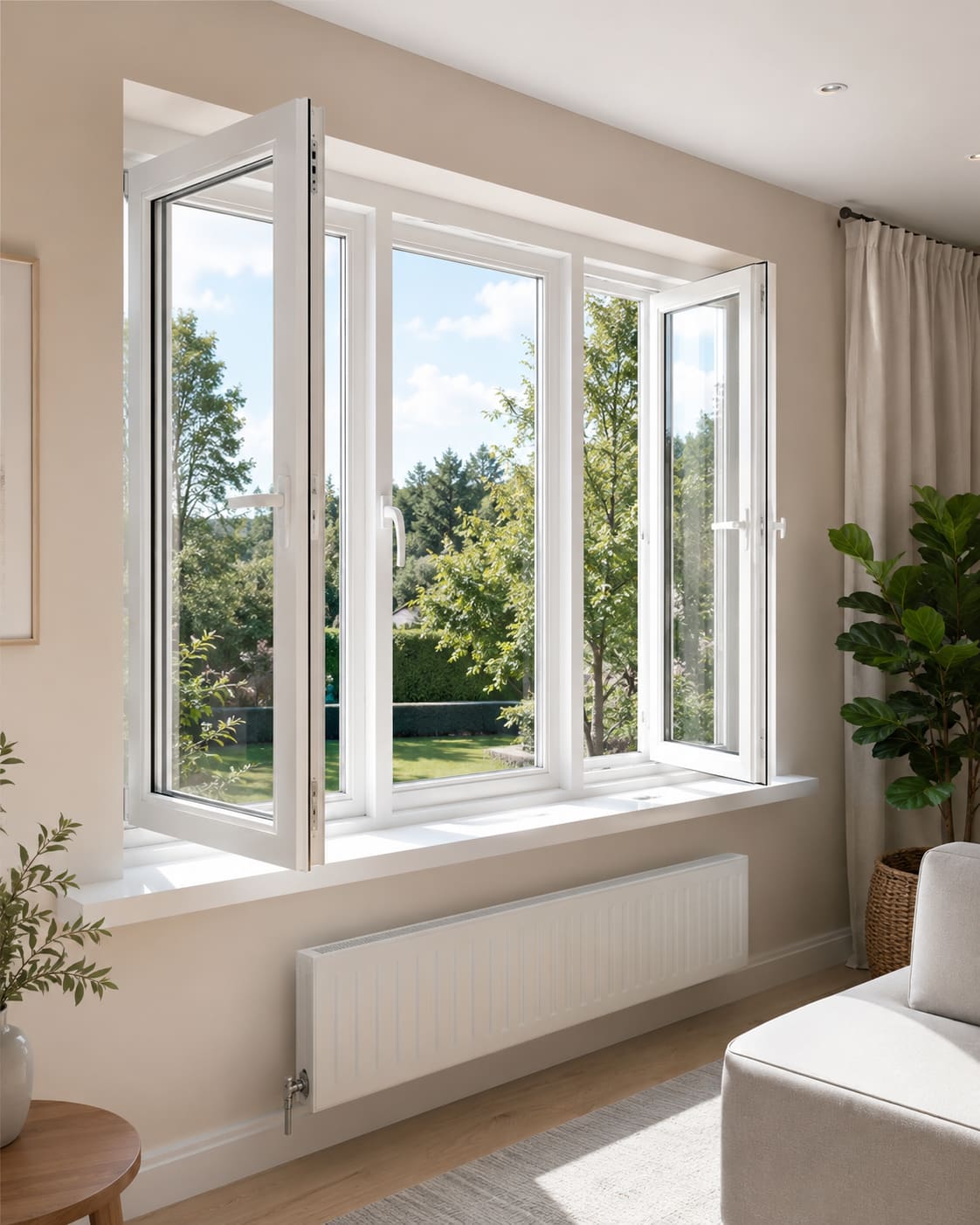
Energy-efficient windows in India are windows engineered to minimise heat transfer between indoors and outdoors, defined chiefly by a low U-value (thermal transmittance, ideally 1.8-3.0 W/m²K) and a low Solar Heat Gain Coefficient (SHGC below 0.40), achieved through insulated double glazing, low-emissivity coatings and thermally broken or uPVC frames. In a predominantly hot country where air-conditioning dominates energy use, these windows reject the solar heat trying to enter a room and hold back the cooled air trying to escape it, directly lowering cooling load and electricity cost.
For cities like Hyderabad and Secunderabad, which face hot-dry summers with temperatures crossing 40°C and intense solar radiation, glazing performance matters far more than winter insulation. The right combination of glass, spacer and frame can slash the cooling energy attributable to windows, improve indoor comfort, and reduce glare and UV fading of interiors. Whether you are building a villa in Kokapet, an office on the Financial District IT corridor, or a showroom in Secunderabad, the underlying physics is identical.
This guide explains the metrics, materials, standards and realistic 2026 INR costs that decide whether a window genuinely saves energy. It also covers the frames and sealing that make a high-performance window actually perform. If you are ready to specify a system, you can explore our energy-efficient uPVC windows or simply get a free quote for your project anywhere across Telangana and Andhra Pradesh.
The Two Numbers That Define an Energy-Efficient Window
The energy performance of any window is governed by two core metrics, and in Indian conditions lower is better for both.
- U-value (U-factor): the rate of heat conducted through the whole window, measured in W/m²K. A single-glazed aluminium window sits around 5.5-6.0 W/m²K; a good IGU in a thermal-break frame reaches 1.8-2.8 W/m²K.
- SHGC (Solar Heat Gain Coefficient): the fraction of solar heat that passes through, from 0 to 1. For hot climates aim for 0.25-0.40; a lower value rejects more heat.
- Visible Light Transmittance (VLT): the share of daylight admitted, typically 0.35-0.70. High VLT with low SHGC is the ideal pairing, delivered by spectrally selective low-E glass.
- Air infiltration: uncontrolled leakage through gaps. Multi-point locking and EPDM gaskets on quality uPVC and thermal-break systems minimise it, which is why sealing hardware directly affects measured thermal performance.
For most Indian residential and commercial projects, prioritise low SHGC first, because solar gain - not conduction - is the dominant cooling load in Hyderabad, Secunderabad and across Telangana. A cheap window quoted only on frame colour and glass thickness, with no U-value or SHGC on paper, is a red flag.
Glazing Explained: Single, Double, Low-E and Argon IGUs
Glazing choice is the single biggest lever on window energy performance, and double-glazed low-E units outperform single glass by a wide margin.
- Single glazing (4-6 mm float): cheapest but poor, with a U-value around 5.7 W/m²K and high heat gain; suitable only for shaded or non-conditioned spaces.
- Double glazing / IGU: two glass panes separated by a 12-16 mm sealed cavity of dry air or argon, cutting heat transfer by roughly 50-60%.
- Low-E coating: a microscopically thin metallic-oxide layer that reflects infrared heat, blocking 40-70% of solar heat gain while keeping rooms bright and naturally lit.
- Reflective and tinted glass: lower SHGC and glare but also cut daylight, so match them carefully to your VLT target.
- Argon fill and warm-edge spacers: further lower the U-value and reduce edge-of-glass condensation.
Toughened (tempered) safety glass to IS 2553 is recommended for large panes, doors and any glazing near floor level, as it is four to five times stronger than annealed glass and fractures into blunt granules rather than shards. For large-span facades, a laminated low-E outer pane adds acoustic and safety benefits with only a modest SHGC penalty - a common upgrade on our recent projects along Hyderabad's busier arterial roads.
Frame Materials: uPVC vs Thermal-Break Aluminium
The frame accounts for 20-30% of a window's area and heat path, so a thermally insulating frame is essential to realise the benefit of good glass.
- uPVC (unplasticised PVC): inherently low thermal conductivity, multi-chambered profiles, excellent insulation and air-tightness, corrosion-proof and low maintenance - a strong choice for humid interiors and coastal Andhra Pradesh sites. See our uPVC window systems.
- Thermal-break aluminium: a polyamide barrier inserted between inner and outer aluminium extrusions interrupts heat conduction, cutting frame heat transfer by 20-30% versus plain aluminium while retaining aluminium's strength and slim sightlines. Explore our thermal-break aluminium windows.
- Plain aluminium: highly conductive and thermally poor on its own; only acceptable when paired with a good IGU in mild or shaded exposures.
- Wood and composite: good insulators but higher cost and maintenance, and uncommon in urban Indian projects.
Both uPVC and thermal-break aluminium deliver the low frame U-values needed to meet modern energy targets. The choice usually comes down to span, wind load and aesthetics: uPVC wins on pure insulation value and price, while thermal-break aluminium wins on large openings, sliding spans and a slim contemporary look. For very tall or wind-exposed openings, aluminium's structural strength often makes it the only practical option.
Sealing and Hardware: What Makes Efficient Windows Perform
The most overlooked factor in window efficiency is the seal: a perfectly specified IGU still leaks energy if the sash does not compress its gaskets evenly. On paper two windows can look identical, yet perform very differently once installed.
- Multi-point locking gear draws the sash tight against EPDM seals at several points, eliminating the pressure gaps that single-point latches leave along the frame.
- Continuous, correctly sized EPDM or TPV gaskets maintain an unbroken air seal around the full perimeter and resist UV hardening in the Telangana sun.
- Smooth, low-friction sliding systems let large glazed panels close fully and consistently, preserving the air seal on big openings.
- Friction stays and controlled hinges limit over-opening, so conditioned air is not wasted during ventilation.
- Self-closing door hardware on glazed entrances ensures doors reseal automatically - a frequent source of AC loss in Hyderabad showrooms and offices.
Specifying branded, precision hardware and demanding a clean, plumb installation is the difference between a window that tests well on paper and one that keeps a 40°C afternoon out of the room for 20 years. Insist that your installer shrink-wraps corners, packs the frame correctly and uses backer rod with quality sealant, not just silicone smeared over gaps.
Indian Standards, Codes and BEE Ratings for Fenestration
Energy-efficient windows in India are governed by a set of national standards that specify structural safety, thermal limits and rating methods. Buying to these is what separates a genuinely efficient window from a decorative one.
- Energy Conservation Building Code (ECBC), from the Bureau of Energy Efficiency (BEE): sets maximum U-factor and SHGC values for fenestration in commercial buildings and defines Window-to-Wall Ratio (WWR) limits.
- National Building Code of India (NBC) 2016: covers glazing design, safety, ventilation and daylighting requirements for buildings.
- BEE Star Rating for windows: a voluntary label rating fenestration products from 1 to 5 stars on thermal performance, letting buyers compare energy efficiency directly.
- IS 2553 (safety glass): specifies requirements for toughened and laminated safety glass.
- IS 875 Part 3: defines wind-load design so large glazed openings and facades stay structurally safe - critical for high-rise projects in Hyderabad's Financial District.
For commercial and institutional buildings, ECBC compliance is increasingly tied to occupancy approvals and green-building certifications such as IGBC and GRIHA, so specifying a rated, documented window pays off well beyond the energy bill. To see how these standards translate into a full envelope, review our services.
Costs and Payback: Real 2026 INR Figures
Energy-efficient windows cost more upfront than plain single-glazed units but pay back through lower cooling bills over a 20-30 year lifespan. The figures below are indicative supply-and-install ranges for the Hyderabad market.
- Plain aluminium single glazed: roughly INR 350-600 per sq ft - lowest cost, lowest performance.
- uPVC double glazed: roughly INR 550-1,200 per sq ft depending on profile chambers, reinforcement and glass.
- Thermal-break aluminium with low-E IGU: roughly INR 900-2,000+ per sq ft for high-performance systems.
- Toughened low-E argon-filled IGU (glass only): typically adds INR 150-350 per sq ft over plain float glass.
- Energy saving: well-specified windows reduce a building's cooling load and AC bills by 10-25%, with typical payback in 5-10 years.
As a worked example, upgrading 400 sq ft of west-facing glazing in a Secunderabad flat from single-glazed aluminium to thermal-break low-E IGU might cost an extra INR 3-5 lakh but shave 15-20% off the cooling season for those rooms - meaningful savings across Telangana's long summers, before counting the comfort and reduced UV fading. To compare precise options for your own home or commercial project, get a free quote.
How to Choose and Specify for Hyderabad's Hot-Dry Climate
For Hyderabad, Secunderabad and the wider Telangana-Andhra Pradesh region, the priorities are clear because cooling - not heating - dominates the year.
- Prioritise low-SHGC (0.25-0.35) low-E double glazing on east and west facades, which take the harshest morning and evening sun.
- Add external shading, overhangs or fins; shading a west window can cut its heat gain more cheaply than upgrading the glass alone.
- Use uPVC or thermal-break aluminium frames to control both solar gain and conductive heat transfer.
- Keep the Window-to-Wall Ratio sensible; more glass means more heat gain unless the glazing is genuinely high-performance.
- Insist on branded gaskets, multi-point locks and precision fittings so the sealed unit performs as tested.
- Always ask for the U-value, SHGC and VLT in writing, plus the glass make-up (for example 6 mm low-E + 12 mm argon + 6 mm), so quotes are comparable.
Match the specification to orientation rather than over-glazing the whole building: a north facade can carry more glass than a west one for the same energy budget. Hakimi Aluminium and Glass supplies and installs energy-efficient uPVC and thermal-break aluminium window systems across Hyderabad and Secunderabad, specified to your building's orientation and budget.
Common Mistakes to Avoid
Even a good product underperforms when the specification or install is wrong. Watch for these frequent errors on Indian projects.
- Buying on glass thickness alone: a thick single pane is not efficient; only U-value and SHGC describe real performance.
- Pairing a great IGU with a plain, non-thermal-break aluminium frame, which conducts heat straight past the glass.
- Ignoring orientation and over-glazing west facades without shading, so the AC fights the afternoon sun all day.
- Skimping on hardware and gaskets, leaving air leaks that quietly erase the glazing benefit.
- Choosing a very low VLT reflective glass and then running lights all day, which cancels the daylighting saving.
- Accepting an install with poor sealing, uneven reveals or missing backer rod, which defeats even the best window on the market. A short site survey before ordering avoids almost all of these - something we handle as standard so your specification and installation match.