Float, toughened and laminated glass differ fundamentally in how they are made and how they behave when broken: float is ordinary annealed glass, toughened (tempered) glass is float glass heat-treated to be 4-5 times stronger and to crumble into harmless granules, and laminated glass is two or more glass plies bonded by a plastic PVB interlayer that holds the pane together on impact. All three usually begin as the same soda-lime float glass; toughening and lamination are secondary processes that upgrade strength and safety. If you remember only one thing from this float vs toughened vs laminated glass comparison, remember this: float is the raw material, toughened is the strong one, and laminated is the one that stays together.
The right choice depends on where the glass is installed, the safety and wind-load demands of the building, and the acoustic or security performance you need. Under the National Building Code of India (NBC) 2016 and IS 2553, human-impact locations such as doors, low-level glazing, staircases, shower screens and facades legally require safety glass, meaning toughened or laminated rather than plain float. For projects across Hyderabad, Secunderabad and the wider Telangana and Andhra Pradesh region, getting this specification right the first time avoids costly rework, breakage and compliance problems at handover.
This guide compares the three glass types across strength, breakage, safety compliance, thickness, acoustics, UV control and real INR cost, and explains exactly where each belongs, from toughened glass fabrication for frameless doors to laminated units for skylights and roadside facades. If you already have a live project, you can get a free quote and our team will size the glass to your exact opening.
Float Glass: The Base Material Behind Everything
Float glass is flat, annealed glass produced by floating molten soda-lime glass over a bath of molten tin, which yields perfectly flat, distortion-free surfaces. It is the raw substrate from which almost all architectural glass, including toughened and laminated, is later manufactured, so understanding it is the foundation of the whole comparison.
- Manufacturing: molten glass is floated on tin in the Pilkington float process, then slowly annealed to relieve internal stress and lock in optical clarity.
- Strength: modest, with tensile and bending strength around 40 MPa, making it the weakest of the three types.
- Breakage: fractures into large, sharp, dangerous shards, which is precisely why it is NOT classified as safety glass.
- Thickness: commonly stocked in 2, 3, 4, 5, 6, 8, 10 and 12 mm, and up to 19 mm for special applications.
- Typical use: interior partitions, mirrors, furniture tops, shelving, picture frames and low-impact glazing.
- Thermal insulation: a single 6 mm float pane has a U-value of roughly 5.7-5.8 W/m2K, offering very little insulation on its own.
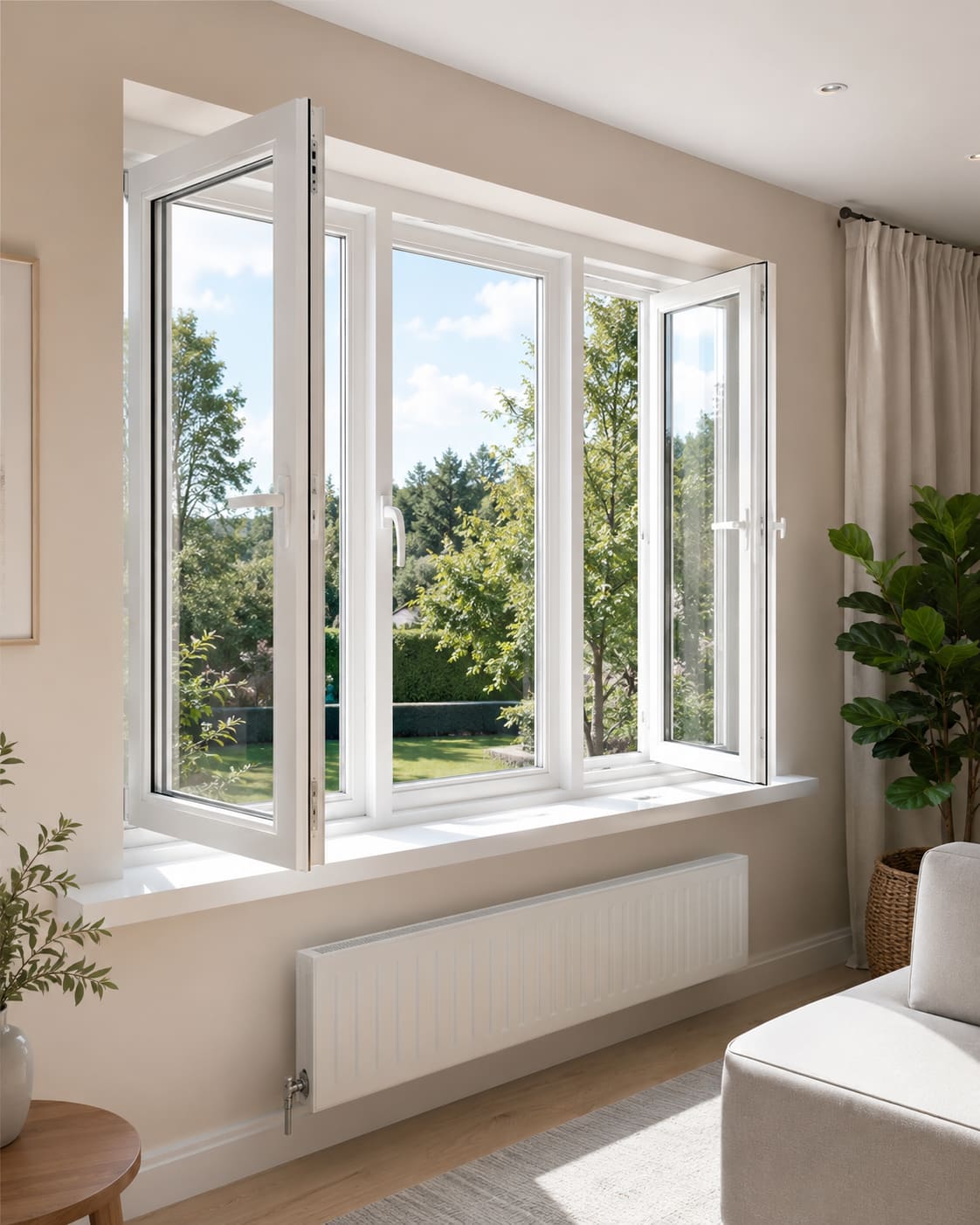
Because float glass is inexpensive and easy to cut, drill and polish on site, it remains the default for decor and non-critical interior work. But the moment human safety, wind load or overhead risk enters the picture, it must be upgraded to a safety glass, and that is where toughened and laminated glass take over.
Toughened (Tempered) Glass: Strength and Safe Breakage
Toughened glass is float glass reheated to about 620-650 C and then rapidly quenched with jets of air, creating a compressed outer skin over a tensioned core that make it 4-5 times stronger than annealed glass of the same thickness. It is a certified safety glass under IS 2553 and is the standard choice for frameless doors, partitions, railings and facades. Our toughened glass work covers exactly these applications, from measurement to final installation.
- Strength: 4-5 times the impact and bending strength of ordinary float, with surface compression commonly 90 MPa or higher.
- Breakage: shatters into small, blunt, cube-like granules that dramatically reduce the risk of serious injury.
- Thermal shock: withstands far larger temperature differentials than float, which matters on the sun-facing elevations common in Hyderabad and Secunderabad.
- Fabrication rule: it cannot be cut, drilled, notched or edge-worked after tempering; every hole and cutout must be finished on the float glass first.
- Spontaneous breakage: a small statistical risk exists from nickel-sulfide (NiS) inclusions, which heat-soak testing to EN 14179 largely mitigates.
- Thickness: typically 4-19 mm, with 10 mm and 12 mm most common for frameless doors, shower screens and balustrades.
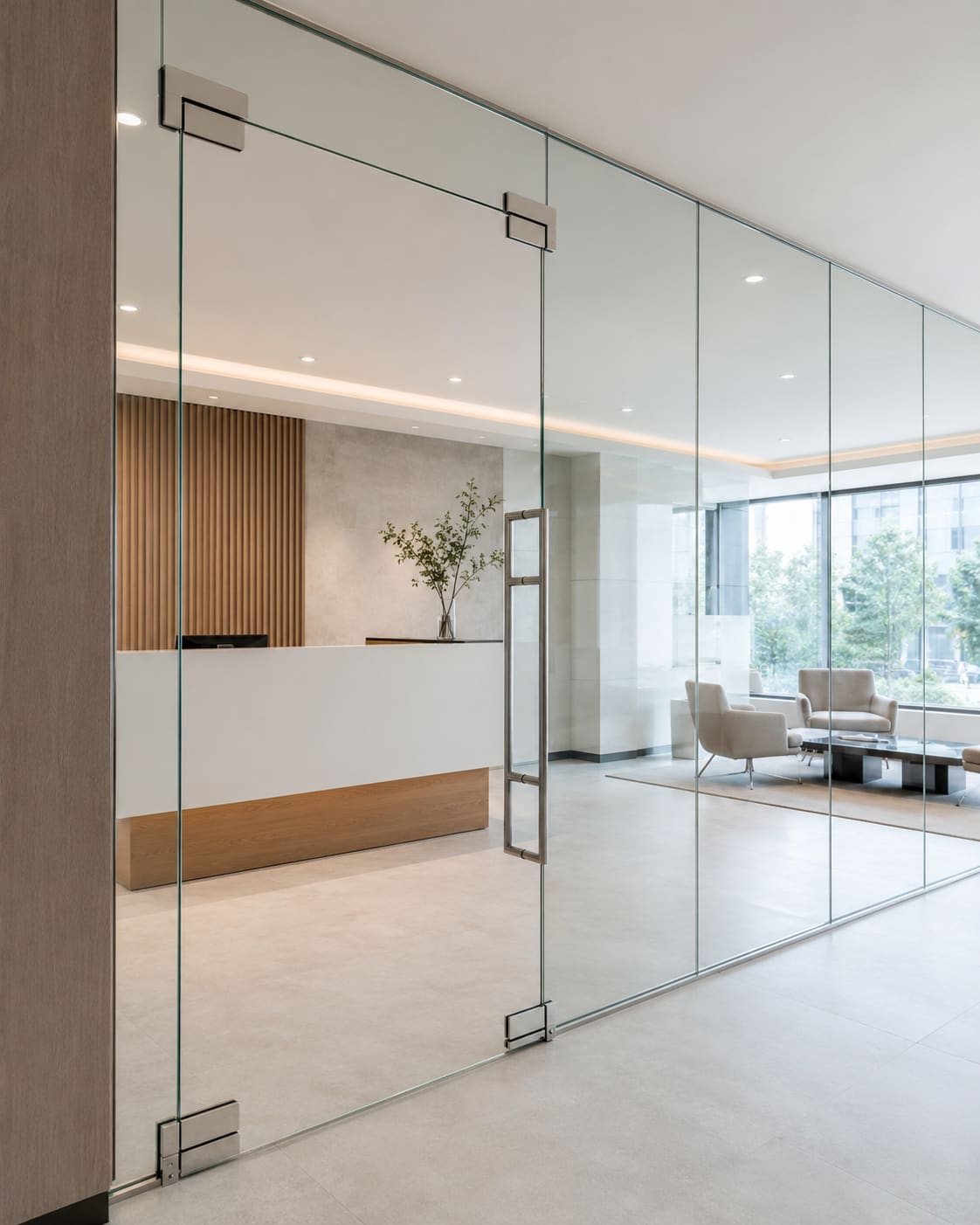
Because it holds nothing together once broken, toughened glass is ideal where strength and clean shattering are wanted but retention is not critical. Frameless glass doors, for example, rely on toughened panels working with floor springs, patch fittings and closers to swing smoothly and self-close under thousands of daily cycles.
Laminated Glass: Retention, Security and Acoustics
Laminated glass consists of two or more glass plies permanently bonded by a polyvinyl butyral (PVB) interlayer, so that when the glass breaks the fragments adhere to the interlayer instead of falling away. It is a safety glass that adds impact retention, forced-entry resistance, UV control and superior sound insulation to any glazing.
- Interlayer: PVB is standard, usually 0.38 mm or 0.76 mm thick; stiffer SGP (SentryGlas) interlayers are used for high-performance and structural work.
- Breakage: it cracks but holds together, maintaining a continuous barrier, which is essential for overhead glazing, skylights, canopies and fall protection.
- Build-up: a 6.38 mm laminate is two glass plies with a 0.38 mm PVB core; 8.38 mm, 10.38 mm and 11.52 mm build-ups are also common.
- UV blocking: the interlayer cuts roughly 99% of ultraviolet radiation, protecting furniture, flooring and merchandise from fading.
- Acoustics: markedly better sound insulation than monolithic glass of the same thickness, valuable near busy roads and flight paths.
- Security: multi-ply laminates resist forced entry and can be specified as bullet-resistant or blast-resistant for banks and secure facilities.
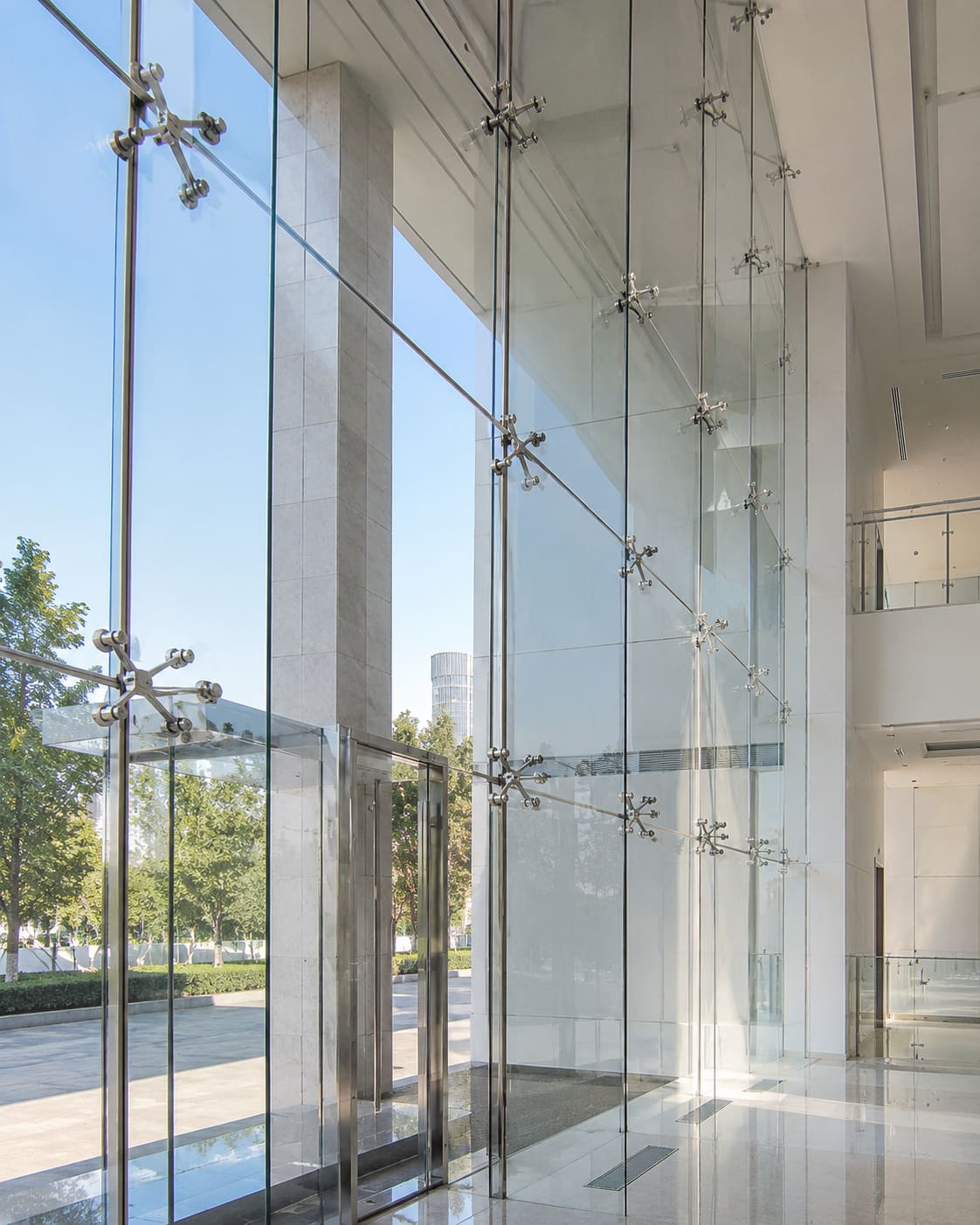
Laminated glass can also be built from toughened plies. This toughened-laminated make-up combines the crumbling strength of tempering with the retention of lamination, and it is the premium choice for structural spider glazing and overhead facades where both performance and safety are non-negotiable.
Side-by-Side: Float vs Toughened vs Laminated
The three types trade off strength, breakage behaviour, acoustics and cost. The summary below assumes the same nominal thickness for a fair comparison.
- Strength: float is weakest (baseline); laminated holds load after cracking; toughened is strongest at 4-5x float.
- Safety classification: float is NOT safety glass; toughened and laminated both qualify under IS 2553.
- On breakage: float breaks into sharp shards; toughened crumbles into blunt granules; laminated cracks but stays intact.
- Acoustics and UV: laminated is clearly best; toughened and float perform similarly and lower.
- Post-processing: float and laminated can be cut and drilled; toughened cannot be altered after tempering.
- Indicative Hyderabad cost: float INR 40-90/sq ft, toughened INR 120-250/sq ft, laminated INR 150-350/sq ft.
- Best fit: float for low-risk interiors; toughened for doors, partitions, showers and facades; laminated for overhead, security and acoustic needs.
In short: if the glass could be hit by a person, choose toughened; if broken glass must not fall or must resist intrusion, choose laminated; if neither risk applies, plain float is the economical option. You can see how these choices play out in real installations across our recent projects.
Cost in Hyderabad and Secunderabad (INR per Sq Ft)
Realistic 2026 Hyderabad market rates place plain float glass at roughly INR 40-90 per sq ft, toughened at INR 120-250 per sq ft, and laminated at INR 150-350 per sq ft, with the spread driven mainly by thickness, coatings and quantity. Treat these as installed-supply guide figures rather than fixed quotes.
- Float 4-6 mm clear: about INR 40-90/sq ft, the cheapest option for interior and decor use.
- Toughened 8-12 mm clear: about INR 120-250/sq ft; 12 mm frameless-door glass sits at the upper end.
- Laminated 6.38-11.52 mm: about INR 150-350/sq ft, rising with thicker plies and premium interlayers.
- Cost drivers: tinting, low-E and reflective coatings, ceramic frit, edge polishing, cutouts and difficult site access all add to the base rate.
- Hardware adds up too: budget separately for patch fittings, floor springs, closers, locks and handles when pricing a complete glass door or partition.
For accurate, opening-by-opening pricing across Telangana and Andhra Pradesh, share your drawings or site dimensions and get a free quote. Glass, fabrication and fittings are best priced together as one package rather than piecemeal, because a saving on glass is easily lost to mismatched or low-grade hardware.
Standards, Codes and Safe Selection in India
Selection is governed by the National Building Code of India (NBC) 2016 and the relevant Bureau of Indian Standards specifications, which mandate safety glass in every human-impact zone. Wind loading on facades is assessed per IS 875 (Part 3), while energy performance follows the Energy Conservation Building Code (ECBC) with BEE star-rated glazing.
- IS 2553: specifies requirements for safety glass, covering both toughened and laminated architectural glass.
- NBC 2016: requires safety glazing at doors, side panels, low-level glazing below 800 mm and all overhead glazing.
- IS 875 (Part 3): the code for design wind loads used to size facade and window glass thickness.
- ECBC / BEE: govern thermal performance; insulated double-glazed units (DGUs) can lower U-values to roughly 1.8-3.0 W/m2K.
- Heat-soak testing (EN 14179): reduces the risk of spontaneous toughened-glass breakage from NiS inclusions and is advisable for large facades.
For Hyderabad's hot, dusty climate, toughened glass resists thermal stress on sun-exposed elevations, while laminated or toughened-laminated units add UV control and acoustic comfort against traffic noise. When in doubt, specify safety glass; the small premium is trivial against the liability of a non-compliant installation.
Where Each Glass Belongs: Application Guide
Matching glass type to location is where the theory becomes practical. The rule of thumb is simple: risk of human impact points to toughened, risk of falling glass or intrusion points to laminated, and neither risk points to economical float.
- Frameless glass doors and partitions: 10-12 mm toughened, paired with patch fittings, floor springs and handles for a clean, minimal look.
- Shower enclosures: 8-10 mm toughened is standard, working with dedicated shower hardware for a watertight, safe result.
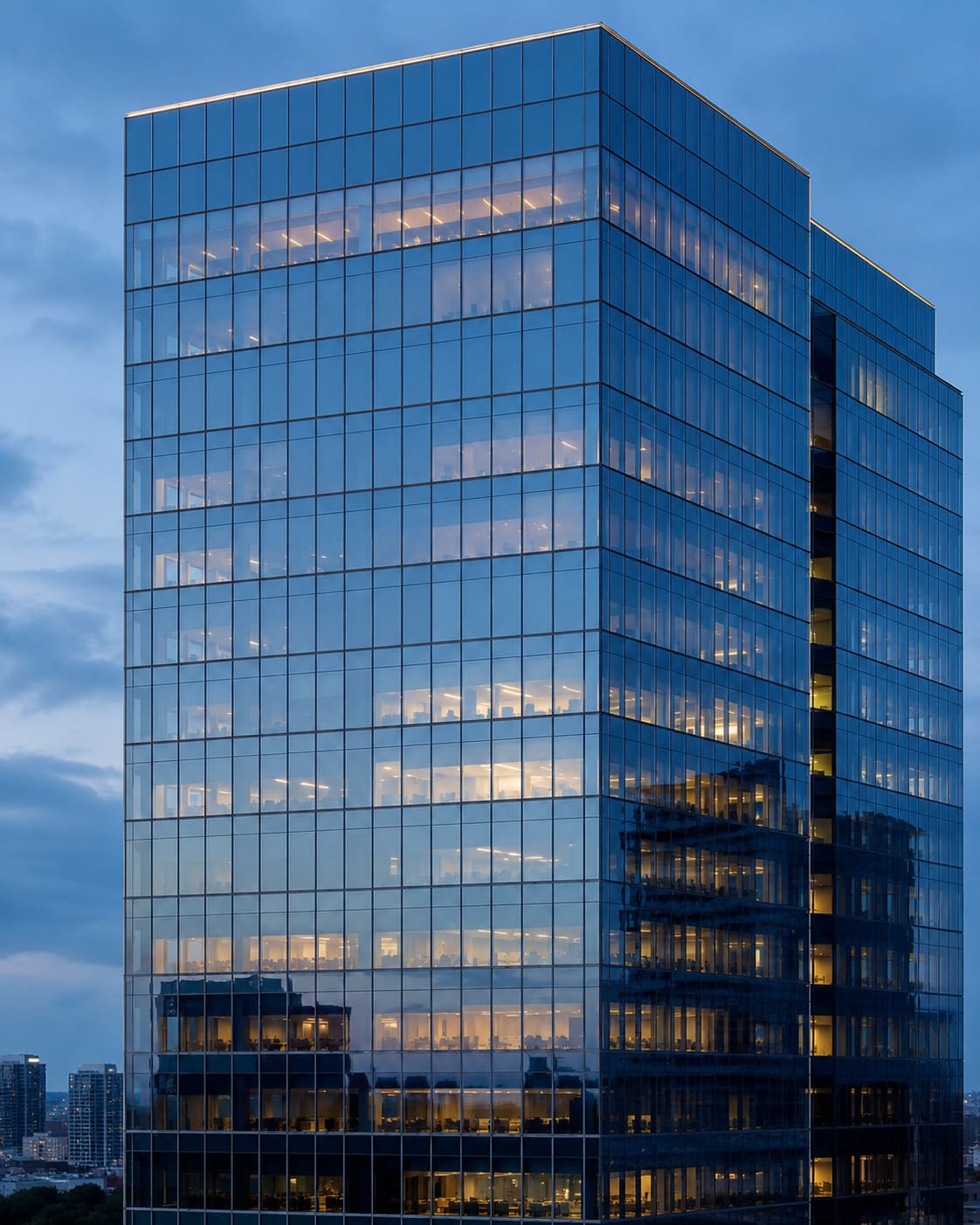
- Facades and structural glazing: toughened or toughened-laminated, engineered to IS 875 wind loads and often supported on spider fittings.
- Skylights, canopies and overhead glazing: laminated or toughened-laminated only, so broken glass is retained and cannot fall.
- Roadside offices, showrooms and studios: laminated for its acoustic and UV benefits, keeping interiors quiet and protected from fading.
- Interior decor, mirrors and furniture: plain float, where impact and safety risks are negligible.
Whatever the application, the glass is only half the system; the fittings carry the loads and deliver the finish. Explore the full range of glass and aluminium solutions across our services, or let us specify the complete assembly so the glass grade, thickness and hardware all match the opening.
Common Mistakes to Avoid When Choosing Glass
Most glass failures on site are specification mistakes, not manufacturing defects. Avoiding a handful of common errors saves money, delay and safety risk.
- Using plain float in impact zones: fitting annealed float at doors or low-level glazing is unsafe and fails NBC 2016 compliance.
- Ordering toughened before finalising cutouts: because it cannot be drilled after tempering, every hinge hole, lock cutout and edge finish must be confirmed first.
- Under-specifying thickness for wind load: tall facade and balcony panels sized by eye rather than to IS 875 can flex, whistle or crack.
- Choosing toughened where retention matters: overhead skylights and canopies need laminated, since toughened granules can still fall as a mass if the pane breaks.
- Skipping heat-soak testing on large facades: large toughened elevations without heat-soaking carry a real, if small, risk of spontaneous NiS breakage.
- Buying glass and hardware separately from different vendors: mismatched fittings are the most common cause of sagging doors and warranty disputes.
A quick specification review before ordering catches nearly all of these. If you are unsure whether an opening needs toughened, laminated or plain float, send us the drawing and we will flag any compliance or load issue before a single sheet is cut.
How Hakimi Aluminium and Glass Can Help
Hakimi Aluminium and Glass supplies, fabricates and installs float, toughened and laminated glass across Hyderabad, Secunderabad and the surrounding Telangana and Andhra Pradesh region, and we also deal in genuine Taiton, Enox and Ozone hardware to complete every job. That means one accountable partner for the glass, the fabrication and the fittings.
- End-to-end delivery: measurement, glass processing, safety-glass certification and installation handled in-house.
- Right-first-time specification: we size glass to IS 875 wind loads and select toughened or laminated to suit each opening.
- Quality hardware: authentic Taiton, Enox and Ozone patch fittings, floor springs, closers, locks and handles.
- Complete systems: from toughened glass work to bespoke glass door assemblies, the glass and hardware are matched as one package.
- Transparent pricing: share your drawings and get a free quote for an itemised, opening-by-opening estimate.
Whether you are glazing a single shower screen or a full commercial facade, the correct choice between float, toughened and laminated glass keeps your project safe, compliant and cost-effective, and we are happy to guide that decision from concept to handover.