A glass railing in Hyderabad typically costs between INR 750 and INR 3,800 per running foot, and the single biggest decision that drives that price is the system family you choose - framed, spigot or frameless. This glass railing buying guide exists so you can buy once and buy right: pick the correct system, the correct glass grade and safety-compliant hardware for your staircase, balcony or terrace before you ever commit to a quote. A wrong specification is not just a cosmetic disappointment - it is unsafe and expensive to unwind.
A glass railing transforms a space. It opens up sightlines, floods rooms with daylight and adds a clean, premium finish that painted MS grills simply cannot match. But no two systems are equal, and the cheapest headline number in a quote very often hides thinner glass, lower-grade steel or an anchoring shortcut you will only discover when the railing starts to move. Knowing what separates a good specification from a cheap one is the whole point of this guide.
At Hakimi Aluminium and Glass we design and install glass railings across Hyderabad, Secunderabad and the wider Telangana and Andhra Pradesh region - from high-rise balcony glazing in Gachibowli and Kondapur to sweeping villa staircases in Jubilee Hills and Banjara Hills. The sections below break down the three railing families, the glass grades that keep people safe, the hardware that survives Indian weather, realistic 2026 pricing and the questions that expose a weak quote. If you would rather skip the theory, you can get a free quote and we will size everything after a site visit.
What a glass railing actually is - and why the system matters most
A glass railing (also called a glass balustrade or glass balcony) is a safety barrier made from thick tempered glass panels held in place by metal channels, posts or clamps, instead of the vertical bars of a traditional grill. It does the same job as an MS railing - stopping people and objects from falling over an edge - but does it while staying almost invisible, so you keep the view and the light.
The confusion most buyers run into is that every quote uses the words 'glass railing', yet two quotes at very different prices can be describing completely different products. The difference is the system family, and understanding it up front is the fastest way to compare apples with apples rather than apples with a cheaper, thinner apple.
Three factors decide which system is right for you: the fall risk on the far side of the railing, the wind exposure of the location, and the look you want. A sheltered indoor staircase and a 15th-floor balcony facing open sky are two very different engineering problems, even if the finished glass looks identical. That is why we always recommend a site assessment before locking a specification - you can see the range of installs we have delivered in our recent projects.
The three main glass railing systems compared
There are three families of glass railing, and the one you pick drives both cost and appearance more than any other single decision. Learning them now saves a great deal of confusion later when competing quotes look similar on paper but are built very differently underneath.
- Framed / capped systems: the glass sits inside a top and bottom aluminium or steel channel. This is the most economical and forgiving option and carries the most structural margin, which makes it ideal for windy, high-floor balconies where you want extra reassurance rather than the last word in minimalism.
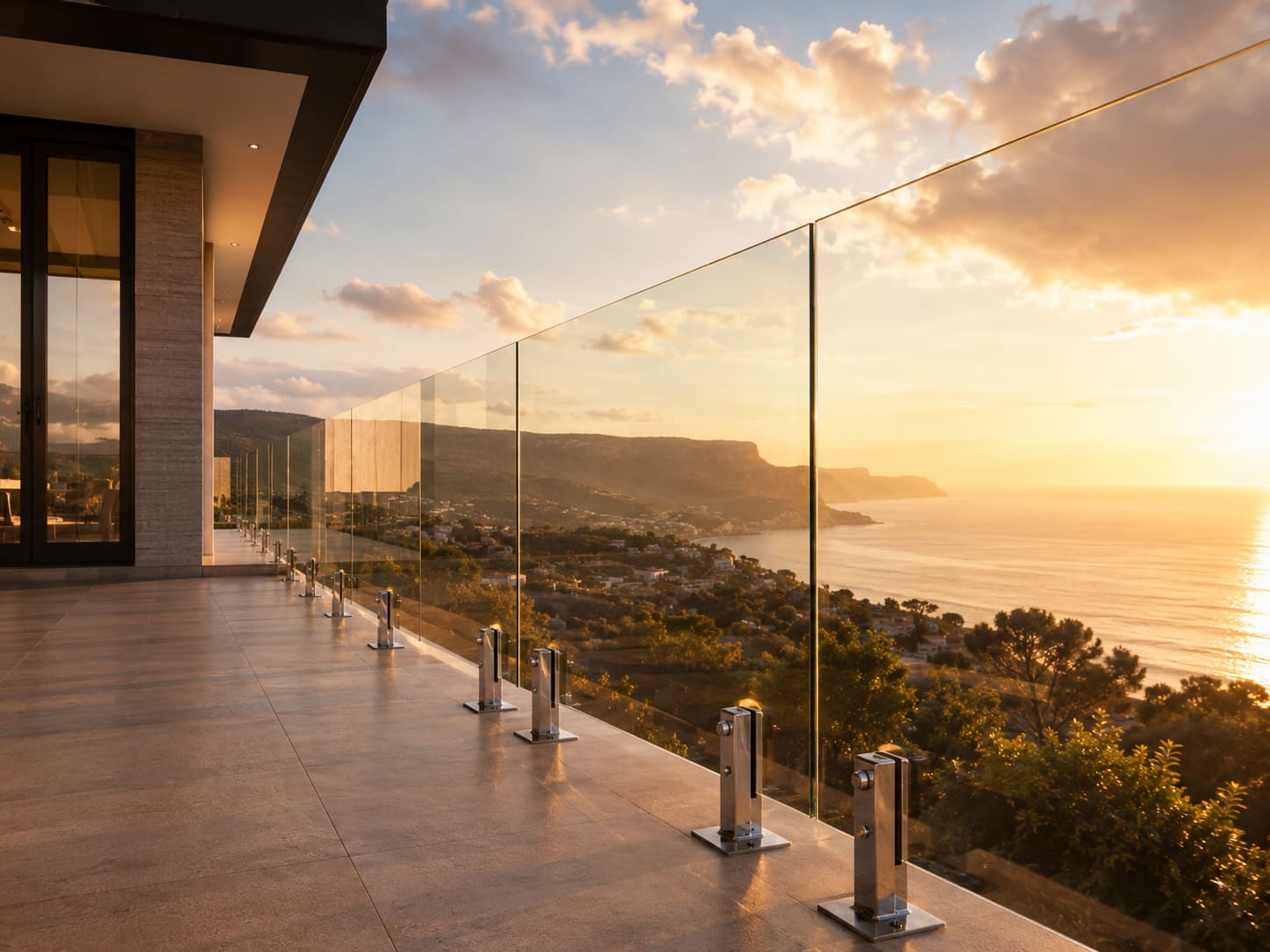
- Spigot / standoff systems: the glass is bolted to the floor slab or fascia edge with polished stainless spigots or standoff pins, leaving the vertical edges open. This gives a clean semi-frameless look that is very popular for terraces, pool decks and villa gardens across Hyderabad and Secunderabad.
- Frameless clamped and base-shoe systems: the glass is held by discreet clamps or a continuous aluminium base channel with no top rail at all. This is the most premium, minimalist look - and also the most demanding on glass thickness, fixing quality and slab preparation.
A useful rule of thumb: the fewer visible fixings a system has, the thicker and stronger the glass has to be to carry the load safely. Minimalism is not free - it is paid for in glass thickness and engineering. If you want the railing to visually continue a run of full-height balcony glazing, the two systems should be designed together so lines and reveals align.
Glass grade, thickness and the safety that matters
Safety is non-negotiable on any railing people will lean against, sit near or potentially fall against. For Indian conditions we specify toughened (tempered) glass as an absolute minimum, and toughened-laminated glass wherever there is a genuine fall risk on the far side - a balcony, a mezzanine, a terrace edge or any staircase above ground level.
Toughened glass is heat-treated so it is four to five times stronger than ordinary annealed glass and, if it ever does break, it shatters into small blunt granules rather than long dangerous shards. Toughened-laminated glass goes a step further: two toughened panes are bonded with a PVB (polyvinyl butyral) interlayer, so if a pane is cracked by impact the interlayer holds the fragments together and the barrier does not collapse into an open, unguarded edge. This is the responsible, code-aligned choice for balconies in high-rise apartments across the ORR growth corridors.
- Typical thickness: 12mm toughened for framed or short-span systems; 13.52mm or 17.52mm toughened-laminated for frameless and taller panels.
- Railing height: aim for 1.0m to 1.2m for balconies and terraces, in line with common building and municipal norms across Telangana and Andhra Pradesh.
- Always insist on genuine toughened glass carrying a visible manufacturer stamp in a bottom corner - annealed or unbranded glass is dangerous, non-compliant and a false economy no honest installer will fit.
- For staircases and balconies used by young children, keep any gap below the glass and any base rail under 100mm so a small head cannot pass through.
Hardware, corrosion resistance and finish
Hyderabad's climate is relatively dry, but monsoon exposure, terrace weathering and the salt-laden air of coastal Andhra Pradesh make hardware quality genuinely critical. Cheap fittings pit and rust within a year or two, streak the glass with brown stains and, worst of all, weaken the very fixing that is holding the barrier up. The metal is not a cosmetic detail - it is structural.
- Choose SS 316 grade stainless steel spigots, clamps and standoffs for all outdoor, terrace and coastal use; the added molybdenum in SS 316 sharply improves corrosion resistance.
- SS 304 is acceptable only for protected indoor staircases where it will never see monsoon moisture or salt air.
- For aluminium base-shoe systems, insist on a proper powder-coated or anodised finish rather than raw mill finish, which chalks and oxidises outdoors.
- Handrails are optional on frameless systems but add a comfortable grip and protect the exposed top glass edge - a slim round or D-section aluminium cap is the common choice.
The point fixings, clamps and standoffs matter as much as the glass itself, so we specify trusted architectural hardware rather than generic imports. When a railing meets a glass gate or door, matching the handle and lock hardware keeps the whole run visually consistent - something our team plans as part of the glass railing scope rather than as an afterthought.
Fixing, slab preparation and structural anchoring
A glass railing is only as strong as what it is bolted into. The most common cause of a wobbly or failed railing is not the glass at all - it is poor anchoring into a slab that was never prepared for the load. This is the part of the job that is invisible in the finished product and where cheap installs quietly cut corners.
- Spigots and base shoes must anchor into sound structural concrete, not into thin screed or a brittle tile bed. Adequate embedment depth and chemical or expansion anchors sized to the wind load are essential.
- On tiled terraces, the fixing should reach through to the slab; packing a spigot into tile alone is a recipe for movement within months.
- Frameless base-shoe systems apply a continuous bending load to the slab edge, so slab reinforcement and the edge condition should be checked before you commit to that look.
- Corner joints, curved runs and gate openings need careful setting-out - these are where leaks and cracks tend to appear later if the geometry is rushed.
If your project involves a glass entrance or shopfront beside the railing, the anchoring should be coordinated so railing, door and facade share a single engineered load path rather than fighting each other. Browse our services to see how the railing, glazing and fabrication scopes fit together on a typical build.
Indicative glass railing pricing in Hyderabad and Telangana
Glass railing is usually quoted per running foot, inclusive of glass, hardware and installation. Prices vary with glass thickness, hardware grade, floor height and site access, but these ranges are realistic for the Hyderabad, Secunderabad and wider Telangana market in 2026:
- Framed / capped toughened railing: around INR 750 to INR 1,200 per running foot.
- Spigot / standoff systems in SS 304: around INR 1,300 to INR 2,200 per running foot.
- Spigot / standoff systems in SS 316 with laminated glass: around INR 1,800 to INR 2,800 per running foot.
- Frameless clamped or base-shoe with laminated glass and SS 316: around INR 2,200 to INR 3,800 per running foot.
- Add-ons: a continuous aluminium handrail cap typically adds INR 250 to INR 500 per running foot; curved runs and glass-to-glass corner details cost more than straight runs, and upper-floor material lifting can add a small premium.
Always get a site measurement before committing - corners, curved runs, gate cut-outs and floor height all move the final figure. A trustworthy written quote should itemise glass grade (toughened vs laminated), exact thickness, hardware grade (SS 304 vs SS 316) and finished railing height, so you are comparing like with like rather than a low headline number hiding thinner glass. When you get a free quote from us, every one of those line items is spelled out.
How to choose the right system for your site
Matching the system to the setting is where experience pays off. The same railing that looks perfect on a sheltered indoor stair can be the wrong call on a high-floor balcony facing open wind. Use these pairings as a starting point for your own site:
- High-rise apartment balconies (Gachibowli, Kokapet, Financial District): framed or spigot systems in toughened-laminated glass, SS 316 hardware, 1.1m to 1.2m high - the extra structural margin handles gusting wind loads.
- Villa and duplex staircases (Jubilee Hills, Banjara Hills, Kompally): frameless clamped or base-shoe systems for a clean, gallery-like interior; SS 304 is acceptable indoors.
- Terraces, pool decks and garden edges: spigot standoff systems in SS 316 with laminated glass, so a broken pane still guards the edge.
- Commercial lobbies and mezzanines (Secunderabad, HITEC City): base-shoe frameless with a slim handrail cap for a premium, low-maintenance finish that reads well in a corporate setting.
If you are unsure which family suits your site, wind exposure and budget, the fastest route is to send photos and dimensions when you get a free quote - though sending one enquiry is enough, so pick the moment that suits you. A short site visit resolves most of these questions in one conversation.
Common mistakes to avoid when buying glass railing
Most glass railing regret traces back to a small handful of avoidable errors. Watching for these will protect both your budget and your safety.
- Chasing the lowest quote without checking specification: a price that looks 20% cheaper usually means thinner glass, SS 304 in place of SS 316, or annealed glass in place of toughened. You are not comparing the same product.
- Skipping laminated glass where there is a real fall risk: plain toughened glass can still break, and without a PVB interlayer a broken pane leaves an open edge.
- Ignoring the anchoring: a beautiful glass panel bolted into tile instead of slab will loosen within a season.
- Forgetting the child-safety gap: leaving more than 100mm below the glass defeats the point of the barrier for small children.
- No written spec sheet: if the quote does not name glass grade, thickness, hardware grade and height, you have nothing to hold the installer to.
Getting these right the first time is far cheaper than a re-do. The well-specified railing is the one you forget about; the cheap one is the one you replace.
Maintenance, cleaning and expected lifespan
One quiet advantage of glass railing is how little it asks of you once it is installed correctly. There is no annual repainting as with MS grills and no rust bleeding onto your floor - provided the hardware grade was right in the first place.
- Clean the glass with a soft cloth and a mild glass cleaner every few weeks; avoid abrasive scourers that scratch the surface.
- Wipe down stainless fittings occasionally, especially on coastal Andhra Pradesh sites, to remove salt film before it can etch the finish.
- Check clamp and spigot tightness once a year and re-torque if needed - a five-minute job that prevents any developing movement.
- Inspect the sealant line where base shoes meet the slab and re-seal if you see any gap, to keep water out of the fixing.
Specified and installed properly, a quality toughened-laminated railing with SS 316 hardware should give 15 to 20 years of service with only routine cleaning. That longevity is exactly why cutting corners on glass grade or hardware to save a few hundred rupees per foot rarely pays off in the long run.