The best glass railing design ideas for a modern home combine frameless toughened panels, a slim handrail and hidden LED lighting to create a safe barrier that still lets light and views flow freely between floors. If you want your home to feel bigger, brighter and unmistakably contemporary, few upgrades deliver as much as glass. The right design turns an ordinary staircase or balcony into the visual centrepiece of the house, replacing bulky metal grills with an almost invisible boundary that never blocks a view or a sightline.
Across Hyderabad, Secunderabad and fast-growing corridors like Gachibowli, Kokapet, Tellapur and the Financial District, glass balustrades have quietly become the default choice for premium villas, duplexes and high-rise apartments. As specialists in glass railing systems and staircase glass railings, we design, fabricate and install these across Telangana and Andhra Pradesh, choosing hardware and glass grades that survive the region's punishing summer heat and monsoon humidity.
But glass railings are not one-size-fits-all. The system you pick, frameless, standoff, base-channel or post-and-glass, changes the look, the safety rating and the cost dramatically. This guide walks through the design ideas that genuinely work in Indian homes, the glass and hardware specs to insist on, honest indicative pricing in INR, the installation process, and the common mistakes that lead to rusted fittings and rattling panels within a single monsoon.
What is a glass railing, and why choose one?
A glass railing (also called a glass balustrade) is a safety barrier for a staircase, balcony, terrace or mezzanine that uses toughened glass panels in place of, or alongside, traditional metal grills. The glass provides the fall protection required by building norms while staying visually transparent, so light travels between floors and views stay uninterrupted.
Homeowners choose glass for four practical reasons. It makes compact Indian flats feel noticeably larger and brighter by removing visual clutter. It is far easier to clean than an intricate grill, needing only a wipe with a soft cloth. It resists corrosion when paired with the right stainless hardware. And it adds clear resale appeal, reading as a premium, contemporary finish that buyers in Hyderabad's gated communities have come to expect.
The trade-off is that glass shows fingerprints and dust more readily than powder-coated steel, and a quality installation costs more upfront than a basic grill. For most modern homes, though, the openness and the resale lift more than justify it. If you are weighing options, browse our recent projects to see how frameless and channel systems look in real Telangana homes before you commit to a style.
Popular glass railing design ideas that suit Indian homes
The design starts with how the glass is held. Each mounting style has its own personality, cost and hardware footprint, so match it to your space and to how much visible metal you can live with.
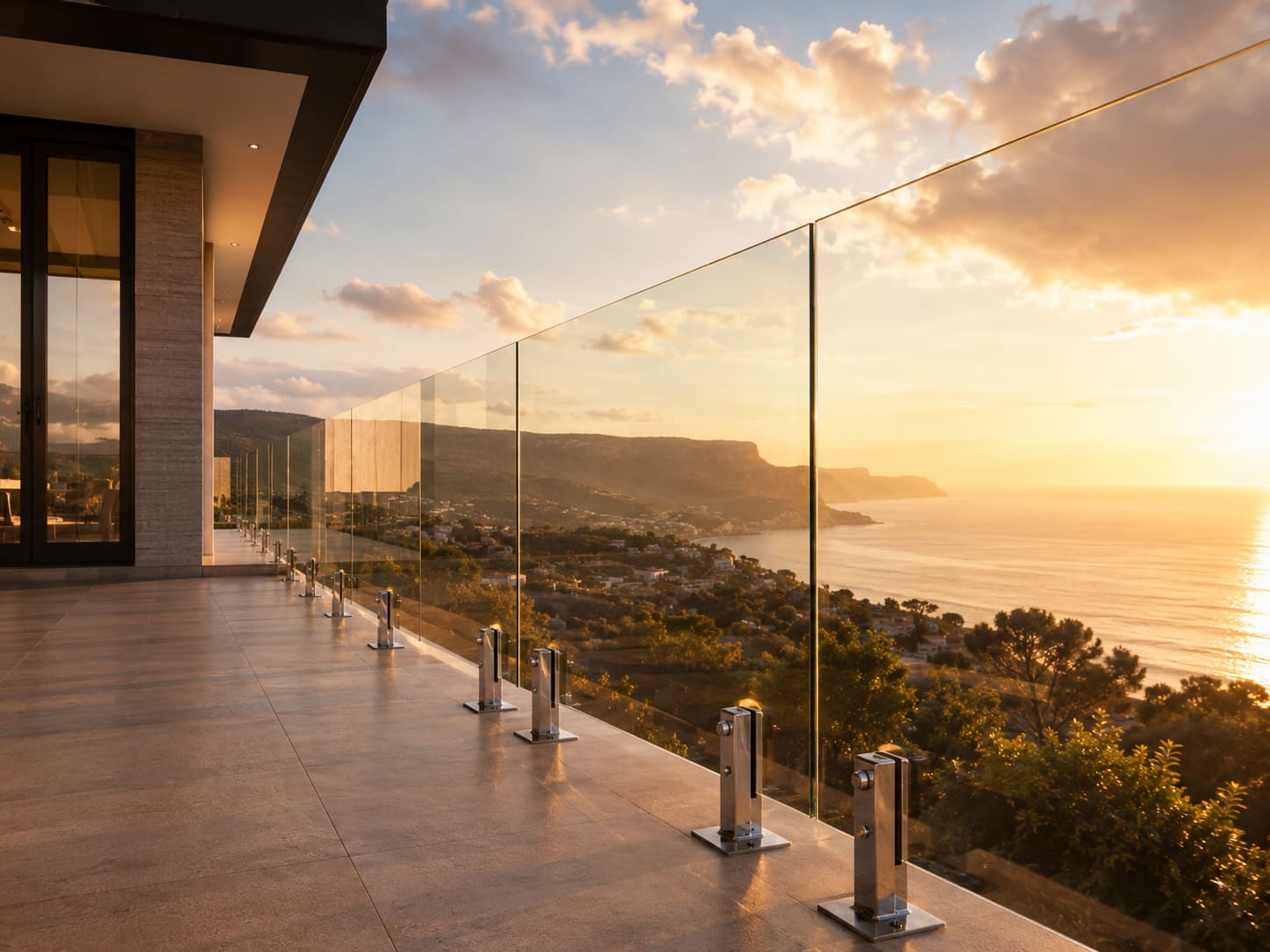
- Frameless glass railing: Panels held only by a slim base channel or discreet floor spigots, giving an almost invisible barrier. Ideal for balconies with a view and open-plan staircases where you want the glass to disappear.
- Standoff (button-fixed) railing: Toughened panels bolted to a wall face or floor edge with polished steel standoffs. A clean, architectural look that is popular in duplex villas and split-level homes.
- Base channel system: Glass slotted into an aluminium U-channel along the floor, structurally strong, easy to clean and quick to align, a favourite for balcony parapets and terraces.
- Post-and-glass railing: Stainless steel or aluminium posts with glass infill, the most budget-friendly and forgiving option for long runs and irregular layouts.
- Handrail-capped glass: Any of the above topped with a teak, brass or steel handrail for grip and a warmer, tactile finish.
For most homes we recommend deciding one thing first: do you want the glass to disappear (frameless or standoff) or to read as a deliberate design line (post-and-glass with a contrasting handrail)? That single decision drives everything else, from glass thickness to the hardware budget. If you are unsure, our glass railing service team can mock up both options against your floor plan.
Staircase glass railing ideas that make a statement
A glass staircase railing is where design pays off most, because the stair is seen from every angle, from the entrance, the living room and each landing. Pairing frameless glass with a slim wooden handrail softens the modern look and adds grip, which matters in homes with elderly parents or young children. Explore our full range of staircase glass railing options for tread-fixed, side-mounted and stringer-fixed layouts.
The mounting detail is what makes a stair railing feel bespoke rather than off-the-shelf. Tread-fixed spigots let the glass rise cleanly with each step, while a continuous side channel gives a crisp, unbroken diagonal line that architects love in double-height foyers.
- Add integrated LED strips along the base channel for a floating, backlit effect at night, especially striking on a curved or cantilevered floating staircase.
- Mix glass with a mild-steel, brass or teak handrail to tie the railing into the home's overall material palette.
- Use tread-mounted stainless spigots to keep the floor line clean and make daily sweeping easier.
- For mezzanines and pooja-room lofts, clear frameless panels keep sightlines open while still meeting the safe fall height.
- Choose ultra-clear low-iron glass on feature staircases so the glass reads as genuinely colourless rather than pale green at the edges.
Balcony and parapet glass railing ideas for apartments and villas
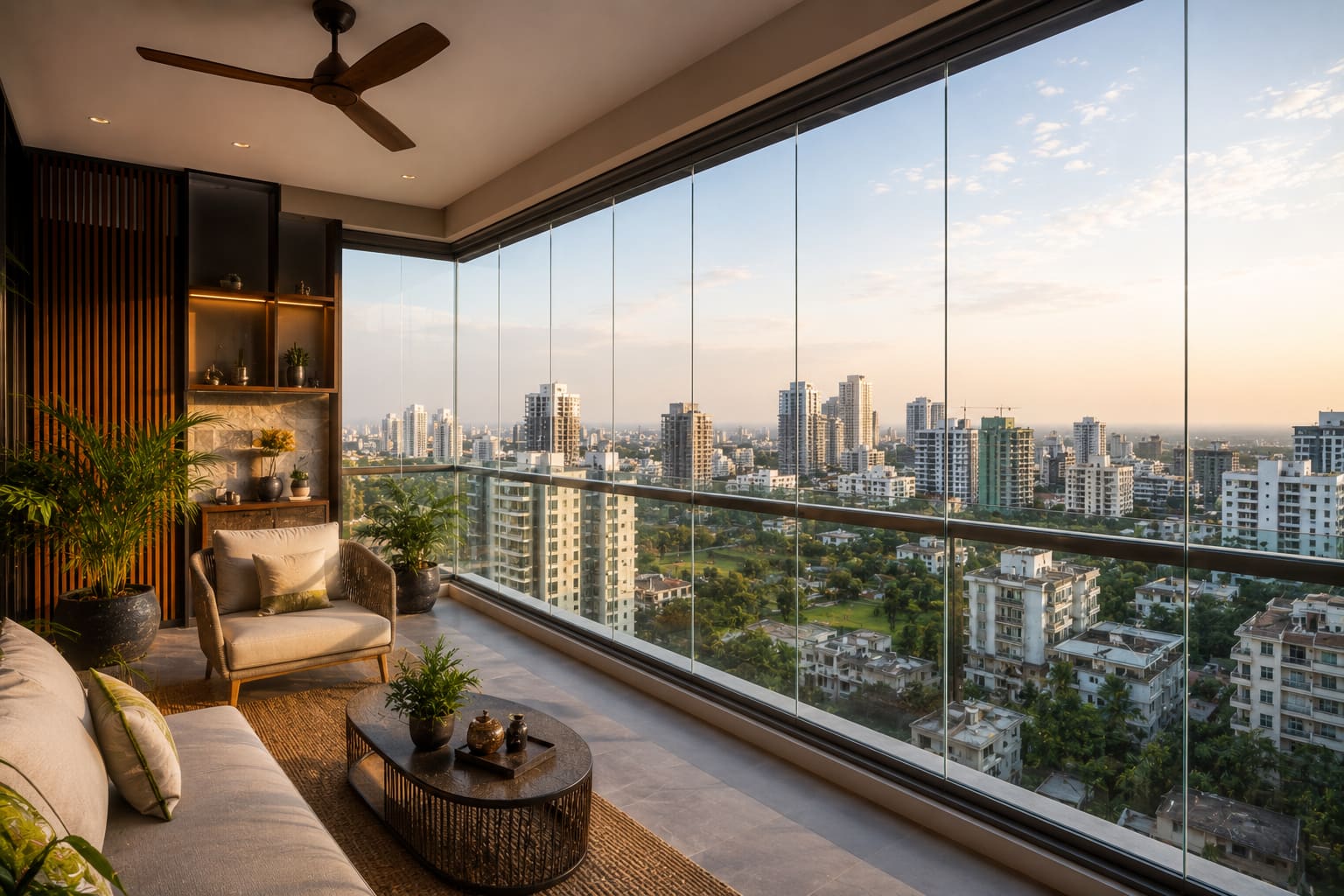
For balconies, low-iron (extra-clear) glass keeps views crisp without the green tint of standard float glass, well worth it for apartments overlooking the Hussain Sagar skyline or open layouts in Kokapet, Tellapur and Financial District high-rises. A balcony railing has to balance the view, wind loads and privacy, so its design often differs from an indoor staircase.
- Use frosted, fluted or ceramic-fritted glass on ground-floor and street-facing balconies where privacy matters more than the view.
- Specify a robust base channel or 316-grade spigots for exposed high-rise balconies that catch strong wind and driving monsoon rain.
- Consider a slim top handrail on tall buildings; it adds rigidity and reassurance even on an otherwise frameless system.
- For terrace gardens and pool decks, laminated toughened glass acts as a wind-break and pet barrier without blocking the horizon.
If your balcony doubles as a sit-out, coordinate the railing with a matching aluminium sliding system or a fixed glass screen so the whole elevation reads as one clean design rather than a patchwork of finishes. You can see how we combine railings with wider glazing across our services.
Materials, safety and the right glass thickness
Never use ordinary annealed glass for a railing. Always specify toughened (tempered) glass, which is roughly four to five times stronger and, if it ever breaks, crumbles into small blunt granules instead of dangerous shards. This single specification is the most important safety decision you will make.
For staircases and high balconies, laminated toughened glass, two toughened panes bonded with a PVB interlayer, is the gold standard. Even if both panes crack, the interlayer holds the panel together so nobody falls through, which is exactly what you want anywhere a fall would be serious.
- Standard toughened panels: 10mm to 12mm for most supported home railings.
- Frameless and long unsupported spans: 15mm toughened, or laminated for added security.
- Hardware: 304-grade stainless steel indoors, 316-grade for open balconies exposed to Hyderabad's monsoon and coastal Andhra Pradesh humidity.
- Railing height: at least 900mm, ideally 1000mm to 1100mm, to meet common residential safety norms and deter climbing.
- Edges: insist on polished or ground edges and heat-soaked glass to minimise the rare risk of spontaneous breakage in tempered panels.
Quality hardware matters as much as the glass itself. Branded clamps, spigots and standoffs in genuine stainless steel resist corrosion and keep their finish for years rather than pitting after one monsoon, a difference you will notice within twelve months on an exposed balcony.
How to choose the right glass railing for your home
With so many combinations, a simple decision path keeps the choice manageable. Work through location, safety, look and budget in that order and the right system usually becomes obvious.
- Start with location. Indoor stair or covered balcony? 304 stainless and 12mm toughened is plenty. Open, wind-exposed high-rise balcony? Step up to 316 stainless and consider laminated glass.
- Weigh the safety load. Homes with toddlers or elderly members should lean toward laminated glass and a graspable handrail, even where a frameless look is technically possible.
- Decide the look. Choose frameless or standoff if you want the glass to vanish; choose base-channel or post-and-glass if clean alignment, long runs and lower cost matter more.
- Set the finish. Standard toughened is fine for most rooms; upgrade to low-iron glass only on feature staircases and prime view balconies where the green tint would show.
- Match the budget. Post-and-glass keeps costs down for large areas, while frameless spigot systems are best reserved for the spaces guests actually see.
When you have a shortlist, get a free quote with rough dimensions and we will confirm the exact glass thickness, hardware grade and system that suits your site and budget.
Indicative glass railing prices in Hyderabad, Secunderabad and Telangana
Pricing depends on glass thickness, mounting system and hardware grade, but these ranges reflect typical rates across Hyderabad, Secunderabad and the wider Telangana and Andhra Pradesh market. Treat them as a planning guide; a firm quote always needs a site measurement.
- Post-and-glass railing (12mm toughened): approximately INR 550 to 850 per sq. ft.
- Base channel / standoff systems: approximately INR 900 to 1,400 per sq. ft.
- Frameless spigot railing (12mm to 15mm): approximately INR 1,400 to 2,200 per sq. ft.
- Low-iron (extra-clear) glass upgrade: add roughly 15% to 25% over standard toughened glass.
- Wooden or steel handrail: approximately INR 350 to 900 per running foot.
- Integrated LED lighting: approximately INR 250 to 600 per running foot including driver and profile.
As a rough guide, a standard 10-foot balcony railing usually lands between INR 20,000 and INR 45,000 depending on the system. A full staircase in frameless 15mm glass with a teak handrail can run from around INR 90,000 upward for a typical duplex. Laminated glass, longer spans and premium 316-grade hardware push the number higher, while a simple post-and-glass run for a large terrace keeps it low.
Installation process and timeline
A glass railing is only as good as its installation, because the glass carries real load and genuine safety responsibility. Professional fixing with correctly torqued hardware and structural anchors into slab or beam is essential; this is not a DIY job. Here is how a typical project runs with our team across the twin cities.
- Site survey and measurement (Day 1): We record exact dimensions, check the fixing substrate and confirm the glass type, height and hardware for your space.
- Quotation and approval (Days 2 to 3): You receive a per-square-foot rate and a fixed scope; glass is ordered only after sign-off.
- Toughening and fabrication (about 1 to 2 weeks): Glass is cut, edge-polished, toughened and, if specified, laminated or heat-soaked. Toughened glass cannot be trimmed on site, so measurements must be exact.
- Installation (1 to 3 days on site): Channels or spigots are anchored, panels are set plumb, handrails fitted and LEDs wired. A typical staircase or two-balcony job finishes within a couple of days.
- Handover: Protective film comes off last, fittings are checked for tightness and you get care guidance.
Most residential railings are complete within two to three weeks from approval, with the toughening lead time being the main variable. See finished installs in our recent projects to set your expectations.
Maintenance and common mistakes to avoid
Glass railings are low-maintenance, but a few simple habits keep them looking and performing like new for a decade or more.
- Clean with a soft microfibre cloth and mild glass cleaner; avoid abrasive pads that dull the surface or scratch the hardware.
- Leave the protective film on until surrounding civil work is finished, to avoid scratches during handover.
- Check clamp, spigot and standoff tightness once a year, especially on exposed balconies in windy high-rise locations.
- Rinse coastal and dusty-site hardware occasionally to stop grime baking onto the finish in the summer heat.
The most common mistakes we are called to fix are under-specified glass thickness, cheap non-stainless hardware that rusts within a single monsoon, railings set below the safe 900mm height, and panels anchored into tile or screed instead of concrete or a reinforced steel base. Each of these is avoidable at the design stage. Spending a little more on the right glass grade, genuine stainless fittings and professional fixing almost always costs less than redoing the job a year later, and it keeps your family safe in the meantime.