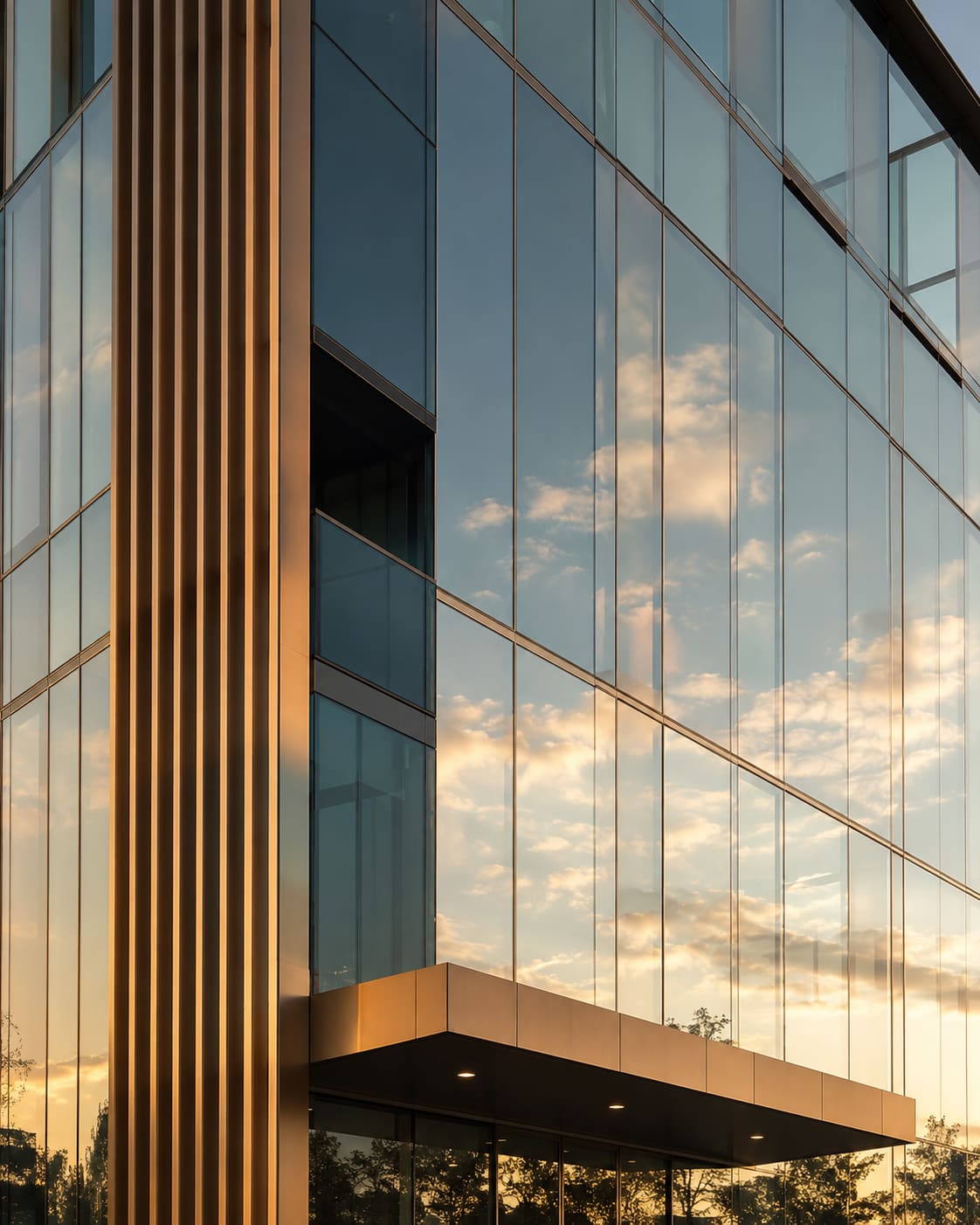
Green building glazing is high-performance architectural glass chosen to minimise solar heat gain and heat transfer while still letting in useful daylight, so a building can earn credits under IGBC (Indian Green Building Council) and LEED (Leadership in Energy and Environmental Design). It is defined by three measurable numbers: the U-value (thermal transmittance in W/m2K), the Solar Heat Gain Coefficient (SHGC, on a 0-1 scale) and Visible Light Transmittance (VLT, %). Getting the right combination of these three values directly lowers a building's air-conditioning load and unlocks points in the Energy & Atmosphere category of both rating systems.
In a hot climate like Hyderabad and Secunderabad, where summer temperatures across Telangana and Andhra Pradesh routinely cross 40 degrees Celsius, glazing is usually the single biggest source of unwanted heat entering a building. India's Energy Conservation Building Code (ECBC), notified under the Energy Conservation Act and administered by the Bureau of Energy Efficiency (BEE), sets mandatory glazing performance limits for commercial buildings, while the National Building Code of India (NBC) 2016 governs safety, wind load and structural aspects. Specifying the glass correctly is therefore as much an engineering decision as an architectural one.
This guide explains the metrics, glass types, standards, process and real INR costs you need to specify glazing for a green-rated project, drawing on how we design and install glass facade systems and structural glazing for offices, showrooms and IT campuses across Hyderabad, Secunderabad and Andhra Pradesh. If you would rather move straight from theory to a priced specification, you can get a free quote at any point.
What Green Building Glazing Actually Means
Green building glazing means an assembled glass unit that has been deliberately engineered to control energy flow, not just to be transparent. Ordinary window glass is chosen for looks and price; green glazing is chosen for measured thermal and optical performance that a rating assessor can verify from a data sheet.
The distinction matters because a green-rated building has to document how much cooling energy the envelope saves. Glass that admits too much solar heat forces larger chillers, higher electricity bills and lost IGBC or LEED points. The same building, glazed correctly, runs a smaller air-conditioning plant for its entire service life.
- Conventional glazing prioritises cost and appearance, with U-values around 5.7 W/m2K and no coating.
- Green glazing prioritises a low U-value, a low SHGC and adequate daylight, usually delivered as a coated double-glazed unit.
- Every green glazing claim must be backed by a manufacturer data sheet quoting values tested to recognised standards.
In practice the same aluminium framing can carry either type of glass, so the performance upgrade sits mainly in the glass make-up and coating rather than in the visible frame. That is why the glass specification, not the frame profile, is where a green project earns or loses its energy points.
The Three Numbers That Define Green Glazing
Green building glazing is judged on three performance numbers, each printed on a manufacturer's data sheet and verifiable under standards such as ASTM E1084 and ISO 10292. Understanding them is the difference between buying the right glass and overpaying for the wrong one.
- U-value (thermal transmittance): the rate of heat flow through the glass in W/m2K; lower is better. 6 mm single clear glass is about 5.7 W/m2K, while a low-E DGU reaches 1.6-1.8 W/m2K.
- SHGC (Solar Heat Gain Coefficient): the fraction of solar heat admitted, from 0 to 1; lower is better in hot climates. ECBC targets roughly 0.25-0.27 for Hyderabad's hot-dry zone.
- VLT (Visible Light Transmittance): the percentage of daylight passing through; a high VLT combined with a low SHGC (a Light-to-Solar-Gain ratio above 1.25) is the signature of a good spectrally selective coating.
The goal is a low U-value AND a low SHGC AND adequate VLT (typically 40-60%) at the same time, which single tinted glass simply cannot deliver. A cheap dark tint lowers SHGC but also kills daylight, defeating the very daylighting credits a green building is trying to earn.
Think of it as a three-way balancing act: block the sun's heat, keep the sun's light, and stop indoor cool air from leaking out through the glass. Only a coated, multi-pane assembly hits all three targets simultaneously, which is why single glazing is effectively ruled out of a serious green rating.
Glass Types Used in Green Facades
The workhorse of green glazing is the double-glazed unit (DGU) with a low-emissivity (low-E) coating, which outperforms single glazing on every metric that matters for a green rating. Around it sit a handful of other glass types, each with a defined job.
- Low-E coated glass: a microscopically thin metallic-oxide layer that reflects long-wave heat while transmitting daylight; hard-coat (pyrolytic) and soft-coat (sputtered/MSVD) are the two families, with soft-coat giving the lowest SHGC.
- Double-Glazed Unit (DGU): two glass panes (typically 6 mm) separated by a 12-16 mm air- or argon-filled cavity with a desiccant-filled spacer, cutting U-value to 1.6-1.8 W/m2K.
- Toughened (tempered) glass: heat-treated to IS 2553 (Part 1); 4-5 times stronger than annealed glass and effectively mandatory for structural glazing and large facades.
- Laminated glass: two panes bonded with a PVB or SGP interlayer, used where safety, acoustics or security matter; the interlayer also blocks over 99% of UV.
- High-performance tints and reflective coatings reduce glare and SHGC but should never be the sole strategy in a green building.
For frameless and semi-frameless facades, argon fill and a warm-edge spacer squeeze the U-value down further, while an outer toughened pane and an inner laminated pane can combine strength, safety and acoustic control in one unit. The right make-up depends on orientation, floor height and the target rating, which is why the glass build-up is fixed alongside the frame rather than after it.
How Green Glazing Earns IGBC and LEED Credits
Glazing contributes to green rating scores primarily through energy performance rather than through a standalone 'glass' credit, so the specification is proven by simulation, not by the material alone. This is the point most owners misunderstand: you do not buy points, you buy modelled energy savings.
- Under LEED v4/v4.1 (USGBC), high-performance glazing helps earn points in the Energy & Atmosphere category via whole-building energy modelling (Optimize Energy Performance).
- Under IGBC Green New Buildings, glazing supports credits for energy efficiency and can aid daylighting and thermal-comfort credits in the Indoor Environmental Quality category.
- Both systems reward daylight access, so specifying adequate VLT while keeping SHGC low is a genuine dual-benefit strategy that scores twice.
- Compliance is demonstrated through simulation (for example against ASHRAE 90.1 or ECBC baselines), so accurate manufacturer U-value and SHGC data are essential documentation.
For projects chasing Platinum or Gold ratings, the glazing is modelled together with shading devices, orientation and the wall assembly. That is why we recommend fixing the glass spec early, alongside the aluminium facade design, rather than value-engineering it out late in the build when the energy model is already locked. You can see how this comes together on our recent projects.
Indian Standards and Code Compliance
Green glazing in India must satisfy both energy codes and structural-safety standards before it can be certified, and a competent facade contractor should be able to cite each one on request.
- Energy Conservation Building Code (ECBC): mandatory glazing U-value and SHGC limits by climate zone for commercial buildings, enforced through BEE.
- National Building Code of India (NBC) 2016: governs safety glazing, fire and human-impact requirements.
- IS 875 (Part 3): wind-load design, critical for high-rise facades in Hyderabad, which sits in a moderate wind zone.
- IS 2553 (Part 1): specification for toughened safety glass used in facades.
- ASTM C1401: the standard guide for structural sealant glazing, governing the silicone that bonds glass to the aluminium frame.
- BEE Star Rating labels help identify energy-efficient glass products for compliance documentation.
Telangana and Andhra Pradesh municipal approvals increasingly reference ECBC for larger commercial buildings, so a facade that ignores these limits risks both a failed green rating and a compliance problem at occupancy. Treating the code sheet as a design input from day one is far cheaper than retrofitting glass after an assessor flags it.
Framing, Hardware and Sealants That Complete the System
Even the best DGU under-performs if the frame, seals and moving hardware around it are weak, because heat and air leak through gaps, not just through glass. The green rating is a whole-assembly result, not a glass-only one.
- Thermally broken aluminium profiles stop the frame from short-circuiting the insulating cavity of the DGU; a quality thermal break protects the U-value you paid for.
- Structural silicone and edge seals must meet ASTM C1401, since a failed edge seal lets moisture fog the cavity and quietly destroys the thermal performance.
- Operable vents and doors need reliable, well-adjusted sliding and swing hardware so that openings seal tightly and do not leak conditioned air.
- Entrance and access points rely on durable handles, closers and floor springs that keep a heavy glass door aligned and airtight over years of daily use.
As a facade specialist working with established hardware brands, we match the glass specification to hardware rated for the same load and cycle life, which is what separates a facade that stays green on paper from one that stays green in operation. You can review the full scope on our services page.
Cost, Performance and Lifespan in Hyderabad (INR)
A correctly specified low-E DGU facade can cut a building's cooling energy by 20-30% in Hyderabad's cooling-dominated climate, paying back its premium over several years of lower electricity bills. Indicative installed costs help set a realistic budget before you commission a detailed design.
- Single glazed clear glass: lowest cost at roughly INR 150-400 per sq ft installed, but poor thermal performance and not green-compliant.
- Reflective or tinted single glazing: mid-range at around INR 400-800 per sq ft, reduces glare but offers limited U-value benefit.
- Low-E DGU: higher upfront cost at roughly INR 900-2,000+ per sq ft installed depending on coating, spacer and gas fill, with the best energy return.
- Structural glazing systems with toughened low-E DGUs typically start around INR 1,200 per sq ft and rise with size, wind zone and hardware grade.
- Service life of a sealed DGU is typically 20-25 years, dependent on edge-seal quality, while structural silicone joints should be inspected periodically.
Hyderabad and Secunderabad projects benefit most from east and west shading combined with low-SHGC coatings, because the hot-dry climate makes solar gain, not heat loss, the dominant concern. Weigh these options against your project's cooling budget rather than its facade budget alone, because the cheaper glass often costs more over the building's life.
The Specification and Installation Process
A green glazing package moves through a predictable sequence, and knowing it up front prevents the delays that push glass changes into the energy model too late to matter.
- Design and energy modelling: the architect and simulation team set target U-value, SHGC and VLT per elevation against the ECBC or ASHRAE baseline.
- Glass and frame selection: coatings, DGU make-up, thermal breaks and hardware are chosen to meet those targets with margin.
- Toughening and fabrication: cutting, drilling and edgework are completed before tempering, because toughened glass cannot be cut or drilled afterwards.
- DGU assembly and sealing: panes are bonded to a spacer with primary and secondary seals, then quality-checked for a fogged or failed cavity.
- Site installation: profiles are fixed to structural framing, glass is set on structural silicone or captured in the frame, and joints are weather-sealed.
For a typical mid-size commercial facade in Hyderabad, budget several weeks from approved shop drawings to a glazed elevation, with toughened DGU lead times being the usual critical path. Building this schedule in early avoids the temptation to substitute non-compliant single glass just to hit a handover date.
Common Mistakes to Avoid
Most green glazing problems trace back to a handful of avoidable decisions taken to save money in the wrong place. Watching for these keeps the rating and the comfort intact.
- Using one dark tint everywhere: it lowers SHGC but crushes VLT, losing daylighting credits and forcing more artificial lighting.
- Ignoring the frame: a non-thermally-broken aluminium frame short-circuits the DGU and undoes much of its U-value benefit.
- Skipping external shading: glazing alone rarely meets ECBC on harsh west elevations without fins, reveals or overhangs to help it.
- Trusting coating names over data sheets: identical-sounding coatings vary between suppliers, so always confirm the tested U-value and SHGC in writing.
- Value-engineering the glass late: swapping to cheaper glass after the energy model is done can silently break the target rating.
The best way to specify green glazing without overpaying is to buy performance where the sun actually hits and save where it does not: low-SHGC low-E DGUs on east, west and south elevations, higher-VLT coatings on shaded or north faces, and external shading doing part of the work everywhere. Hakimi Aluminium and Glass supplies and installs low-E double-glazed and structural glazing facades for green-rated projects across Hyderabad, Secunderabad and the wider Telangana and Andhra Pradesh region. To size and price a compliant facade, get a free quote with your elevations and target rating.