For most Hyderabad homes and offices, a motorised aluminium louvered pergola is the best all-round choice because its rotating blades let you control sun, breeze and rain from a single button, and its rain sensor closes the roof automatically during a sudden monsoon shower. A glass-roof pergola wins when you want maximum daylight and an open view of the sky, while a fixed slat pergola is the budget pick for gardens and car porches where dappled shade, not full weather cover, is the goal.
A pergola turns an unused terrace, balcony or courtyard into a genuinely usable outdoor room, but the choice between a louvered, glass or slat design decides how much sun, rain and heat you actually control. This pergola buying guide compares all three side by side, with real 2026 pricing, so you can spend on the right structure the first time instead of retrofitting later.
In Hyderabad, Secunderabad and across Telangana and Andhra Pradesh, pergolas face harsh summer sun that pushes past 42 degrees, heavy monsoon downpours from June to September, and relentless construction dust in fast-growing pockets like Kokapet, Financial District and Kondapur. The material and roofing system you pick matter far more here than in milder climates, and the wrong choice can mean a leaking, overheated or rust-streaked structure within a couple of seasons.
The Three Pergola Types Explained
Each style solves a different problem, so understand what each one actually does before you compare price. All three are commonly built on powder-coated aluminium fabrication frames in Hyderabad because aluminium survives the local climate far better than untreated steel or timber.
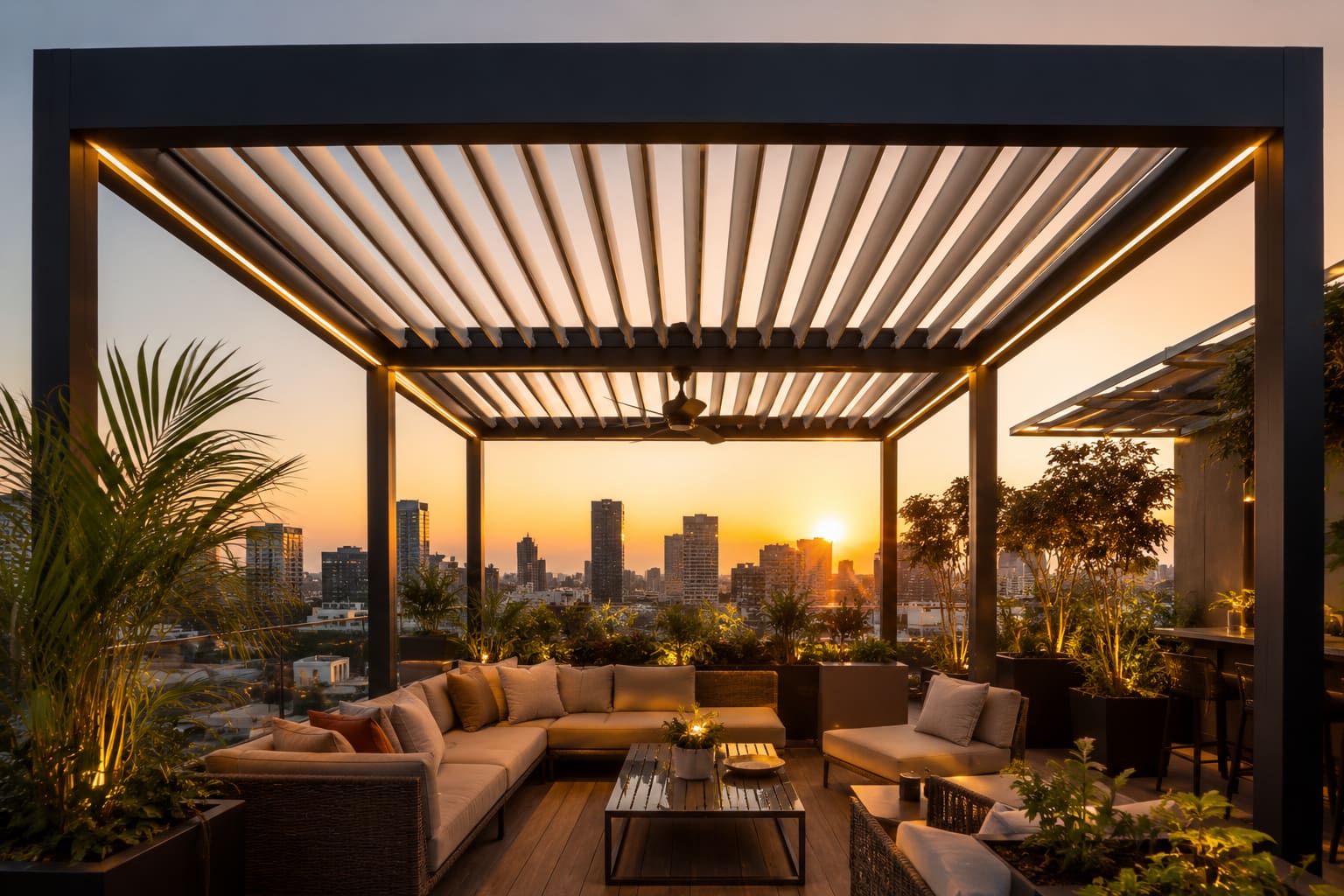
- Louvered pergola: Adjustable aluminium blades (louvers) rotate anywhere from fully open to fully closed to let in sun, filter light or seal against rain. Motorised versions tilt at the push of a button and add rain and wind sensors that close the roof automatically.
- Glass pergola: A fixed or retractable toughened and laminated glass roof over an aluminium or steel frame. It delivers full weather protection while keeping the space bright, making it ideal for a covered sit-out, dining terrace or cafe-style outdoor area.
- Slat pergola: Fixed timber-look aluminium or WPC slats set at a spacing that throws attractive shade patterns across the floor. It is the most affordable option and suits gardens, walkways, car porches and decorative shade rather than full rain cover.
How Much Does a Pergola Cost in Hyderabad (2026)?
Pergola prices in Hyderabad vary with span, material grade, motorisation and finish. As a working reference for Telangana and Andhra Pradesh projects in 2026:
- Aluminium slat pergola: around Rs 550 to Rs 950 per sq ft, supplied and installed.
- Glass pergola (toughened glass roof on an aluminium frame): around Rs 1,400 to Rs 2,600 per sq ft, depending on glass thickness and framing.
- Manual louvered pergola: around Rs 1,600 to Rs 2,400 per sq ft.
- Motorised louvered pergola with rain sensor: around Rs 2,800 to Rs 4,500 per sq ft.
A typical 12 ft x 12 ft (144 sq ft) motorised louvered pergola therefore lands roughly between Rs 4 lakh and Rs 6.5 lakh, while the same area built as a slat pergola may cost under Rs 1.4 lakh. Wide spans that need heavier extrusions, premium branded motors, or curved and multi-bay layouts push the upper end higher. Always get a measured, itemised quote rather than a per-sq-ft guess, because edge conditions, parapet fixing and drainage routing change the real number. You can get a free quote with a site measurement for your exact terrace.
Which Pergola Suits Hyderabad's Climate?
For a terrace you want to use year-round, a motorised louvered pergola is the strongest performer. Open the louvers for breeze on pleasant winter evenings, angle them against the brutal west-facing afternoon sun in April and May, and close them fully when the monsoon rolls in. The rain sensor is genuinely useful given how fast Hyderabad's skies turn from clear to cloudburst.
A glass pergola is the pick when you want maximum daylight and an unbroken view of the sky, such as over a dining sit-out, a rooftop lounge in Jubilee Hills, or a boutique cafe front in Madhapur. Insist on laminated safety glass and a proper roof slope so water and dust run off cleanly, and consider a solar-control or reflective coating to cut heat gain, similar to what we specify on a reflective glass facade.
Slat pergolas are best for gardens, car porches and pathways where dappled shade is the goal and full rain protection is not essential. They are the value option, pair beautifully with climbing plants, and suit villa projects in Kokapet and gated communities around Tellapur and Gachibowli where the look matters as much as function.
Louvered vs Glass vs Slat: Which Should You Choose?
The right pick comes down to how you plan to use the space and how much control over the weather you need.
- Choose louvered if you want a true all-season outdoor room with adjustable sun, shade and rain control, and you are comfortable with the highest budget.
- Choose glass if daylight, an open sky view and a clean modern look matter most, and you want permanent cover without moving parts.
- Choose slat if you want affordable, low-maintenance decorative shade for a garden, porch or walkway and do not need to keep rain out.
Many Hyderabad villas combine styles: a glass or louvered pergola over the main sit-out for weatherproof use, and slat pergolas over the driveway and garden path. If your outdoor space flows into an enclosed balcony, a louvered or glass roof also pairs neatly with frameless balcony glazing to create a fully sheltered zone.
What to Check Before You Buy
The frame and hardware decide how long your pergola lasts in dusty, humid conditions, so scrutinise the specification, not just the render.
- Insist on powder-coated or anodised aluminium rather than untreated steel to avoid rust streaks after the first monsoon.
- Check the water drainage design: louvered and glass roofs must channel water into integrated gutters and concealed downpipes, not just spill off the edge onto your floor.
- Confirm the motor and sensor warranty separately from the structural warranty; reputable suppliers offer 2 to 5 years on motors.
- Verify the wind rating and the fixing method for open terraces and higher floors in Hyderabad's apartment towers, where gusts are stronger than at ground level.
- Ask for the aluminium wall thickness of the extrusion; thin sections flex and sag over wide spans and heavy glass loads.
- Get the roof slope in writing for glass and closed-louver designs; a flat roof will pond water and collect dust in a city this dusty.
Materials and Finishes That Last in Telangana
Aluminium is the default frame material for good reason: it resists termites, rot and corrosion, needs almost no maintenance, and carries a marine-grade powder coat that holds colour under intense UV. Timber-look powder coats and wood-finish laminates give the warmth of wood without the cracking, warping and repainting that real timber demands in monsoon humidity.
For the roof itself, laminated glass is safer than plain toughened glass because it holds together if it ever breaks, and it also cuts UV and noise. On louvered systems, look for double-walled aluminium blades with EPDM gasket seals along each edge, which is what makes the closed roof genuinely watertight.
Finish choices matter for heat and glare too. Lighter powder-coat shades reflect more solar heat, while a low-E or solar-control glass coating keeps a glass pergola from turning into a greenhouse in May. These are the same performance principles we apply across our canopies, skylights and outdoor work throughout Hyderabad.
Installation, Structure and Maintenance
A pergola is only as good as its fixing. On terraces, the posts must anchor into the slab or a properly designed parapet with sealed base plates, and the whole structure should be engineered for local wind loads, especially for high-rise projects in Financial District and Hitec City. Freestanding designs need adequate footing, while wall-mounted lean-to pergolas transfer load into the building and must be waterproofed at the junction.
Maintenance for aluminium systems is light: rinse dust off two or three times a year, clear the gutters and downpipes before and after monsoon, and lubricate the louver pivots annually on motorised units. Glass roofs need periodic cleaning to stay clear, since Hyderabad dust settles fast on any flat or low-slope surface.
See how these details come together in built projects on our projects page, and if you are weighing a solid roof against an open one, our guide to choosing between a canopy and a pergola breaks down the trade-offs. Working with an experienced fabricator matters here, because drainage, fixing and wind rating are exactly where cheap installs fail.
Common Mistakes to Avoid
A few recurring errors turn a good-looking pergola into a headache within a season or two.
- Skipping integrated drainage, so rainwater sheets straight onto the terrace floor and seeps toward the building.
- Buying on per-sq-ft price alone and ending up with thin extrusions and an unbranded motor that fails out of warranty.
- Ignoring roof slope on glass and closed-louver designs, which leads to water pooling and stubborn dust marks.
- Choosing a slat pergola while expecting rain protection, then trying to retrofit cover later at extra cost.
- Overlooking wind fixing on open, high-floor terraces where uplift is a real structural risk.
- Forgetting servicing access, which makes clearing gutters and lubricating louver motors awkward down the line.