Types of glass coatings refer to the thin functional layers applied to glass to control heat, light and glare, and the three principal categories are Low-E (low-emissivity) coatings, reflective coatings and solar-control coatings. Each works by altering how the glass transmits, reflects or absorbs solar radiation, quantified by two key metrics: the U-value (rate of heat flow, in W/m2K) and the Solar Heat Gain Coefficient (SHGC, on a 0 to 1 scale). Coatings are measured in nanometres, deposited either by a pyrolytic (hard-coat) or magnetron-sputtering (soft-coat) process, and they turn ordinary float glass into a high-performance building material used in everything from home windows to full glass facades.
In a hot, high-solar-radiation climate like Hyderabad and Secunderabad, where summer temperatures regularly cross 40 degrees C and dust and monsoon humidity add their own stresses, the coating choice directly affects cooling loads, comfort and running cost. The right coated glazing can reject 50-80% of solar heat while retaining daylight, cutting air-conditioning demand and helping buildings in commercial belts like Gachibowli, the Financial District and Hitec City comply with the Energy Conservation Building Code (ECBC).
This guide defines each coating type, its realistic performance range, the Indian standards that apply, how the coatings are made and what they cost per square foot, so specifiers, builders and homeowners across Telangana and Andhra Pradesh can choose accurately rather than by brand name alone.
What Are Low-E (Low-Emissivity) Coatings?
A Low-E coating is an ultra-thin, near-invisible layer of metallic oxide-usually silver-that reflects long-wave infrared (radiant heat) while allowing visible light through, lowering the glass surface emissivity from about 0.84 (uncoated) to as low as 0.02-0.20. This dramatically reduces radiant heat transfer and improves the U-value of the whole glazing unit, which is why Low-E is the default choice for energy-efficient aluminium windows and uPVC windows in premium homes.
- Two production types exist: hard-coat (pyrolytic), applied during float manufacture and durable enough for single glazing and toughening; and soft-coat (sputtered/MSVD), higher-performing but requiring sealing inside an insulated glass unit (IGU).
- Solar-control Low-E is the variant suited to hot climates like Hyderabad, combining low emissivity with a low SHGC of roughly 0.25-0.40.
- Typical double-glazed Low-E IGU U-values range from about 1.1 to 1.8 W/m2K, versus roughly 5.7 W/m2K for single clear glass-a three-to-five-fold improvement in insulation.
- Visible light transmittance for good Low-E glass is high, commonly 40-70%, preserving daylight while cutting heat.
- Best applied on the number-2 or number-3 surface of an IGU for optimum solar and thermal performance, a detail that a specialist DGU facade supplier will get right.
What Are Reflective Coatings?
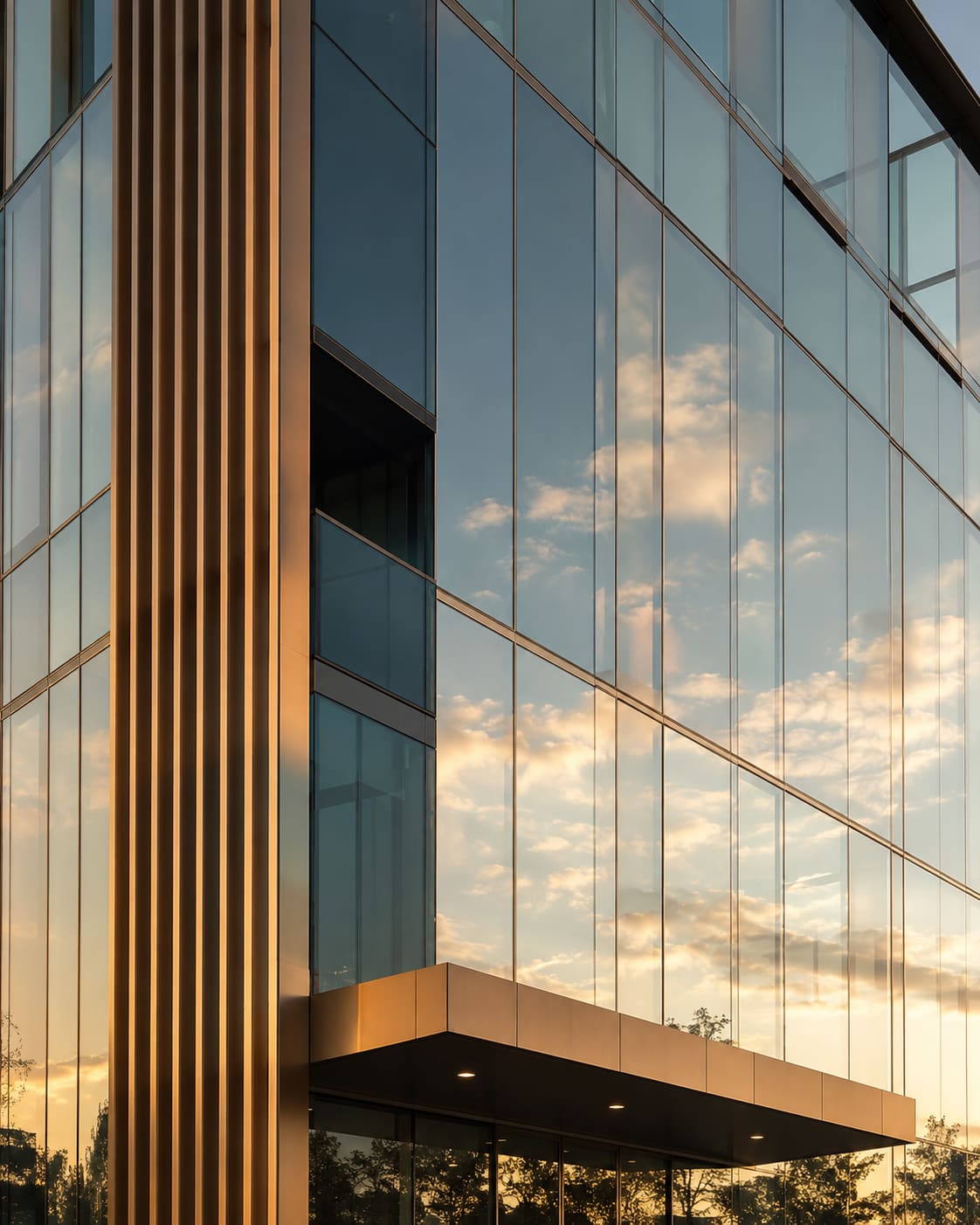
A reflective coating is a metallic or metal-oxide layer (such as chromium, titanium or stainless steel) applied to glass to reflect a large share of incident solar radiation, giving a mirror-like exterior and reducing SHGC to about 0.25-0.45. It is one of the most common facade finishes on Indian commercial buildings and the signature look of the reflective glass facades seen across Hitec City and Madhapur.
- Applied pyrolytically (hard-coat: durable, tintable, temperable) or by vacuum sputtering (soft-coat: wider colour range, used inside IGUs).
- Reduces glare and solar heat gain effectively but also lowers visible light transmittance, often to 8-40% depending on grade.
- Available in tints including silver, blue, green, bronze and grey to match architectural intent and elevation design.
- Provides daytime privacy due to the exterior mirror effect, though this reverses at night when interiors are lit and the room becomes visible from outside.
- Can be toughened to comply with IS 2553 (safety/toughened glass) for structural glazing and curtain-wall applications where wind and impact loads matter.
What Are Solar-Control Coatings?
A solar-control coating is a spectrally selective layer engineered to block infrared and ultraviolet radiation while transmitting visible light, achieving a low SHGC (often 0.25-0.40) without the heavy reflectivity of traditional reflective glass. It targets the goal every architect in a tropical climate wants-high daylight with low heat-which makes it the smart default for offices in the Financial District and Kokapet.
- Advanced solar-control coatings use multiple silver layers (double or triple silver) to maximise the ratio of light transmission to solar gain, known as the Light-to-Solar-Gain (LSG) ratio, which can exceed 2.0.
- Blocks up to 99% of UV radiation, reducing fabric, furniture, artwork and merchandise fading indoors-valuable for showrooms and retail.
- Lower reflectivity than mirror-finish reflective glass gives a clearer, more neutral appearance that reads as premium.
- Almost always soft-coat, so it is supplied within a sealed IGU for durability and performance.
- Well suited to Hyderabad's intense solar exposure, where cutting cooling load while keeping interiors bright is the priority; these are the products we most often recommend for structural glazing facades on corporate campuses.
How Are Glass Coatings Applied?
Glass coatings are applied by two industrial processes-pyrolytic (hard-coat) and magnetron sputtering (soft-coat)-and the process determines the coating's durability, its position in the unit and its performance ceiling. Understanding this helps you judge whether a quoted product is genuinely fit for its location.
- Pyrolytic (CVD): the coating is fused onto hot glass during float production, creating a hard, chemically bonded layer that resists abrasion, can be single-glazed, tempered, bent and even exposed on surface 1 (the outermost face).
- Magnetron sputtering (MSVD): metals are deposited in a vacuum chamber at room temperature, yielding higher performance and more silver layers but a softer coating that must sit on a protected inner surface of a sealed IGU.
- Soft-coat glass is typically edge-deleted and sealed within 6-8 hours of cutting to prevent oxidation of the silver layer, so it should never be stored as loose stock in a dusty Hyderabad site.
- Coating thickness is on the nanometre scale, so it does not change the nominal glass thickness (commonly 5, 6, 8, 10 or 12 mm substrates).
How Do the Three Coating Types Compare?
Choosing between the coatings comes down to what you are optimising: insulation, glare and privacy, or the balance of daylight against heat. The table below-style summary makes the trade-offs concrete for a typical Telangana project.
- Low-E: SHGC 0.25-0.40, visible light 40-70%, U-value 1.1-1.8 in an IGU, near-clear appearance-best where insulation and daylight both matter, such as air-conditioned homes and glazed interior partitions.
- Reflective: SHGC 0.25-0.45, visible light 8-40%, mirror finish-best for large commercial elevations wanting glare control, privacy and a bold architectural statement.
- Solar-control (double/triple silver): SHGC 0.25-0.40 with visible light up to 60-70%, neutral look-best for premium offices that want brightness without heat.
- Combining approaches is common: a solar-control Low-E coating in a double-glazed unit gives both low SHGC and a low U-value, the specification most ECBC-compliant corporate towers in Gachibowli now use.
- Orientation matters: west and south facades in Hyderabad take the harshest afternoon sun, so lower-SHGC glass is justified there even if north facades use a lighter, brighter product.
Which Coating Is Best for Hyderabad's Climate?
For Hyderabad, Secunderabad and the wider Telangana and Andhra Pradesh region, a solar-control Low-E coating in a sealed double-glazed unit is usually the best all-round choice because it attacks the two things the local climate throws at a building-intense solar heat gain and high UV-while keeping interiors daylit.
- The region's composite-to-hot climate means cooling, not heating, dominates energy use, so a low SHGC (0.25-0.35) delivers the biggest saving on air-conditioning bills.
- Monsoon humidity and airborne dust make a hermetically sealed IGU with a robust edge seal important; a failed seal fogs the unit and destroys performance.
- For budget-sensitive projects, a good hard-coat reflective or solar-control glass in single glazing still cuts heat meaningfully at lower cost.
- High-rise towers in the Financial District and Kondapur often pair solar-control glazing with aluminium curtain walling and proper thermal breaks to stop heat bypassing the glass through the frame.
- If you are unsure which SHGC and U-value your building actually needs, an independent facade consultancy review pays for itself by preventing over- or under-specification.
Standards, Performance and Cost in India
Coated glazing in India is governed by energy and safety codes that set the maximum permissible U-value and SHGC by climate zone and window-to-wall ratio, most importantly the Energy Conservation Building Code (ECBC) and the National Building Code of India (NBC) 2016.
- ECBC prescribes envelope performance limits; Hyderabad falls in a hot climate zone where low-SHGC coated glass is effectively required for large glazed facades.
- Toughened coated glass must meet IS 2553 (safety glass), and facade wind-load design follows IS 875 Part 3.
- Structural silicone used to bond coated glass in curtain walls is designed to standards such as ASTM C1401 (structural sealant glazing).
- Indicative cost: reflective glass from about INR 250-500 per sq ft; single-silver Low-E and solar-control IGUs from about INR 500-800 per sq ft; double- and triple-silver high-performance IGUs from about INR 800-1,200 per sq ft, varying with tint, substrate and processing.
- Good coated IGUs have a service life of 15-25 years or more, with performance retained as long as the hermetic edge seal remains intact.
- You can see coated glazing installed on real elevations in our completed projects, and if you want product-specific numbers for your building, get a free quote with your window schedule and orientation.
Common Mistakes When Choosing Coated Glass
Even well-funded projects waste money or lose performance by getting a few details wrong. Avoiding these keeps your glazing both compliant and cost-effective.
- Chasing the darkest reflective glass for looks while ignoring SHGC and daylight, which forces more artificial lighting and can breach ECBC daylight expectations.
- Using soft-coat glass as an exposed single glaze, where the silver oxidises and the coating degrades within a few seasons of Hyderabad heat and monsoon.
- Buying coated glass on price per sq ft without checking the actual SHGC, U-value and visible-light numbers on the manufacturer's data sheet.
- Specifying high-performance glass but pairing it with a cheap non-thermal-break aluminium frame, so heat simply bypasses the glass through the metal.
- Skipping toughening or heat-strengthening on large or west-facing panes, risking thermal-stress cracks under the region's steep temperature swings.
- For a fuller cost picture, our guide on toughened glass price in Hyderabad breaks down processing charges that also apply to coated substrates.