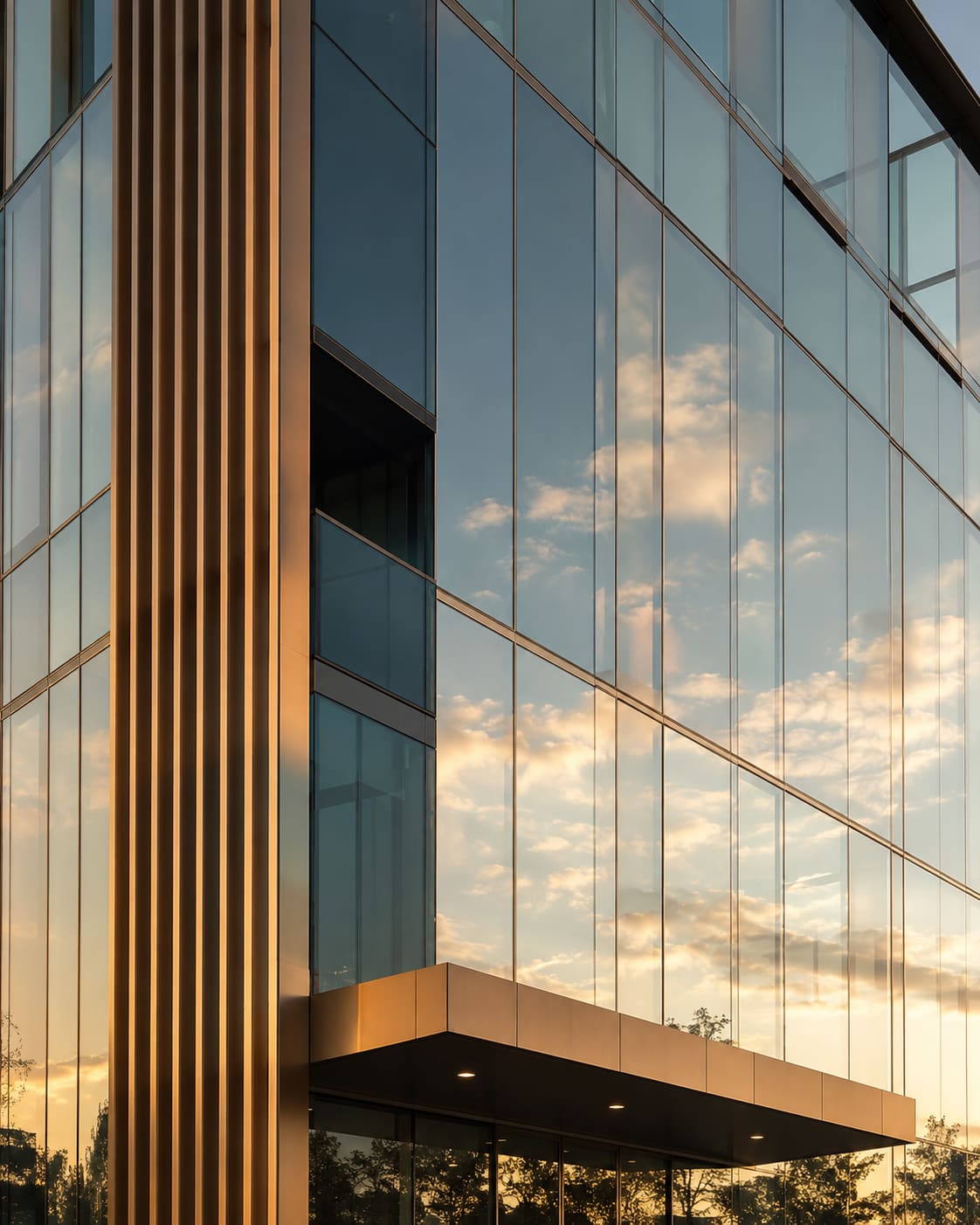
The main types of glass used in buildings are annealed float glass, toughened (tempered) glass, laminated glass, insulated glass units (IGU/DGU), low-emissivity (low-E) glass, reflective glass, tinted (heat-absorbing) glass, wired glass and smart (switchable) glass, each engineered for a specific balance of strength, safety, thermal performance and appearance. Float glass is the raw base product from which almost every other type is processed, while toughened and laminated glass are the two recognised categories of safety glass under Indian standards.
Choosing the right glass for a building depends on the application (window, facade, partition, railing, skylight, door), the required safety class, thermal and acoustic performance, and local wind and climate loads. In India, selection is governed by the National Building Code (NBC) 2016, wind load calculations under IS 875 Part 3, and energy targets under the Energy Conservation Building Code (ECBC), with toughened safety glass conforming to IS 2553. This guide defines each type, gives typical thicknesses, U-values, real Hyderabad price ranges and performance figures, and explains where each is best used.
For property owners across Gachibowli, Kokapet, Madhapur, Hitec City, Kondapur and the Financial District, the stakes are practical: the wrong glass means glare, heat build-up, higher electricity bills through the long Telangana summer, and safety risk. The right specification does the opposite. If you would rather skip the theory, you can get a free quote and we will size the glass to your project directly.
Float (Annealed) Glass: The Base Product
Float glass is the standard clear glass made by floating molten glass over a bed of molten tin, producing a flat, distortion-free sheet that serves as the base for nearly all processed architectural glass.
It is annealed (slowly cooled) to relieve internal stress, which makes it easy to cut, drill and polish, but relatively weak. It breaks into large sharp shards, so on its own it is not a safety glass and is banned from doors, low-level glazing and any impact zone under the NBC.
- Common thicknesses: 2, 3, 4, 5, 6, 8, 10, 12, 15 and 19 mm
- Uses: interior glazing, furniture tops, mirror stock, picture framing, and raw stock for toughening and lamination
- Light transmission: up to about 90% for clear 4-6 mm glass
- Limitation: low impact and thermal-shock resistance; not permitted where safety glass is required
- Indicative Hyderabad price: roughly INR 60-130 per sq ft for plain 4-6 mm clear float, before any processing
In practice you rarely install raw float glass in a facade or door. Instead it becomes the input to the value-added products below, most notably toughened glass work and laminated glass work.
Safety Glass: Toughened and Laminated
Toughened (tempered) and laminated glass are the two recognised safety glasses, mandated by the NBC for doors, large windows, railings, facades and any glazing at risk of human impact.
Toughened glass is heat-treated to about 620-650 degrees C and then rapidly quenched with cold air, locking the surface into compression. This makes it 4-5 times stronger than annealed glass, and under IS 2553 it must fragment into small blunt granules rather than sharp shards. It also resists thermal shock far better, which matters for west-facing Hyderabad elevations that swing from cool morning to 40-plus degree afternoons.
- Toughened glass cannot be cut, drilled or edge-worked after tempering; all fabrication must be done before heat treatment
- Laminated glass sandwiches a polyvinyl butyral (PVB) interlayer (0.38, 0.76 or 1.52 mm) between panes so fragments adhere to the interlayer and stay in the frame when broken
- Laminated glass blocks up to 99% of UV, dampens noise, and resists forced entry; it is the default for overhead glazing, balustrades and glass railings
- Heat-strengthened glass is an intermediate grade (about 2x annealed strength) used where toughened fragmentation is undesirable, for example spandrel panels
- Typical safety glass thicknesses: 6-12 mm for doors and partitions, 10-19 mm for structural and overhead use
- Indicative Hyderabad price: toughened clear from about INR 150-260 per sq ft (thickness dependent); laminated 6.38-11.52 mm from about INR 220-400 per sq ft
For frameless entrances and shopfronts, 12 mm toughened is standard, and we install it as part of our toughened glass doors and shopfront work. Where fall-through protection is required, such as a balcony edge or a first-floor lobby, laminated-toughened is specified so the pane holds even if both plies break.
Energy-Efficient Glass: DGU, Low-E and Coated Types
Energy-efficient glazing reduces heat gain and cooling costs through insulated glass units, low-E coatings, reflective coatings and tints, all of which are increasingly specified under ECBC for commercial buildings in Telangana.
An insulated glass unit (IGU), also called a double-glazed unit (DGU), uses two or more panes separated by an aluminium or warm-edge spacer and a hermetically sealed air or argon gap (typically 6-16 mm). This lowers the U-value to roughly 1.8-2.8 W/m2K against about 5.8 for single glazing, so less outdoor heat crosses into the conditioned interior.
- Low-E glass carries a microscopically thin metallic-oxide coating that reflects infrared heat while admitting visible light, cutting SHGC to below 0.3
- Reflective glass has a metallic coating that mirrors sunlight and glare, reducing solar heat gain and adding daytime privacy, and is common on tower elevations across Hitec City
- Tinted (heat-absorbing) glass is body-coloured (bronze, grey, green, blue) to absorb solar radiation and cut glare
- For Hyderabad's hot, high-solar climate, low-E double-glazed DGUs materially reduce air-conditioning load and can improve a building's BEE energy rating
- Double-glazing also improves acoustic insulation, useful along busy corridors in Kondapur and Secunderabad
A properly specified DGU facade or reflective glass facade is the single biggest lever on the running cost of a glazed office. On a large IT floor plate in the Financial District, the difference between plain single glazing and a low-E DGU can be several lakh rupees a year in cooling. Indicative supply-and-fix pricing for a low-E DGU runs from about INR 550-950 per sq ft depending on coating and gas fill.
What is Smart (Switchable) Glass and When is it Worth It?
Smart glass, also called switchable or privacy glass, changes from clear to opaque on demand using an electric current, giving instant privacy without blinds or curtains.
The most common variant in India is PDLC (polymer dispersed liquid crystal) film laminated between two glass plies. Off, the liquid crystals scatter light and the pane looks frosted; on, they align and the glass turns clear in under a second.
- Ideal for boardrooms, MD cabins, clinic consultation rooms and premium villas in Kokapet and Jubilee Hills
- Doubles as a rear-projection surface in its frosted state for presentations
- Draws only a few watts per square metre and is off (private) by default, so a power cut leaves the room private
- Higher cost: typically INR 2,200-3,800 per sq ft installed, versus a fraction of that for an acoustic glass partition with a manual blind
If the privacy need is occasional and budget matters, a standard partition with an internal blind is more economical. Where the wow factor and clutter-free look justify it, our smart glass and PDLC film installations deliver it. For a fixed-privacy cabin, frosted or frameless glass partitions remain the value pick.
Specialised, Fire-Rated and Decorative Glass
Specialised glass types serve functional and aesthetic needs beyond standard glazing, including wired, frosted, patterned, ceramic-fritted and fire-rated glass.
- Wired glass embeds a steel mesh to hold fragments in place and provide limited fire integrity, though it is not a true impact-safety glass
- Frosted and acid-etched glass diffuses light for privacy in cabins, bathrooms and partitions
- Patterned (textured) glass is rolled with a design for decorative and privacy applications
- Ceramic-fritted glass has baked-on ceramic dots or lines used for solar shading and to hide floor slabs behind spandrel panels on facades
- Fire-rated glass resists flame and smoke for a rated period (30-120 minutes) and is used in escape corridors, lobbies and compartment walls
Fire safety is not optional in commercial towers, and a certified fire-rated glazing or fire-rated glass door is often demanded by the building's fire NOC. For decorative and made-to-order pieces, our specialty glass range covers fritted, back-painted and custom-printed panels.
How Thick Should Building Glass Be?
Building glass thickness is set by the pane size, the wind load at that height and location, the fixing method and the safety class, then verified against IS 875 Part 3 and the NBC 2016 rather than chosen by eye.
As pane area and building height grow, so does the wind pressure the glass must resist, which is why a ground-floor shop and a 20th-floor curtain wall using the same visual glass may be very different thicknesses. A simple rule of thumb for typical Hyderabad low- and mid-rise work:
- Small windows and interior partitions: 5-8 mm toughened
- Doors, shopfronts and standard facades: 10-12 mm toughened
- Structural glazing, skylights and overhead: 12-19 mm, usually laminated or laminated-toughened
- High-rise or large spans: sized pane-by-pane to wind load, frequently as DGU build-ups
Never rely on a rule of thumb for a tall or exposed elevation. A structural glazing or glass facade job should always have thickness confirmed against the wind zone and pane schedule. You can see completed elevations sized this way in our project gallery.
Which Glass is Best for Hyderabad's Climate?
For Hyderabad's climate, the best glass is a low-E double-glazed unit on sun-exposed elevations for heat control, toughened safety glass for doors and windows, and laminated glass for overhead and fall-hazard areas. The local climate has three enemies of glazing, and each points to a specification.
- Heat and high solar radiation: low-E DGUs and reflective coatings to keep SHGC low and cut cooling bills through the long summer
- Monsoon and driving rain: quality structural silicone and drainage detailing so sealed units do not fog or leak
- Dust: a genuine problem across Gachibowli and the ORR corridor, so easy-clean coatings and accessible glazing detailing pay off
West and south-west facing rooms take the worst afternoon heat, so prioritise low-E glass there even if the north face uses plainer glazing. Pair the glass with the right frame: aluminium doors and windows with a thermal break, or uPVC windows, stop heat and noise bridging around the glass. Glass and frame are a system; specifying one without the other wastes the performance you paid for.
How to Select the Right Glass: A Quick Decision Guide
Select building glass by matching the safety class, thickness, thermal and acoustic performance to the application and local wind and climate loads, then verify against NBC 2016 and IS 875 Part 3.
- Doors, partitions and low-level glazing: toughened safety glass, 8-12 mm, per IS 2553
- Overhead glazing, skylights and railings: laminated or laminated-toughened glass for fall-through protection
- External facades and windows in hot climates: low-E double-glazed DGUs to control SHGC and U-value
- High-rise glazing: thickness sized to wind load using IS 875 Part 3, commonly 10-12 mm or DGU build-ups
- Acoustic zones: laminated or asymmetric double glazing to raise sound reduction
- Privacy on demand: smart/switchable glass; fixed privacy: frosted or back-painted glass
Getting this right the first time is far cheaper than replacing failed or non-compliant glazing later. Hakimi Aluminium and Glass supplies, fabricates and installs every glass type in this guide across Hyderabad, Secunderabad and the wider Telangana and Andhra Pradesh region. Tell us the elevation, the room and the budget, and get a free quote with the exact specification and price.