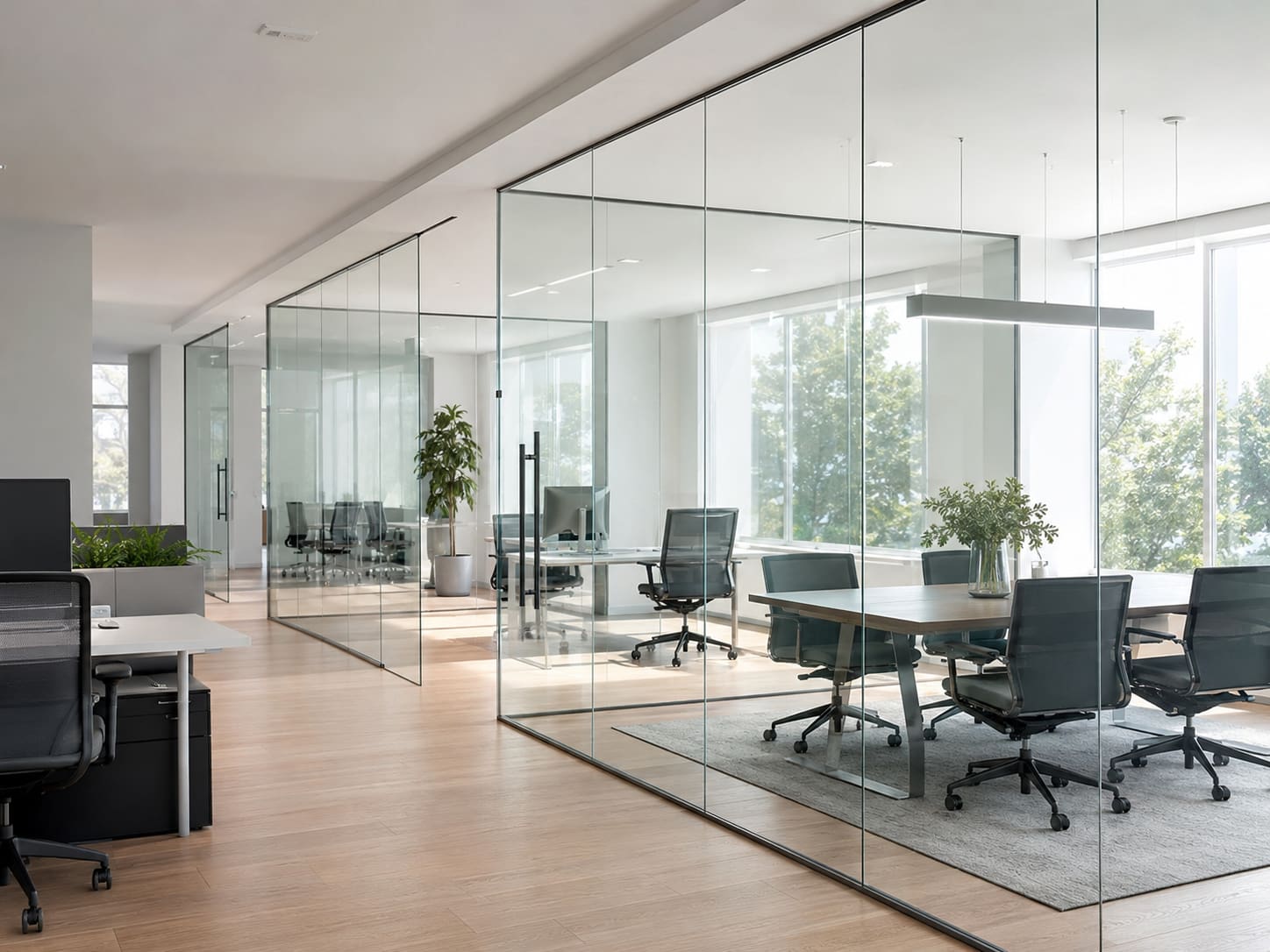
The main types of glass partitions for offices are framed partitions, frameless partitions, single-glazed and double-glazed (DGU) systems, switchable smart-glass partitions, and demountable modular partitions. Each type is defined by how the glass is supported (framed vs frameless), how many panes it uses (single vs double glazing), and whether it offers a fixed or reconfigurable, on-demand-privacy layout. Nearly all office partitions use toughened safety glass 8-12 mm thick, complying with IS 2553 for safety glass and installed under the general provisions of the National Building Code of India (NBC) 2016.
Choosing the right type is a balance of acoustic privacy, visual privacy, energy performance, cost and flexibility. In the hot-dry climate of Hyderabad and Secunderabad, where summer temperatures regularly cross 40 degrees Celsius before the monsoon breaks, glazing choice also affects heat gain and air-conditioning load, which the Energy Conservation Building Code (ECBC) addresses through solar heat gain coefficient (SHGC) and U-value limits. Fine dust from construction corridors in Gachibowli, Kokapet and the Financial District is a second local factor: the frame detailing and gasket you choose directly affects how much grime settles in the joints and how often the partition needs cleaning.
This guide defines each type, its specifications, its standards and typical Hyderabad pricing so architects, facility managers and business owners can specify accurately. For turnkey design and installation you can review our interior glass partition service or get a free quote for your exact floor plate.
Framed vs Frameless Glass Partitions
Framed glass partitions hold each pane inside an aluminium or steel frame on all sides, while frameless partitions use minimal top-and-bottom channels or patch fittings so the glass appears continuous with near-invisible joints. The choice sets the visual tone of an office more than any other single decision.
- Framed: uses 6-10 mm glass in aluminium sections; lower cost (INR 350-700 per sq ft installed) and easier to service; frame width typically 25-50 mm. See our aluminium glass partition systems.
- Frameless: uses 10-12 mm toughened glass with slim floor and ceiling U-channels or patch-fitting hardware; premium, seamless appearance; INR 450-1,200 per sq ft. Explore frameless glass partitions for a truly minimal look.
- Frameless joints are sealed with clear structural silicone (bonding governed by ASTM C1401 for structural sealant glazing) or polycarbonate H-profiles that keep the sightline clean.
- Framed systems generally achieve better acoustic sealing because the perimeter gasket is continuous on all four sides, which matters in noisy open-plan floors around Hitec City and Madhapur.
- Frameless partitions show fingerprints and dust more readily, so in dust-prone corridors many Hyderabad clients pair frameless glass with a slim framed door leaf as a practical compromise.
Single-Glazed vs Double-Glazed (DGU) Partitions
Single-glazed partitions use one pane of glass, whereas double-glazed partitions (double glazed units, DGUs) use two panes separated by a 12-16 mm sealed air or argon gap for superior acoustic and thermal performance. The gap, not the glass, does most of the acoustic and thermal work.
- Single 10 mm toughened glass: sound reduction of about 28-32 dB Rw; adequate for open collaborative zones and low-privacy cabins.
- Double-glazed unit: sound reduction of about 38-45 dB Rw, suitable for boardrooms, HR cabins and MD offices requiring genuine speech privacy. Our acoustic glass partition systems target this band.
- DGUs lower the U-value to roughly 1.8-2.8 W/sq m K versus about 5.8 for single glazing, cutting perimeter heat gain and easing the air-conditioning load through a Hyderabad summer.
- Laminated glass (two panes bonded with a PVB interlayer) can be used in either type to add security and further dampen sound; see our laminated glass work.
- DGU partitions cost more, typically INR 900-2,000 per sq ft depending on glass, spacer and hardware, but they pay back through lower energy bills and fewer noise complaints.
Switchable (Smart) Glass Partitions
Switchable glass partitions use an electrically controlled PDLC (polymer dispersed liquid crystal) film laminated between two glass panes that turns from opaque to clear instantly on demand, giving privacy at the flick of a switch. This is the most talked-about option in premium fit-outs across Kondapur and the Financial District.
- Switching time is under 1 second when a 48-65 V AC supply is applied; power off returns the glass to a frosted, private state, so the default failsafe state is privacy.
- Typical power draw is low, around 5-8 watts per square metre, and only while the glass is held in the clear state.
- Ideal for conference rooms, doctors' cabins and directors' offices where privacy is needed only intermittently. Learn more on our smart glass and PDLC smart glass pages.
- Cost in India is high, generally INR 2,500-6,000 per sq ft installed, driven largely by the imported PDLC film and the low-voltage wiring.
- Can be combined with double glazing for both privacy and acoustic performance, giving executive rooms speech confidentiality and instant opacity in one unit.
Demountable and Modular Glass Partitions
Demountable glass partitions are factory-engineered modular systems that can be dismantled and relocated without demolition, using pre-finished aluminium framing and gaskets rather than wet-sealed joints. For fast-growing companies on leased floors, this is often the smartest long-term buy.
- Panels are typically 8-12 mm toughened glass in a click-fit or gasket-clamped aluminium grid, aligned with our aluminium partition framing.
- Reusability makes them favoured for leased offices and fast-changing floor plates around Gachibowli and Hitec City; up to 90 percent of components are recoverable on relocation.
- Single-glazed demountable: INR 500-900 per sq ft; double-glazed acoustic demountable: INR 1,200-2,200 per sq ft.
- Integrated options include blinds inside the cavity, sliding or hinged glass doors, and manifestation film for safety marking.
- Manifestation (frosted strips or logos) at eye level, around 1,000-1,500 mm above finished floor, is recommended so occupants do not walk into clear glass, a requirement under general safety-in-glazing guidance.
What Glass Thickness and Safety Standard Should You Specify?
Specify 8-12 mm toughened glass to IS 2553 for office partitions: 8-10 mm for framed systems and 10-12 mm for frameless and door-integrated panels. Thickness is driven by pane size, whether a door is hung from the panel, and expected impact.
- Toughened (tempered) glass is 4-5 times stronger than annealed glass of the same thickness and, when broken, fragments into small blunt granules rather than dangerous shards; our toughened glass work meets this standard.
- Panels that carry a swing door usually step up to 12 mm to resist the racking loads from repeated opening.
- Fixed glazing should be designed for wind and impact loads under IS 875 Part 3 and the NBC 2016, especially for tall floor-to-ceiling runs.
- Edges must be polished and, on frameless work, corners eased; sharp arrises are both a safety and a chipping risk.
- Where fire compartmentation is needed between departments, switch to a certified fire-rated partition rather than standard toughened glass, which offers no fire rating.
How Do Glass Partitions Perform in Hyderabad's Climate?
In Hyderabad's hot summers, monsoon humidity and construction dust, the frame system and glazing type matter as much as the glass itself. Detailing for the local climate is what separates a partition that still looks new after five years from one that fogs, streaks or rattles.
- Heat: on west and south glazing near the building envelope, double glazing or a low-E coating limits solar heat gain and keeps cabins comfortable without overworking the AC.
- Monsoon humidity: quality DGUs use a desiccant-filled spacer and dual seal to prevent internal fogging; cheap units fog within a year or two in humid July and August.
- Dust: powder-coated aluminium frames and EPDM gaskets shed the fine dust common near active construction better than raw or anodised sections with open joints.
- Cleaning: frameless glass and smart glass need gentle, ammonia-free cleaning to protect films and silicone; grit-loaded cloths scratch coated surfaces.
- Thermal movement: continuous floor-to-ceiling glass needs setting blocks and gasket clearance so daily expansion does not stress the panels or crack corners.
How to Choose the Right Type
Select a glass partition type by matching acoustic privacy needs, budget, flexibility and heat control to each specific office zone rather than applying one system everywhere.
- For open workspaces and cabins on a budget: framed single-glazed toughened glass.
- For a premium, seamless look: frameless 12 mm toughened glass.
- For boardrooms needing speech privacy: double-glazed (DGU) laminated partitions rated 40 dB Rw or higher.
- For on-demand privacy: switchable PDLC smart glass, used selectively on a few key rooms.
- For leased or evolving spaces: demountable modular systems that relocate with the tenant.
- For enclosed manager and MD rooms, combine the partition with matching office glass cabins or an MD cabin glass package for a coordinated finish.
- Always specify toughened or laminated safety glass per IS 2553 and design fixed glazing for wind and impact loads under IS 875 Part 3 and NBC 2016.
Cost, Lifespan and Working With a Fabricator
Budget by zone: framed systems from INR 350-700 per sq ft, frameless from INR 450-1,200, DGU acoustic from INR 900-2,000, demountable from INR 500-2,200, and switchable smart glass from INR 2,500-6,000 per sq ft, all installed. A mixed specification usually gives the best value.
- A well-installed toughened glass partition system lasts 20-25 years with only periodic gasket and hardware maintenance, so the amortised annual cost is modest.
- Hidden costs to check in quotes: door hardware and floor springs, manifestation film, cut-outs for switches, and low-voltage wiring for smart glass.
- Ask your fabricator for site measurement before ordering; toughened glass cannot be cut after tempering, so every panel is made to size.
- You can see completed office fit-outs and material finishes in our project gallery to calibrate expectations before you specify.
Hakimi Aluminium and Glass designs, fabricates and installs all of these glass partition types for offices across Hyderabad, Secunderabad and the wider Telangana and Andhra Pradesh region. For a measured quote tailored to your floor plate, get a free quote.