The main types of glass railings are framed, semi-frameless, frameless (base-channel), standoff (button-fixed), spigot (post-clamp) and point-fixed systems, distinguished by how the glass is supported and how much aluminium or steel framing is visible. In framed systems the glass sits inside a continuous metal frame; in frameless systems the toughened-laminated glass panel is itself the load-bearing balustrade, clamped only at the base or at discrete points. That single decision governs glass thickness, structural glass grade, cost per running foot and how much of the view you keep.
Every glass railing in India is governed by the National Building Code of India (NBC) 2016 for height and load, IS 2553 for toughened and laminated safety glass, and IS 875 Part 3 for wind load on exposed balconies and terraces. In Hyderabad and Secunderabad, where balconies in Gachibowli, Kokapet and the Financial District face strong pre-monsoon gusts, monsoon-driven rain and year-round UV, the glass grade and interlayer matter as much as the fixing type. A railing that looks identical in two brochures can differ by three glass thicknesses once the wind load is run.
This guide compares each system on structure, glass specification, corrosion-grade hardware, realistic Hyderabad cost and best-fit application, then gives you a decision framework so you can brief a fabricator with confidence. If you already know the look you want, you can jump straight to our glass railing service for a site measurement.
The six glass railing systems at a glance
Before comparing them in detail, it helps to see how the six systems line up by framing, typical glass and cost. Each row below is a different answer to one question: how is the glass held up?
- Framed: glass captured in a full metal frame; 8-12 mm toughened; cheapest; most wind-forgiving
- Semi-frameless: top rail or slim posts, no surrounding frame; 10-12 mm toughened; mid-range
- Frameless base-channel: glass set into a floor U-channel, open top edge; 13.52-21.52 mm laminated; premium
- Standoff / point-fixed: glass bolted on stainless discs or spider fittings; 12-19.5 mm; architectural
- Spigot: glass gripped between floor clamps; 12-17.52 mm; the popular frameless-look choice
The rest of this article works through each family, and all of them are available through our balcony and railing installations across the city.
Framed and semi-frameless glass railings
Framed glass railings enclose each glass panel within a continuous top, bottom and side aluminium or steel frame, making them the most economical and structurally forgiving type. Because the frame carries the load, the glass can be thinner and cheaper than in frameless systems, and a cracked pane is contained by the surround.
- Glass: 8-12 mm toughened, single-pane acceptable where no fall risk exists
- Frame: powder-coated or anodised aluminium, often matched to the aluminium doors and windows already on the elevation
- Cost (Hyderabad): approx. INR 600-1,400 per running foot
- Best for: budget projects, staircases, and windy high-rise balconies needing extra rigidity
Semi-frameless railings retain a top handrail or slim vertical posts but drop the surrounding frame, giving a cleaner sightline while still bracing the glass edge. They use 10-12 mm toughened glass and suit mid-range residential balconies in areas like Kondapur and Miyapur where owners want a modern look without the cost of a fully structural panel. A framed glass railing is also the safest default for a windy 20th-floor balcony, because the frame shares the wind load with the glass.
Frameless base-channel (U-channel) railings
Frameless base-channel railings clamp toughened-laminated glass into a continuous aluminium U-profile at the floor, leaving the top edge completely open for an uninterrupted view. The glass is the entire structural balustrade, so it must be thick, laminated and either dry-glazed with gaskets and wedges or resin-set into the channel.
- Glass: 13.52-21.52 mm toughened-laminated (two toughened plies bonded by a PVB or SGP interlayer)
- Interlayer: SGP (SentryGlas) preferred over PVB for higher edge stiffness and post-break retention
- Base channel: extruded aluminium, surface-mounted on the slab or fascia (side) mounted to the edge beam
- Cost (Hyderabad): approx. INR 1,500-3,500 per running foot
- Best for: premium villas in Kokapet and Jubilee Hills, pool decks, terraces and unobstructed skyline balconies
A top handrail is optional and often added as a slim brushed-steel or wood-topped cap for grip. Where the railing protects a fall of more than a floor, laminated glass is mandatory under IS 2553 so a cracked panel stays standing until it can be replaced. This is the flagship look of frameless glass railings, and the fascia-mounted version in particular frees up floor width on tight balconies.
Spigot (post-clamp) railings
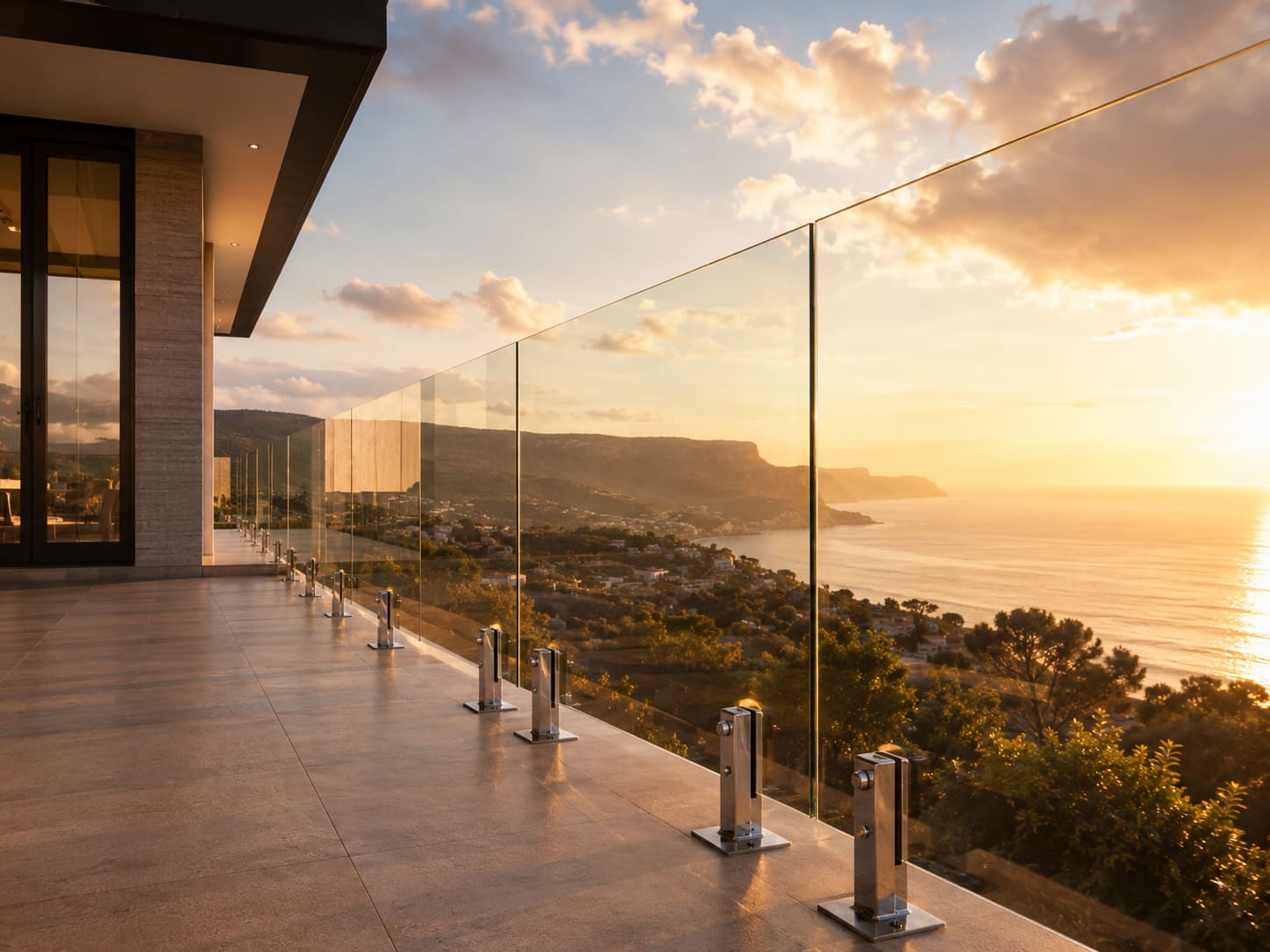
Spigot glass railings hold each panel between pairs of stubby floor-mounted clamps called spigots, needing no top rail and no side frame while staying quick to install and service. They are the most common frameless-look system for pool fencing and balconies in India because a single damaged panel can be swapped without dismantling a whole run.
- Glass: 12 mm toughened minimum, 15-17.52 mm laminated for balconies and pool decks
- Spigots: cast 316 stainless or aluminium, core-drilled into the slab or base-plate mounted
- Cost (Hyderabad): approx. INR 900-2,200 per running foot
- Best for: pool enclosures, ground-level decks and balconies where panels may need future replacement
Each spigot must be anchored into structural concrete or steel; fixing into tile screed alone fails the 0.75 kN/m handrail load required by NBC 2016 and is the single most common cause of a wobbly railing. On tiled Hyderabad terraces we core-drill through the screed into the slab and grout the anchor, then re-tile around the spigot for a clean finish. You can see spigot and frameless runs we have completed in our project gallery.
What glass, interlayer and hardware grade should you specify?
The fixing type sets the minimum glass thickness, but the interlayer and stainless grade decide how the railing ages in Telangana's climate. Get these three specifications right and the system will outlast the building's paint.
- Toughened vs laminated: toughened glass shatters into blunt granules, but a railing over a drop needs laminated glass so those granules stay bonded to the interlayer and the panel does not disappear
- PVB vs SGP interlayer: PVB is cheaper and fine for interiors; SGP is roughly five times stiffer and holds a broken panel far more rigidly, which matters for exposed balconies and pool decks
- Stainless grade: 304 is acceptable for dry indoor stairs, but specify 316 for balconies, terraces, pool surrounds and any site near water, because Hyderabad's monsoon humidity and airborne dust will pit lesser grades
- Edge finish: all exposed edges must be polished (flat-polished or pencil-round) to remove the micro-chips where cracks start
- Glass tint and coating: a light tinted or reflective specialty glass cuts glare and heat on a west-facing balcony without darkening the room
For a fall-protection railing, IS 2553 and NBC 2016 together mean laminated safety glass is not optional, and the exact thickness comes from running the balcony's wind load through IS 875 Part 3 rather than from a catalogue default.
How to choose the right system for your project
Choose the system by fall risk, wind exposure, view priority and budget, then let those four factors dictate glass thickness and interlayer. Any railing guarding a drop must use laminated safety glass so a broken panel is retained.
- View priority high, budget high: frameless base-channel with 17.52 mm SGP-laminated glass
- High-rise balcony with strong wind: framed or spigot with thicker laminated glass, sized to IS 875 Part 3
- Pool or deck at ground level: spigot system in 316 stainless for corrosion resistance
- Budget-led interior stair: framed or semi-frameless in 10-12 mm toughened glass, or a dedicated staircase glass railing
- Coastal or high-humidity microclimates: specify 316 stainless and an SGP interlayer for UV and moisture durability
Match the railing to the rest of the elevation too - a frameless balcony line reads best when it continues the language of the building's glass balcony glazing rather than clashing with it. When in doubt, brief a fabricator on the drop height, floor level and wind exposure first, and let the engineering follow.
Installation, maintenance and getting a quote in Hyderabad
A glass railing is only as good as its anchoring and its measurement. The best glass will still fail inspection if the base channel is fixed to screed or the spigots miss the slab, so installation quality is not a place to save money.
- Site survey: panels are made to measure after a laser survey, because balcony slabs are rarely perfectly straight
- Anchoring: base channels and spigots must reach structural concrete or steel, with anchors sized to the 0.75 kN/m handrail load
- Curing: resin-set channels and grouted spigots need full cure time before load is applied - do not lean on a day-old railing
- Cleaning: wash glass with a soft cloth and mild soap; Hyderabad dust and hard-water spots wipe off easily but etch if left through a monsoon
- Hardware care: rinse 316 stainless occasionally to keep its passive layer bright, especially on pool decks
Hakimi Aluminium and Glass designs, supplies and installs all of these glass railing systems across Hyderabad, Secunderabad and the wider Telangana and Andhra Pradesh region, sizing glass and fixings to NBC 2016 and IS 2553. Tell us the floor level, drop and look you want and we will recommend the system and glass spec - get a free quote with a site measurement included.