The main types of shower enclosures are framed, semi-frameless, frameless, walk-in (wet room), quadrant, and prefabricated cubicle enclosures, distinguished by how much aluminium framing supports the glass and by the shape they enclose. Each type balances glass thickness, cost, watertightness, and installation complexity differently, so the right choice depends on bathroom size, budget, and whether the layout is a corner, alcove, or open wet area.
A shower enclosure is a glass-and-metal barrier that isolates the showering zone from the rest of the bathroom to contain water spray and steam. Modern enclosures almost universally use toughened safety glass conforming to IS 2553, most commonly in 6 mm, 8 mm, 10 mm, or 12 mm thicknesses, with the framing content decreasing (and price increasing) as you move from framed to fully frameless designs.
Hakimi Aluminium and Glass designs, toughens, and installs all six enclosure types across Hyderabad and Secunderabad, from compact quadrant units in Kondapur apartments to spa-grade frameless shower enclosures in Kokapet and Financial District villas. This guide explains each type, its ideal glass thickness, realistic local pricing, and how to match it to your bathroom so you buy once and buy right.
The Six Main Types of Shower Enclosures at a Glance
Before comparing details, it helps to see how the six types differ in framing, glass, and cost. The core trade-off is simple: more aluminium framing means lower cost and better sealing, while less framing means a cleaner look and easier cleaning but higher price and thicker glass.
- Framed: aluminium on all edges, 5-8 mm glass, lowest cost, most watertight.
- Semi-frameless: framing on fixed panels only, 6-8 mm glass, mid-range.
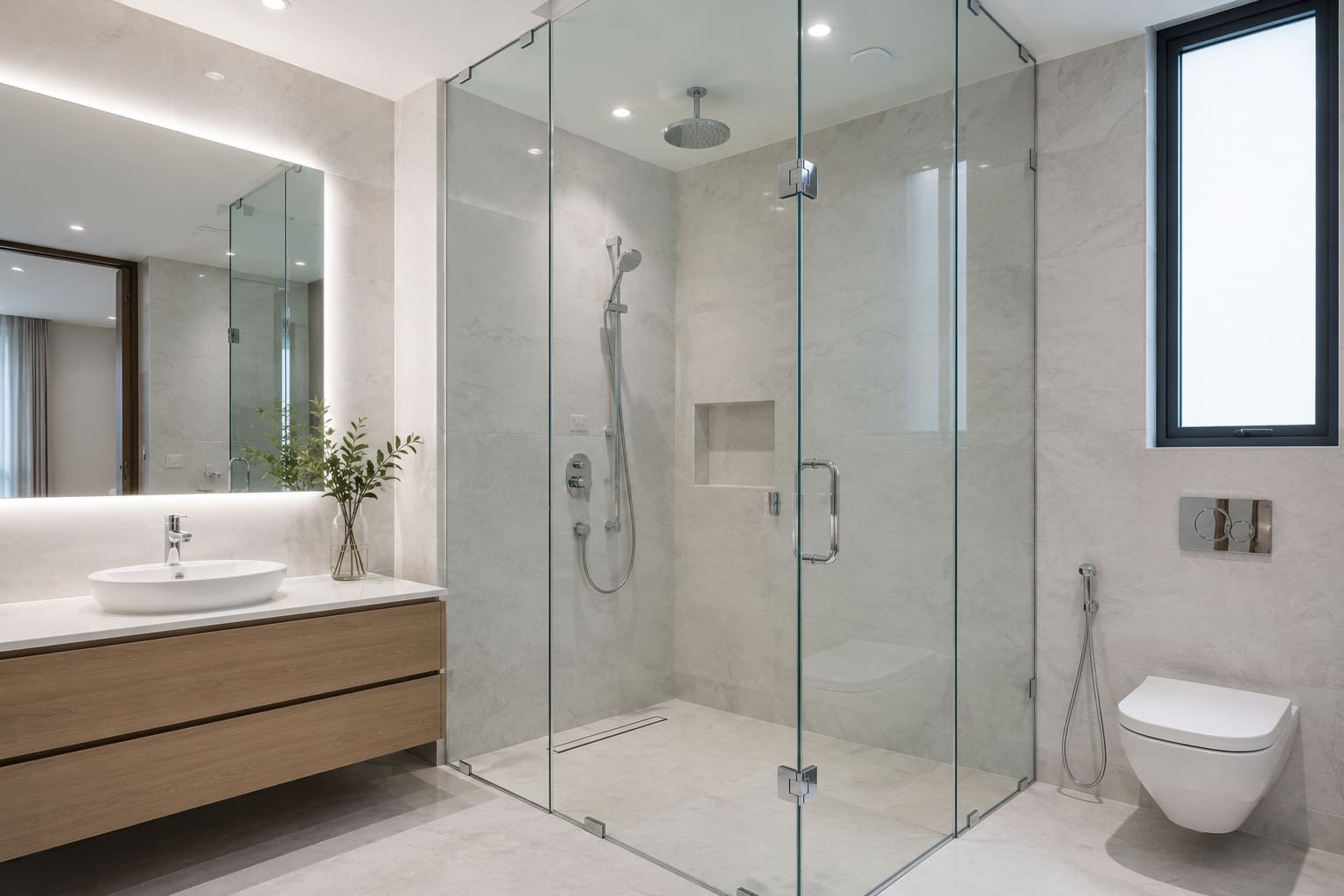
- Frameless: no framing, self-supporting 10-12 mm glass, premium look.
- Walk-in / wet room: doorless fixed screen, 10-12 mm glass, open and accessible.
- Quadrant / corner: curved or angled sliding panels, 6-8 mm glass, space-saving.
- Prefabricated cubicle: factory-made all-in-one unit, standard sizes, quickest to install.
If you are still deciding between glass and aluminium bathroom solutions generally, our range of toughened glass work covers enclosures, doors, and partitions under one roof.
Framed Shower Enclosures
A framed shower enclosure surrounds every edge of the glass with a continuous aluminium frame, making it the most economical and structurally forgiving type. Because the frame carries the load, thinner glass can be used safely, and the rubber or PVC gasket seated in each channel gives the best watertightness of any enclosure type.
- Glass thickness: 5 mm to 8 mm toughened glass (IS 2553 Part 1).
- Framing: powder-coated or anodised aluminium on all four sides plus the door.
- Cost in Hyderabad: approximately INR 450-900 per sq ft, the lowest of all types.
- Best for: budget bathrooms and layouts needing maximum spray containment.
- Drawback: visible metal lines and frame channels that trap water, soap scum, and demand regular cleaning.
Framed units share the same aluminium fabrication logic as our wider aluminium doors and windows work, so profiles are readily available in silver, champagne, black, and wood-finish anodising to match your bathroom fittings.
Semi-Frameless and Frameless Enclosures
Semi-frameless enclosures frame only the fixed panels while leaving the door edges bare, and frameless enclosures eliminate framing entirely, using thick self-supporting glass held by minimal clamps and hinges. Frameless is the premium choice for a clean, contemporary look and is by far the most requested upgrade in new Gachibowli and Madhapur apartments.
- Semi-frameless glass: 6 mm to 8 mm toughened; frameless: 10 mm or 12 mm toughened.
- Frameless hardware: glass-to-glass hinges and clamps in 304/316 stainless steel or brass.
- Cost in Hyderabad: semi-frameless roughly INR 800-1,400 per sq ft; frameless INR 1,200-2,500 per sq ft.
- Advantage: minimal metal means fewer joints for mould and hard-water scale, easier cleaning, and an open, spacious appearance.
- Consideration: frameless doors rely on precise levelling and quality seals; poor installation causes leaks at the pivot points.
Because a frameless door hangs entirely from its glass, fabrication tolerances matter far more than in framed units. See finished examples in our frameless shower cubicle work, and if you only want the door edges free of metal, a semi-frameless shower hits a comfortable middle ground on both price and cleaning.
Walk-In and Wet Room Enclosures
A walk-in enclosure is a fixed glass screen with no door, letting the user step directly into the showering zone, and a wet room extends this concept by waterproofing (tanking) the entire bathroom floor. Both suit larger bathrooms and accessible, step-free designs, and they are increasingly specified in Kokapet and Financial District villa projects where floor space is generous.
- Glass: usually a single 10 mm or 12 mm toughened panel, often with a stabiliser bar.
- No moving door, so there is almost no hardware to fail and nothing to clean along a track.
- Requires correct floor gradient (a fall of about 1:50 to 1:80 toward the drain) to prevent water reaching dry areas.
- Best for: modern minimalist bathrooms, wheelchair access, and family bathrooms where door swing is inconvenient.
- Consideration: needs sufficient room depth (typically 900 mm or more of screen offset) so spray does not escape the open side.
Walk-in screens use a single large toughened panel, which is exactly the sliding shower enclosure family of hardware when a low-clearance sliding door is added for a hybrid layout.
Quadrant, Corner, and Cubicle Enclosures
Quadrant enclosures use two curved or angled glass panels with sliding doors to enclose a corner on a curved tray, while prefabricated cubicles are self-contained factory-made units. These maximise floor efficiency in compact bathrooms, which is why they are the default choice in most Hyderabad 2BHK and 3BHK apartments in Kondapur, Miyapur, and Hitec City.
- Quadrant: curved corner design that saves floor space; ideal for small apartment bathrooms.
- Corner-entry: two straight sliding panels meeting at a right angle.
- Prefabricated cubicle: complete unit with tray, walls, and sometimes a roof, often with acrylic or ABS panels instead of full glass.
- Sliding doors avoid outward door swing, an advantage in tight layouts.
- Glass in quadrant/corner types is typically 6 mm to 8 mm toughened to allow bending or sliding tracks.
Curved quadrant glass must be toughened after bending, so always confirm the fabricator can supply IS 2553 curved-toughened panels rather than cold-bent annealed glass.
What Glass, Safety Standards, and Hardware Should You Specify?
Every glass shower enclosure must use toughened (tempered) safety glass conforming to IS 2553 Part 1, because it is 4-5 times stronger than ordinary annealed glass and, if broken, fragments into small blunt granules rather than sharp shards. This is a life-safety requirement, not an upgrade, and it is the single specification you should never compromise on.
- Toughened glass surface compression under IS 2553 is a minimum of 69 MPa (69 N/mm2).
- Optional anti-limescale nano-coating reduces hard-water spotting, relevant given Hyderabad's moderately hard municipal and borewell water.
- Hinges, clamps, and handles should be grade 304 stainless steel (or 316 for humid, coastal-adjacent Andhra Pradesh coastal towns).
- Low-iron (extra-clear) glass removes the green tint of standard float glass for a truer, brighter appearance.
- Seals and sweeps are PVC or silicone; structural bonding where used should follow ASTM C1401 guidance for structural silicone glazing.
For textured, tinted, frosted, or fluted privacy options beyond clear glass, explore our specialty glass range, which pairs well with frameless enclosures in master bathrooms.
How Hyderabad's Climate and Water Affect Your Choice
Local conditions matter more than most buyers expect. Hyderabad summers push bathroom surface temperatures high, the monsoon spikes humidity, and hard borewell water leaves stubborn white scale on glass, so material and hardware grade should be chosen with the Telangana climate in mind rather than copied from a generic online guide.
- Hard water: borewell supply across Gachibowli, Kondapur, and Kokapet is moderately hard, so a nano-coating plus 10-12 mm frameless glass minimises visible scaling.
- Humidity and monsoon: high ambient moisture accelerates corrosion, making 304/316 stainless hinges and marine-grade fasteners worth the small premium.
- Dust: fine construction and road dust settles in framed channels, so frameless or semi-frameless designs stay presentable with less effort.
- Heat: thermal stress is a non-issue for correctly toughened glass, but avoid dark tints on south-facing bathroom windows adjacent to the enclosure.
- Mineral staining: wipe glass dry after use and squeegee weekly; this single habit doubles the visible lifespan of any enclosure.
How to Choose the Right Type for Your Bathroom
Choose an enclosure type by matching bathroom shape, budget, and cleaning tolerance: framed for lowest cost and best watertightness, frameless for looks and easy cleaning, quadrant for small corners, and walk-in for large or accessible bathrooms.
- Small corner bathroom: quadrant or corner-entry sliding enclosure.
- Tight budget: framed enclosure in 6 mm toughened glass.
- Premium or minimalist look: frameless in 10 mm or 12 mm glass.
- Accessibility or large space: walk-in screen or wet room.
- Measure the opening precisely; custom enclosures accommodate out-of-square walls common in older Hyderabad construction, whereas prefabricated cubicles require standard dimensions.
It also pays to think about the whole bathroom as a system: many clients pair an enclosure with matching frameless glass doors or an LED backlit bathroom mirror for a coordinated finish. You can browse completed installations in our projects gallery, and when you are ready, get a free measurement and quote and our team will survey your bathroom and recommend the right type, glass thickness, and hardware grade.