A skylight is a light-transmitting fenestration set into a roof or ceiling, and the six main types are fixed, vented (ventilating), pyramid, dome, ridge or barrel-vault, and tubular (sun tunnel) skylights. They are distinguished by whether they open, their geometry, and how they are glazed - ranging from a simple sealed rooflight over a stairwell to a multi-facet pyramid crowning an atrium. Each type trades off daylight, ventilation, span, and architectural drama differently, so the right choice depends on where the light needs to land and how the roof is built.
Choosing a skylight type depends on roof pitch, clear span, ventilation needs, and climate. In the hot composite climate of Hyderabad and Secunderabad - long dry-heat summers, a dusty pre-monsoon, and heavy monsoon downpours - glass selection and shading matter as much as the shape itself, because an unshaded rooflight can pour intense solar heat into a room. Modern skylights answer this with insulated double glazing, low-emissivity (low-E) coatings, and laminated safety glass, all governed by Indian standards such as IS 2553 for safety glass and structural guidance in the National Building Code of India (NBC) 2016.
This guide breaks down all six types, the glass and framing that make an overhead installation safe, realistic per-square-foot costs in Telangana, and how to keep a skylight cool and leak-free through both the summer and the monsoon. Our skylight fabrication team installs every type described below across Hyderabad, and you can get a free quote once you know which one fits your roof.
What Are the Main Types of Skylights?
There are six primary skylight types, each defined by a mix of operation, geometry, and glazing. Understanding them at a glance makes the rest of the specification - glass, frame, and shading - much easier to reason about.
- Fixed: sealed, non-opening rooflight for pure daylight over stairwells, corridors, and double-height rooms.
- Vented (ventilating): opens manually or by motor to exhaust hot air and humidity from kitchens, baths, and stairwells.
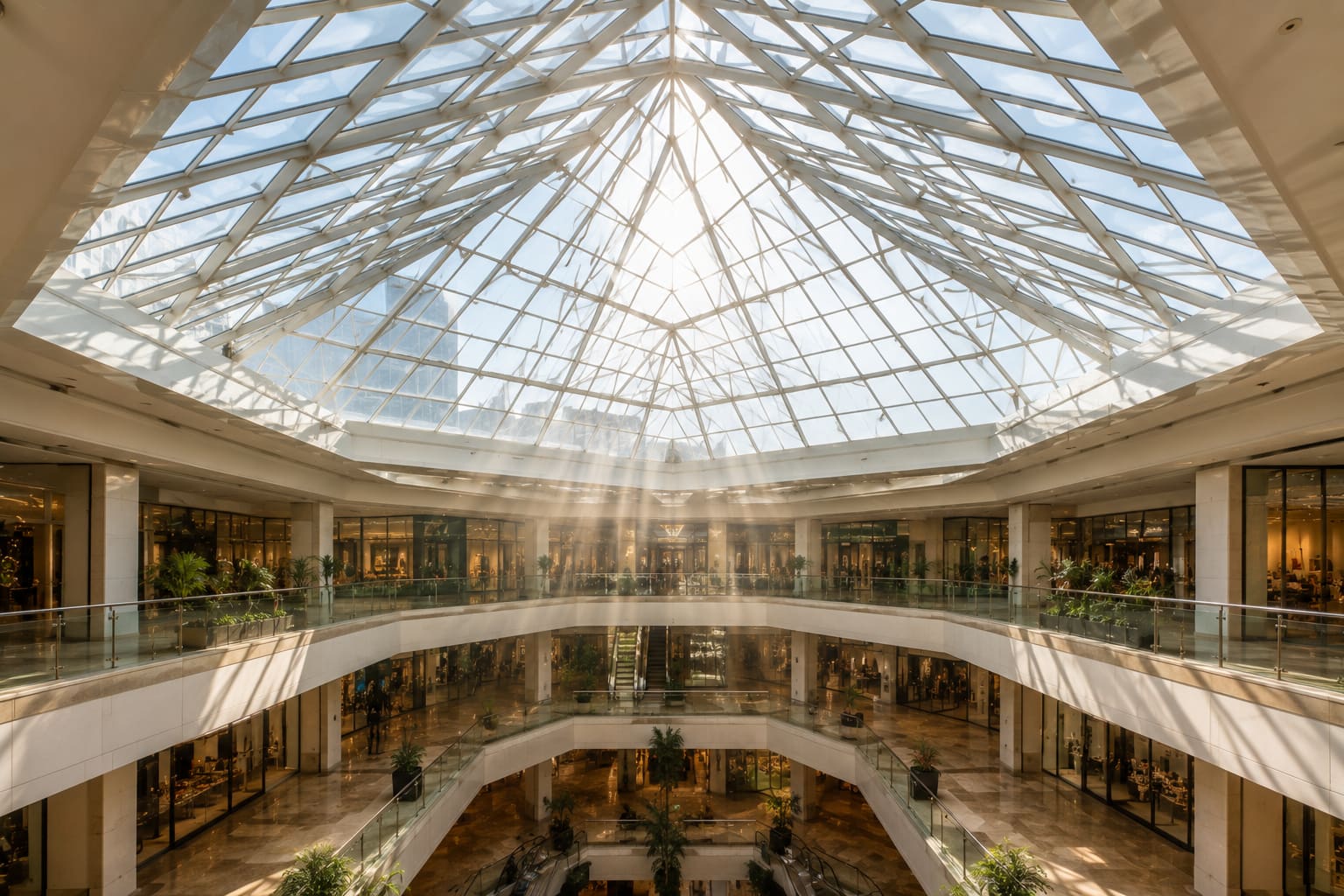
- Pyramid: triangular or trapezoidal glass facets on an aluminium frame, crowning square or rectangular atriums.
- Dome: curved glass, acrylic, or polycarbonate that self-drains and sheds impact, common on flat commercial roofs.
- Ridge / barrel-vault: linear vaulted glazing running over corridors, walkways, and long atrium spans.
- Tubular (sun tunnel): a small roof dome pipes daylight through a reflective tube to a ceiling diffuser in interior rooms.
The first four are usually built as bespoke flat-roof skylight or curved skylight units, while pyramids and vaults belong to the larger glass atrium family. The sections below take each in turn.
Fixed Skylights
A fixed skylight is a sealed, non-opening rooflight that delivers daylight but no ventilation, which makes it the simplest and most leak-resistant type. Because there are no hinges, actuators, or opening gaskets, there is very little that can fail, and it is the natural choice wherever the opening would be out of reach anyway - over a stairwell, a corridor, or a double-height living room in a Kokapet or Financial District villa.
- Best for: maximum daylight, high or inaccessible ceilings, and near-zero maintenance.
- Glazing: typically 8-12 mm toughened glass or 6+6 mm laminated glass to IS 2553, upgraded to an insulated double-glazed unit for thermal control.
- Advantages: fewest failure points, best watertightness during the monsoon, and the lowest cost within its size class.
- Limitation: no ventilation, so in Hyderabad's heat you should pair it with low-E or solar-control glass to limit heat gain.
For overhead safety and toughness, fixed units are almost always built with laminated glass work, so a cracked pane holds together rather than raining shards into the room below.
Vented (Ventilating) Skylights
A vented skylight opens - manually with a crank or pole, or electrically by motor - to exhaust hot air and moisture through the roof using the stack effect. Hot air naturally collects at ceiling level, and an opening skylight lets it escape, pulling cooler air up from the living space. That makes vented units genuinely useful in Hyderabad kitchens, bathrooms, and stairwells where passive cooling and humidity control save on air-conditioning.
- Operation: manual crank, solar-powered actuator, or mains-electric motor, often with rain sensors that auto-close at the first drops.
- Benefit: releases trapped ceiling-level heat, aiding passive cooling through long summer afternoons in Gachibowli and Kondapur.
- Glazing: laminated or toughened safety glass; an insulated unit keeps heat out when the skylight is shut.
- Consideration: more moving parts and seals than a fixed unit, so specify quality EPDM gaskets and plan for periodic checks.
Rain sensors are not a luxury in Telangana - monsoon showers arrive fast, and an auto-closing motorised unit protects interiors when nobody is home. If you also want a controllable roof over a terrace rather than a fixed pane, a louvered-roof pergola offers adjustable shade and ventilation over an outdoor space.
Pyramid, Dome & Ridge Skylights
Pyramid, dome, and ridge skylights are structural glazed forms that span large openings and shed water by their very shape, which is why they dominate atriums, hotel lobbies, and mall courtyards. Their geometry does double duty: it drains rain and dust runoff away from joints, and it adds height and drama that a flat pane cannot.
- Pyramid: 3-facet to multi-facet aluminium frames for square or rectangular atriums, giving a soaring central peak. Our pyramid skylight systems are the go-to for lobby centrepieces.
- Dome: a curved single-piece or segmented unit in acrylic and polycarbonate for smaller openings, or curved glass for premium projects; naturally self-draining and impact-shedding.
- Ridge / barrel-vault: linear vaulted glazing for corridors, walkways, and long spans where a single peak would not suit.
- Structure: framing designed to IS 875 Part 3 for wind load, with structural silicone glazing per ASTM C1401 where the glass is bonded rather than captured.
- Glazing: double-glazed laminated units are standard on large spans to meet both safety and thermal requirements.
These larger installations overlap with atrium roof glazing and the wider canopies and skylights scope, and are best sized with proper wind and drainage engineering rather than off-the-shelf assumptions.
Tubular Skylights (Sun Tunnels)
A tubular skylight - also called a sun tunnel or light pipe - channels daylight through a small roof-mounted dome and a highly reflective tube down to a ceiling diffuser, typically 250-550 mm in diameter. It is the only type that reaches deep interior rooms, closets, and internal bathrooms where a conventional skylight simply cannot see the sky.
- Diameter: commonly 250 mm, 350 mm, or 550 mm, serving rooms of roughly 10-30 sq m.
- Efficiency: mirror-finish tubes transmit 95-98% of captured light, delivering the equivalent of many watts of electric lighting through the day.
- Advantages: minimal heat gain, low cost, and quick installation with no structural framing to build.
- Best for: retrofits, upper-floor flats, and interior rooms far from any external wall or roof edge.
Because a sun tunnel admits very little heat while delivering strong daylight, it is often the smartest daylighting move in a Hyderabad apartment where a full glass skylight would overheat the room. It is also the fastest to install - most units go in within a day without disturbing the ceiling structure.
Glass, Safety Standards & Energy Performance
Skylight performance is defined by its glazing, frame, and compliance with Indian standards, with safety glass mandatory for any overhead application. The single most important rule for a rooflight is that the glass must not fall on the people below if it breaks - which is why laminated glass, held together by its interlayer, is preferred overhead even over toughened glass.
- Safety glass: toughened or laminated glass to IS 2553; laminated is recommended overhead to prevent fall-through of fragments.
- Thermal: single glazing sits near a U-value of 5.5-6.0 W/m2K, while a double-glazed low-E unit reaches about 1.4-2.8 W/m2K.
- Codes: NBC 2016 covers structural and safety provisions, while ECBC and BEE guidance address glazing energy performance.
- Wind and structure: framing and fixings designed to IS 875 Part 3 wind loads, with proper flashing and slope for drainage.
- Hot-climate tip: specify low-E or solar-control coatings and external or internal shading to control glare and heat in Hyderabad and Secunderabad.
For the best summer comfort, a DGU (double-glazed unit) with a solar-control coating cuts heat while keeping daylight, and heavier or safety-critical roofs use toughened glass work beneath a laminated top pane. If people will walk over the glazing - a rooftop terrace or a glass link - that becomes a walkable glass floor design with a far heavier laminated build-up.
How Much Does a Skylight Cost in Hyderabad?
Skylight prices in Hyderabad typically run from about INR 900 to INR 3,500 per square foot, driven mainly by the glass build-up, frame system, and structural complexity. A simple fixed rooflight in single toughened glass sits at the lower end, while a large double-glazed pyramid over an atrium sits at the top.
- Fixed single-glazed toughened rooflight: roughly INR 900-1,500 per sq ft installed.
- Fixed or vented double-glazed low-E unit: roughly INR 1,600-2,400 per sq ft.
- Pyramid, dome, or barrel-vault with structural framing: roughly INR 2,200-3,500 per sq ft and up for large spans.
- Tubular sun tunnel: often priced per unit rather than per sq ft, and among the most affordable daylighting options.
Motorisation, rain sensors, curved or bent glass, and structural silicone glazing all add cost, while larger areas usually lower the per-sq-ft rate. These are indicative Hyderabad ranges - the real figure depends on your roof, and you can see the quality behind them in our completed projects or request a detailed quote for your specific opening.
Which Skylight Type Should You Choose?
Match the type to the job: use fixed skylights for pure daylight in unreachable spots, vented units where heat and humidity need to escape, and structural pyramid or vault forms where a large opening needs both drama and drainage. Tubular units win whenever the room has no roof access of its own.
- Stairwell or double-height living room: fixed skylight with laminated low-E glass.
- Kitchen, bathroom, or top-floor bedroom: vented skylight with a rain sensor for monsoon safety.
- Atrium, lobby, or courtyard: pyramid, dome, or barrel-vault, engineered for wind and drainage.
- Interior room, closet, or internal bath: tubular sun tunnel for daylight with minimal heat.
- Commercial roof needing budget daylight: dome units in polycarbonate for economy and impact resistance.
Whatever the shape, the two decisions that make or break comfort in Telangana are the glass (insist on laminated safety glass, and low-E for anything sun-facing) and the shading. When you are ready to move from planning to fabrication, our skylight specialists can survey the roof, size the structure, and recommend the exact glass build-up for your climate and budget.