Tempered glass, also called toughened glass, is a safety glass made by heating ordinary annealed glass to approximately 620-650°C and then cooling it rapidly with jets of air, a process that locks the surfaces in compression and the core in tension to make the glass roughly 4 to 5 times stronger than untreated glass of the same thickness. This same internal stress causes it to break into small, blunt, cube-like granules instead of long sharp shards, which is why building codes classify it as a safety glazing material and why it is the default glass for doors, railings, showers and facades.
The strengthening is purely physical, not chemical, so tempered glass keeps the same clarity, colour and light transmission as the annealed float glass it starts from. Because the balance of compression and tension is fixed during manufacture, tempered glass cannot be cut, drilled or ground afterward without shattering, so every hole, notch and polished edge must be finished before tempering. In India its manufacture and performance are defined by IS 2553, and it is the standard choice wherever human impact, thermal stress or wind load makes ordinary glass unsafe.
This guide from Hakimi Aluminium and Glass explains how tempered glass is made, exactly how strong it is, the thicknesses and specifications used in real projects, its common applications, and honest Hyderabad pricing so you can specify the right glass with confidence. If you already know what you need, you can get a free quote for supply and installation across Hyderabad and Secunderabad.
How Is Tempered Glass Made?
Tempered glass is produced by heat-treating pre-cut annealed float glass in a horizontal roller furnace and then quenching it with high-pressure air, a controlled process known as thermal toughening. The whole cycle takes only a few minutes but permanently changes how the glass behaves.
- Cutting and edge-working: The glass is cut to its final size and all edges, holes and cut-outs are finished first, because none of this is possible once the panel is toughened.
- Heating: The glass travels through the furnace on ceramic rollers and is heated uniformly to about 620-650°C, close to its softening point.
- Quenching: Arrays of nozzles blast cool air onto both faces at once, freezing the outer surfaces while the centre is still hot and soft.
- Stress locking: As the hot core cools and contracts, it pulls the already-rigid surfaces into permanent compression, storing the elastic energy that later drives safe fragmentation.
The result is a fully tempered panel whose strength and break pattern meet safety-glass requirements. This is the same toughening step behind our toughened glass work and frameless glass doors, where the glass must survive daily impact without a frame to protect its edges.
How Strong Is Tempered Glass?
Tempered glass is 4 to 5 times stronger in bending and impact resistance than annealed glass of identical thickness, and it withstands far greater thermal shock. That strength is what allows large frameless spans and slim, minimal hardware.
- Mechanical strength: Fully tempered glass typically carries a surface compression of at least 69 MPa (10,000 psi), the threshold used in ASTM C1048, and matching criteria in IS 2553.
- Fragmentation: On failure it dices into thousands of small granules; standards specify a minimum fragment count within a defined 50 mm square to confirm the break is genuinely safe.
- Thermal resistance: It tolerates thermal stress up to roughly 250-300°C and sudden temperature differentials of about 200°C, versus only ~40°C for annealed glass. That margin matters on Hyderabad's west-facing elevations, where afternoon summer sun and sudden monsoon downpours create exactly the kind of hot-then-cold shock that cracks ordinary glass.
- Wind and load: Because it flexes further before failing, tempered glass handles the wind pressures seen on tall towers in Gachibowli and the Financial District, engineered to IS 875 (Part 3).
Because it cannot cause the deep laceration injuries associated with sharp shards, tempered glass is mandated for safety-critical positions such as doors, low-level glazing and wet areas.
Tempered Glass Thicknesses, Sizes and Specifications
Tempered glass is available in standard thicknesses from 4 mm to 19 mm, with the choice driven by span, wind load and application. Getting this right is the single biggest factor in whether a frameless installation feels solid or flimsy.
- 4-6 mm: Shower screens, appliance glass, small framed windows and light partitions.
- 8-10 mm: Frameless glass doors, office partitions and standard balustrades.
- 12 mm: Larger frameless doors, structural railings and shopfronts that must feel rigid underhand.
- 15-19 mm: Structural glass fins, canopies and heavy-duty balustrades carrying real load.
- Wind load: For facades, glass thickness is engineered to IS 875 (Part 3) wind provisions and NBC 2016 for the building's height and exposure category.
Tempered glass is also the base ply for laminated safety glass and can be coated, tinted or built into low-E insulated glass units (IGUs) for energy performance under the Energy Conservation Building Code (ECBC), which is increasingly written into approvals for large commercial projects in Hitec City and Kokapet. For sealed double-glazed elevations we specify these as DGU facade systems.
What Is Tempered Glass Used For?
Tempered glass is used wherever strength, thermal resistance or human safety is required, which makes it the standard glazing for most modern architectural work. In practice, almost every visible glass surface in a new office or home in Hyderabad is toughened.
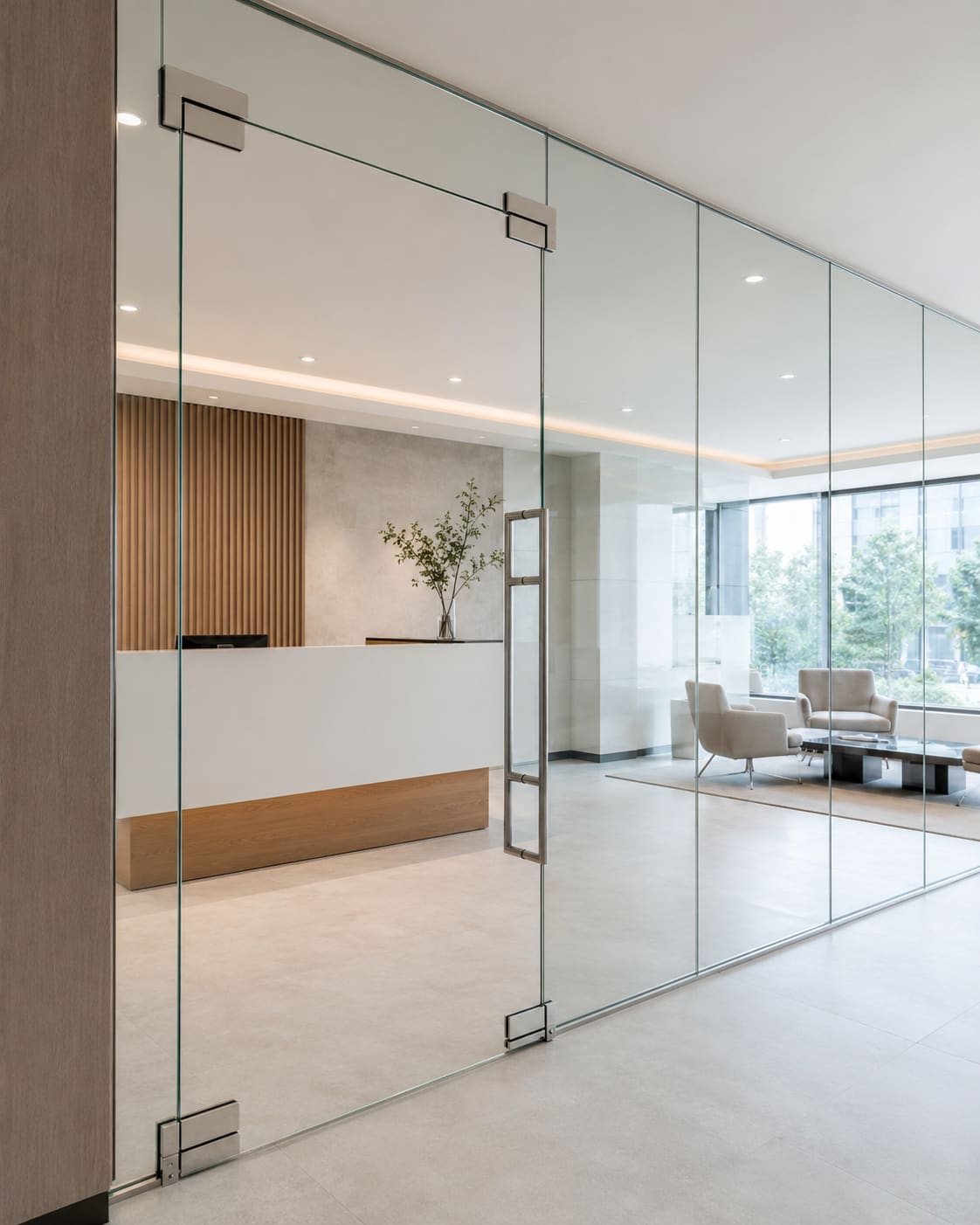
- Frameless entrance systems: toughened glass shopfronts and office glass cabins for showrooms and workplaces.
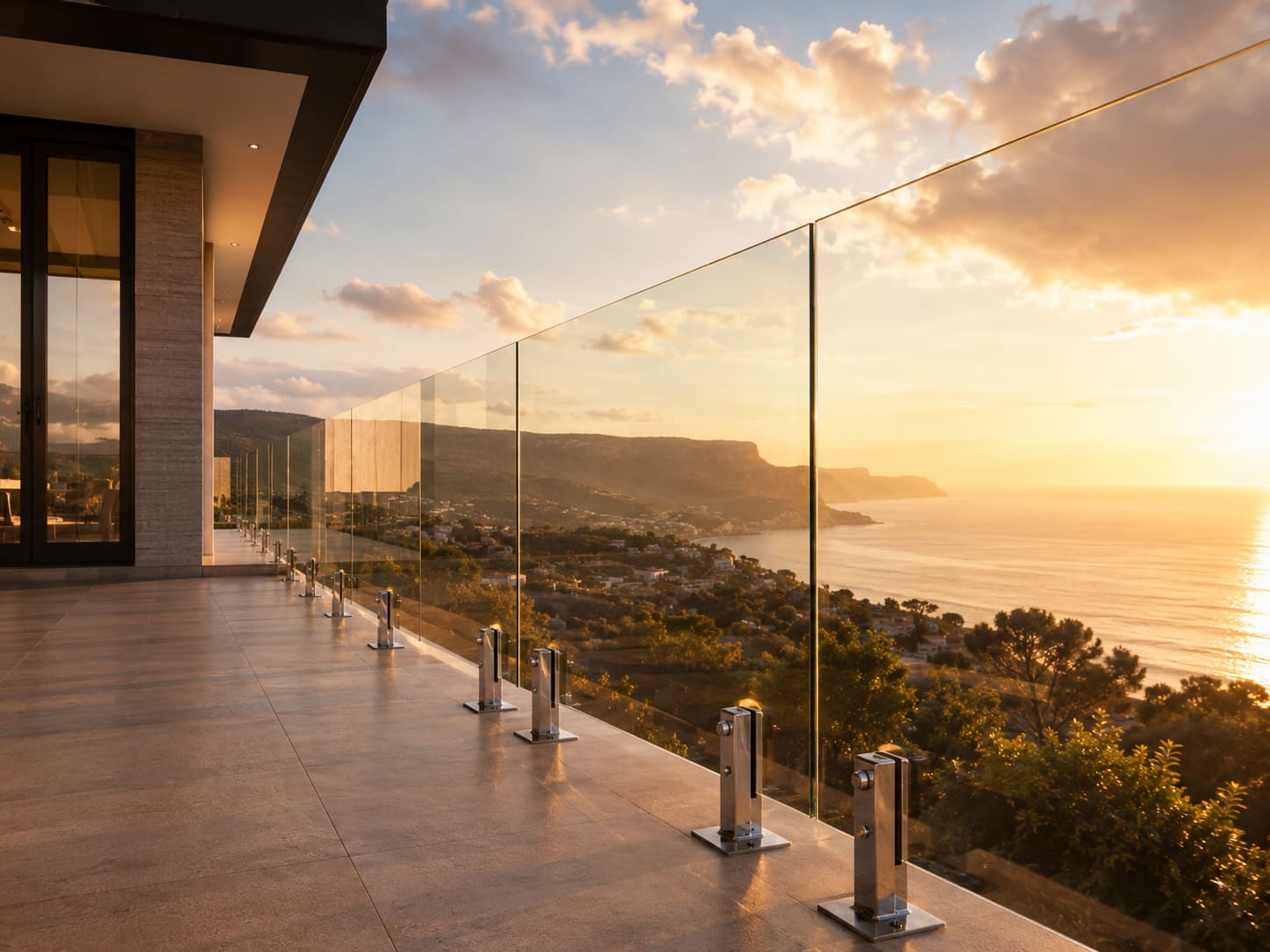
- Railings and balustrades: frameless spigot railings and staircase glazing that carry code-required loads.
- Facades and point-fixed glazing: curtain walls, structural glazing and spider glazing for statement elevations.
- Wet areas: frameless shower enclosures and bathroom partitions that resist heat and splashing.
- Overhead and outdoor: glass canopies, skylights and floors (usually laminated as well for fall-through safety).
- Interiors and products: glass partitions, furniture, tabletops, appliance panels and phone screens.
You can see a range of completed toughened-glass installations across the city in our project gallery, from residential balconies in Kondapur to full commercial fronts in Madhapur.
Tempered vs Laminated vs Annealed Glass
Tempered, laminated and annealed glass differ mainly in how they break and where each is safe to use, and they are often combined rather than treated as competing alternatives.
- Annealed glass: Ordinary float glass; breaks into large sharp shards and is not a safety glass, suited only to picture frames and non-critical windows.
- Tempered glass: Heat-strengthened safety glass that shatters into blunt granules; strong and impact-resistant, but the whole pane falls out of the opening when it breaks.
- Laminated glass: Two or more plies bonded by a PVB or SGP interlayer; it holds together when cracked, giving security, acoustic and overhead-safety benefits. Explore this in our laminated glass work.
- Toughened-laminated glass: Combines both, delivering high strength plus post-breakage retention for skylights, balustrades and overhead glazing.
For any position above head height, or where a person could fall through, laminated (usually tempered-laminated) glass is preferred over plain tempered glass. For a deeper side-by-side breakdown, see our guide on toughened vs laminated glass.
How Much Does Tempered Glass Cost in Hyderabad?
In Hyderabad, plain clear tempered glass typically costs roughly ₹110-260 per square foot for the glass alone, with the price rising by thickness, tint, coatings and edge finish. Fabricated items priced complete cost more once hardware and labour are added.
- 6 mm clear toughened: about ₹110-140 per sq ft.
- 8 mm clear toughened: about ₹150-180 per sq ft.
- 10 mm clear toughened: about ₹180-210 per sq ft.
- 12 mm clear toughened: about ₹220-260 per sq ft.
- Tinted, low-E, or heat-soaked glass and cut-outs for hardware add a premium on top of these figures.
Installed prices for complete systems such as a frameless shower or a glass railing are higher because they include patch fittings, spigots, hinges, silicone and site labour. Because rates move with float-glass prices and project size, the reliable way to budget is a measured quotation. Tell us the location, thickness and finish and we will share a detailed estimate for supply and fitting anywhere in Hyderabad, Secunderabad and the wider Telangana and Andhra Pradesh region.
Why Does Tempered Glass Sometimes Break on Its Own?
Tempered glass occasionally shatters with no obvious impact, and the usual cause is a microscopic nickel sulphide (NiS) inclusion trapped inside the glass during manufacture. Over months or years, and especially under solar heat, the inclusion slowly changes phase and expands, releasing the stored central tension and detonating the pane.
- The statistical risk is low, but on a large facade with hundreds of panels it is not zero, which is why critical elevations get extra protection.
- Heat-soak testing to EN 14179 deliberately holds the glass at about 290°C to trigger unstable NiS panels in the factory, so they fail there rather than on site.
- Edge damage, poor installation, and glass clamped hard against metal without a gasket also cause delayed breakage, so quality fabrication and setting blocks matter as much as the glass itself.
- On tall towers around Gachibowli and the Financial District, we specify heat-soaked glass and, for overhead or fall-risk positions, tempered-laminated units so a failed pane stays in place.
In short, spontaneous breakage is real but manageable with the right specification and a careful installer.
How to Choose and Care for Tempered Glass
Choosing tempered glass well comes down to matching thickness and glass type to the load, the location and the safety risk, then protecting the edges during handling and use. A few practical rules cover most projects.
- Match thickness to span: thicker glass for taller doors, wider railings and windier elevations; do not under-spec to save a small amount.
- Use laminated-tempered anywhere a fall or overhead break is possible, such as skylights, glass floors and high balustrades.
- Protect the edges: chips and nicks are where breakage starts, so avoid metal-to-glass contact and use proper gaskets and setting blocks.
- Clean gently: mild soap, water and a soft cloth are enough; abrasive pads and metal scrapers can scratch coatings and stress the surface. Hyderabad dust and monsoon grime wipe off easily and do not need harsh chemicals.
- Buy from a fabricator who owns the process: consistent tempering, correct heat-soaking and clean edge-work are what separate a durable installation from a callback.
Hakimi Aluminium and Glass supplies and installs tempered glass across every application above, from a single glass door to a full glass facade, with specification advice built into every quote.