Smart glass wins on instant, gap-free privacy and a clean frameless look, while blinds win on upfront cost and adjustable daylight control. For most Hyderabad offices, clinics and premium homes, switchable smart glass is worth the premium in client-facing and hygiene-critical rooms, whereas blinds remain the sensible pick for bedrooms, rented flats and any space where you mainly want to dim the sun. That is the short answer; the right call depends on your room, your budget and how often you actually switch privacy on and off.
The two products solve the same problem in completely different ways. Smart glass turns from clear to opaque electrically using a PDLC film laminated inside the glass, so privacy is built into the panel itself. Blinds sit in front of the glass and physically block the view with slats or fabric that you raise, lower or tilt. One is architecture; the other is an accessory.
At Hakimi Aluminium and Glass we fit both across Hyderabad, Secunderabad and wider Telangana and Andhra Pradesh, from Gachibowli boardrooms to Kokapet villas, so we see where each option genuinely earns its keep. This guide breaks down privacy performance, real INR pricing, maintenance in our dusty monsoon climate and the everyday practicality of each, so you can decide with confidence rather than marketing hype.
How does each option actually deliver privacy?
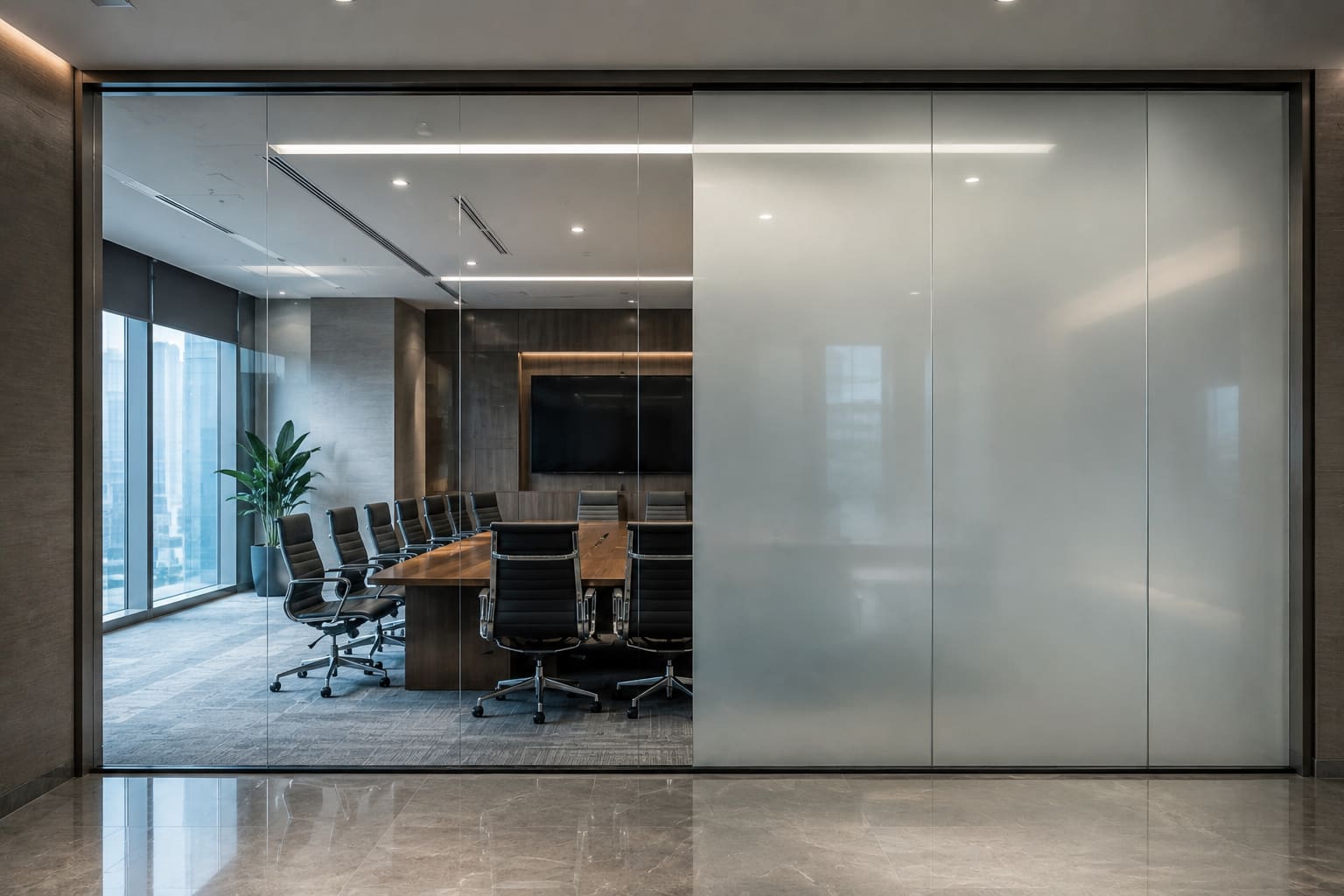
Smart glass uses a PDLC (Polymer Dispersed Liquid Crystal) layer laminated between two sheets of glass. Apply power and the crystals align, so the glass is clear; cut power and they scatter, turning the glass milky white and opaque in under a second while still letting soft, glare-free daylight through. There are no gaps, no viewing angles and no hardware on show, which is why it looks so clean in a frameless glass partition or a boardroom wall.
Blinds work mechanically. Roller, Venetian, Roman and zebra blinds hang in front of the glass, and you control both view and light by raising, lowering or tilting them. That gives you fine control over how much daylight enters, but privacy is never absolute: tilted slats leave narrow sightlines, and there are always small gaps at the edges.
- Smart glass: full opacity on demand, zero visible hardware, flat wipe-clean surface, but privacy is all-or-nothing.
- Blinds: adjustable, familiar and low-tech, but slats and cords collect dust and can warp in humid weather.
The practical difference shows up in real rooms. In a doctor's consultation room or a bank's discussion cabin, a single tap that frosts an entire glass wall reads as far more professional than fumbling with a blind cord while a client waits.
Smart glass vs blinds: cost comparison in INR
This is usually the deciding factor, so let us be specific. Smart glass is a premium product, while blinds span budget to luxury. Prices below are indicative Hyderabad rates for 2026 and vary with panel size, glass thickness and control method.
- Switchable PDLC smart glass: roughly INR 3,500 to INR 6,500 per sq ft installed, depending on glass thickness, panel size and whether you add remote, sensor or app control.
- Retrofit PDLC smart film on existing glass: around INR 2,500 to INR 4,000 per sq ft, a cheaper route when the glazing is already in place.
- Roller and zebra blinds: about INR 150 to INR 600 per sq ft.
- Motorised or premium honeycomb blinds: roughly INR 800 to INR 2,500 per sq ft.
To put that in project terms, a single 4ft x 7ft cabin partition in smart glass may land around INR 1,00,000 to INR 1,80,000, while quality motorised blinds for the same span might cost INR 20,000 to INR 45,000. Smart glass is clearly an investment; you are paying for instant switching, laminated durability, energy-saving glare control and a frameless finish that blinds simply cannot replicate. If the room is somewhere clients or patients will see, that premium often pays for itself in perceived quality.
Which lasts longer in Hyderabad's climate?
Durability matters more here than in cooler, drier cities. Telangana and Andhra Pradesh throw heat above 42 degrees in summer, heavy monsoon humidity and fine construction dust at any glazing product, and the two options age very differently.
Smart glass has no moving parts to wear out. The PDLC film is sealed inside laminated glass, so dust and humidity never touch it, and quality film typically holds its switching performance for 8 to 12 years. The components most likely to need service are the low-voltage transformer and the controller, both easily replaced without touching the glass.
Blinds take a beating in our climate. Slats and fabric trap the dust that blows across sites in Kondapur and the Financial District, cords and tilt mechanisms wear out with daily use, and fabric can fade or sag in the humidity. Expect to replace mid-range blinds every 4 to 7 years, and to clean them far more often than you would like.
- Smart glass: sealed, no consumable parts, 8 to 12 year film life, minimal servicing.
- Blinds: exposed slats and cords, 4 to 7 year replacement cycle, frequent cleaning in dusty areas.
Maintenance and hygiene: which is easier to keep clean?
For any space where hygiene matters, smart glass has a decisive edge. A flat glass surface wipes clean in seconds with a standard glass cleaner, and there are no fabrics, cords or slats to harbour dust, allergens or bacteria. That is exactly why clinics, dental practices, pathology labs and cleanrooms across Hyderabad increasingly specify smart glass over blinds for their partitions and office glass cabins.
Blinds, by contrast, are fiddly to clean well. Each slat needs wiping, fabric blinds may need vacuuming or professional cleaning, and the mechanisms collect grime that shortens their life. In a busy Madhapur office with dozens of cabins, that maintenance burden adds up quickly across a year.
- Choose smart glass for hygiene-critical, high-usage or genuinely low-maintenance spaces.
- Choose blinds where the budget is tight or you specifically want graduated daylight control rather than all-or-nothing privacy.
There is a comfort angle too: because smart glass diffuses rather than blocks light when frosted, rooms stay softly lit instead of going dark, which many clients prefer over the harsh light-and-shadow banding that slatted blinds create.
Do smart glass and blinds save energy?
Both help with Hyderabad's cooling load, but in different ways. Blinds reduce heat gain only when they are down, and a closed blind also blocks your view and daylight, so people tend to leave them open and lose the benefit. Smart glass in its frosted state still diffuses daylight while cutting glare, so you get natural light and privacy at once, which reduces reliance on artificial lighting during the day.
For larger glazed elevations, the bigger energy story is the glass itself rather than what covers it. If you are glazing a whole facade, pairing switchable panels with high-performance DGU facade glazing does far more for your air-conditioning bill than any blind can, by cutting solar heat gain at the building envelope.
That said, blinds remain the cheaper way to knock back a hot west-facing afternoon window in a home. For a single bedroom in a Kondapur flat, a good honeycomb blind is a perfectly rational, low-cost heat control choice; you do not need switchable glass for that job.
Which should you pick for your space?
Match the product to the room rather than picking a favourite. Smart glass shines in office cabins, boardrooms, clinics, luxury bathrooms and villa facades where a switch-to-frosted effect adds real wow and hygiene value, and where the frameless look justifies the cost. Blinds remain the practical, affordable pick for bedrooms, kitchens, rented flats and any space where dimming sunlight matters more than instant, complete opacity.
A quick decision guide from our project experience:
- Pick smart glass: client-facing meeting rooms, doctor and dental cabins, boardrooms, premium bathrooms, glass conference walls, high-end villa glazing.
- Pick blinds: bedrooms, kitchens, rented or short-stay flats, back-office windows, budget fit-outs, rooms needing graduated dimming.
- Consider a blend: mixed office floors where a few statement rooms get smart glass and the rest get blinds.
Many of our Hitec City and Financial District clients do exactly that last option, putting smart glass partitions on the rooms visitors see and blinds on the back-office windows nobody does. You can see a range of installed work in our project gallery to judge the finished effect for yourself.
Common mistakes to avoid when choosing
A few missteps come up again and again on Hyderabad projects, and all are easy to avoid with the right advice up front.
- Buying smart glass for a room you rarely need private: if you switch it once a week, blinds deliver the same result for a fraction of the cost.
- Forgetting the electrical point: smart glass needs a discreet low-voltage supply, so plan the wiring before the glass goes in, not after.
- Expecting smart glass to block all light: it diffuses light when frosted, it does not black out a room, so add a blackout blind in bedrooms if you need full darkness.
- Underestimating blind maintenance in dusty areas like Kokapet and outer Gachibowli, where slats need cleaning far more often than showroom demos suggest.
- Choosing on price alone: the cheapest blind or the flashiest glass is rarely the best fit; the room's function should drive the decision.
If you want the numbers and options for your exact rooms, get a free quote and we will measure on site across Hyderabad, Secunderabad and Andhra Pradesh, then give you side-by-side smart glass and blind pricing so the comparison is clear before you commit. It also helps to read our plain-English guide on how smart glass works before you finalise.