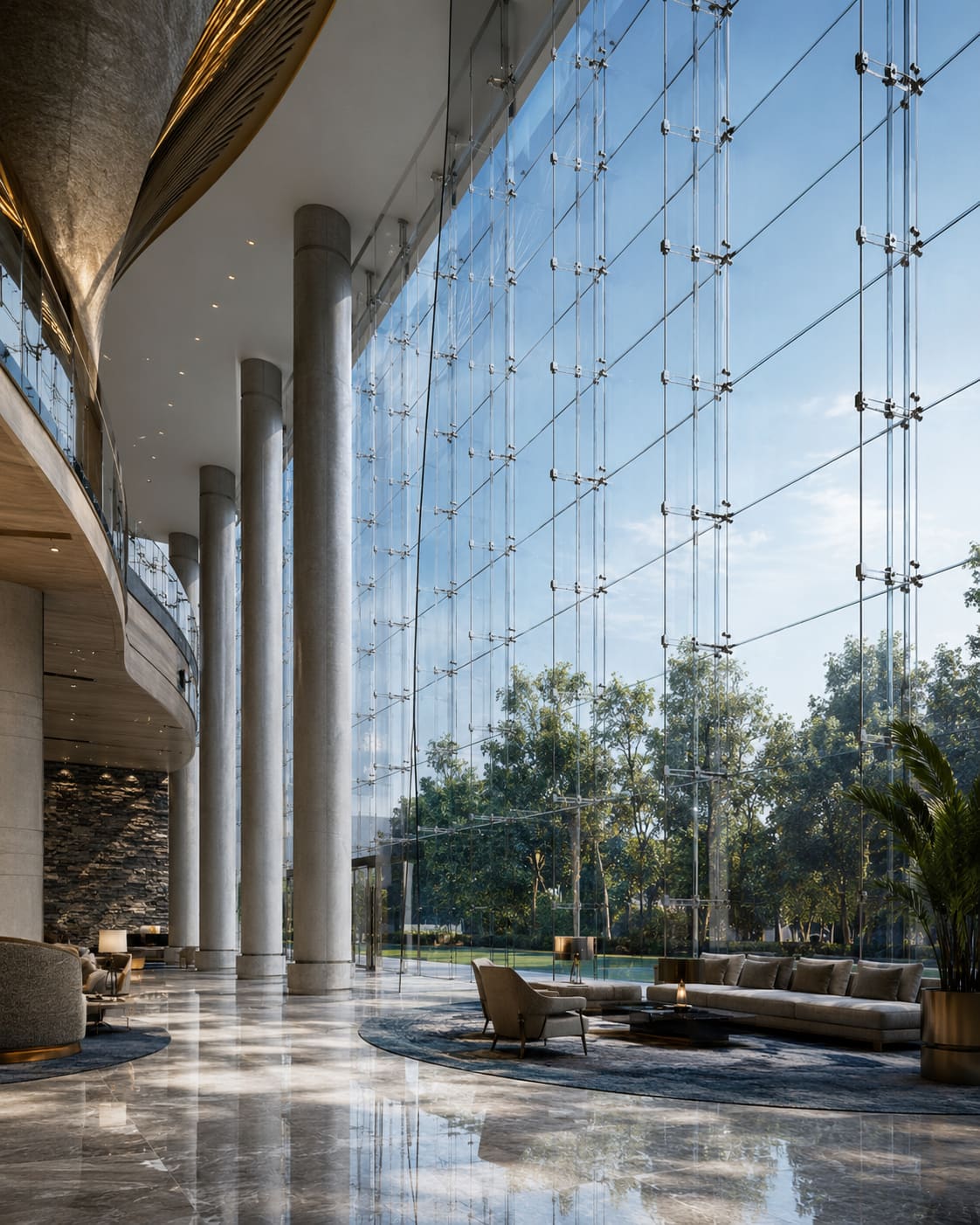
The short answer: choose spider glazing when you want a frameless glass look at a workable budget on normal floor-to-floor heights, and choose a cable-net facade when you have a tall, single-volume space and the budget for a signature, near-invisible glass wall. Spider glazing runs roughly INR 1,600 to INR 3,200 per sq ft installed in Hyderabad, while a cable-net facade typically lands between INR 3,000 and INR 6,500 per sq ft because of the cable tensioning and stiff anchoring it demands. Both are point-fixed systems that replace bulky aluminium frames with stainless steel fittings and maximum transparency, but they behave very differently on structure, span and cost.
When a client wants a lobby, atrium or showroom frontage that reads as one seamless sheet of glass, the spider vs cable facade question comes up almost immediately. The two systems look similar in a rendering but diverge sharply once you factor in the primary structure behind the glass, the wind loads of the Telangana plateau, and how much you are willing to spend per square foot.
At Hakimi Aluminium and Glass we design and install both across Hyderabad, Secunderabad and the wider Telangana and Andhra Pradesh markets, from IT-park receptions in HITEC City and Gachibowli to hotel entrances, hospital atriums and premium showroom facades in Kokapet and the Financial District. This guide breaks down how each system works, what each realistically costs in INR, and which one suits your building.
What is spider glazing and how does it work?
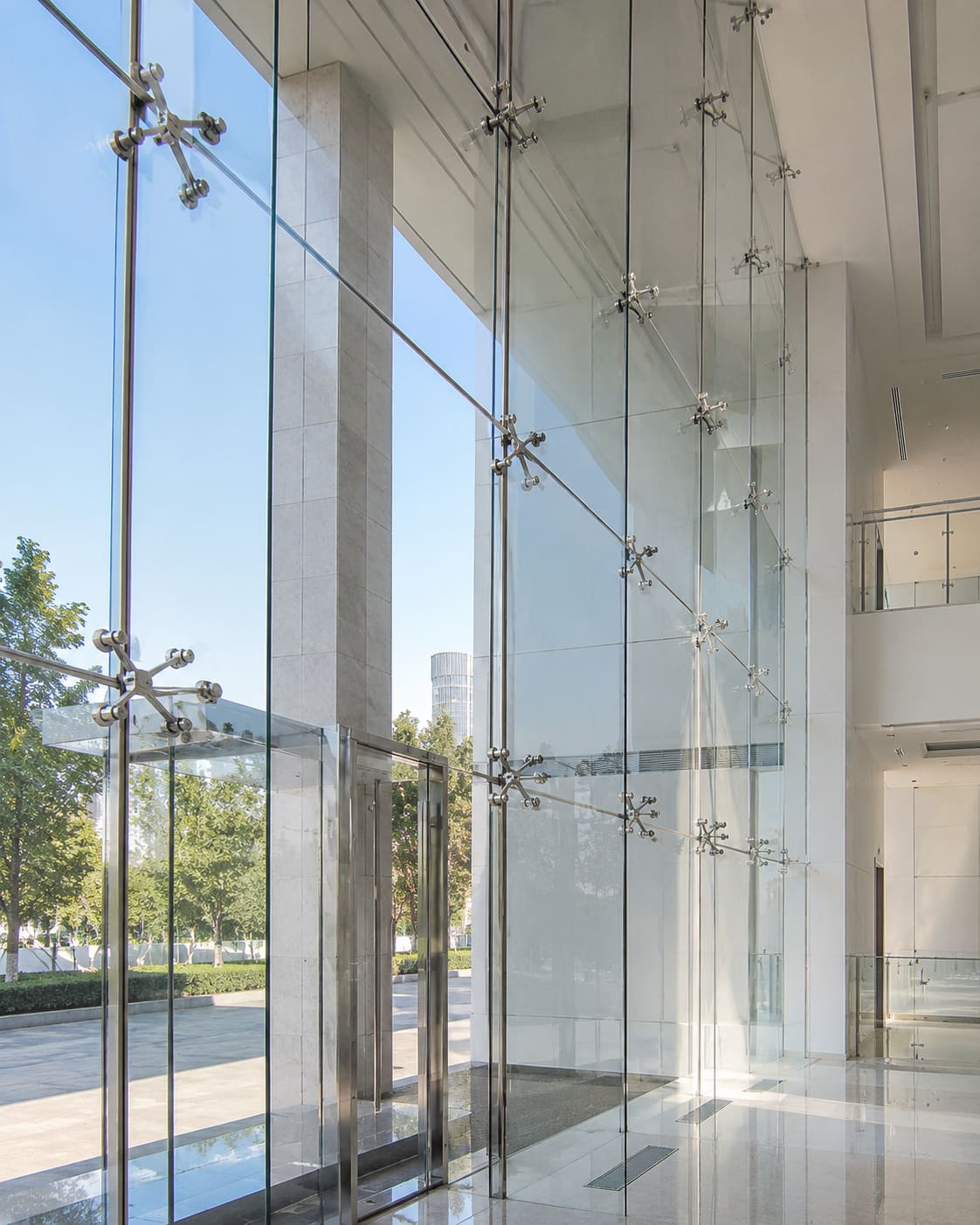
Spider glazing uses cast or forged stainless steel fittings, the familiar two- or four-armed 'spider', bolted to a support structure and gripping toughened glass panels through drilled holes near their corners. Each pane transfers wind and self-weight load to the spider arms, which pass it on to whatever sits behind: aluminium mullions, tempered glass fins, an MS truss, or the floor slab itself.
Because the connection happens at discrete bolted points rather than a continuous frame, you get a clean, minimal facade with only slim stainless fittings visible from outside. The system is a mature, well-understood family within bolt-fixed spider glazing and broader spider glazing work, which is why it is the default choice for frameless lobbies, double-height receptions and shopfronts across the city.
The key strength is flexibility. Spider fittings can bolt to almost any backing structure, so the system adapts to real buildings with floors, canopies, curves and service penetrations without drama.
- Rigid, predictable support that is easy to detail and site-adjust
- Works from a single-storey shopfront to a full multi-storey elevation
- Fittings are visible but discreet, giving a clean point-fixed grid
What is a cable-net facade and how is it different?
A cable-net facade replaces rigid mullions with a grid of pre-tensioned stainless steel cables anchored top-to-bottom (and often side-to-side) into the surrounding structure. Glass panels are point-fixed to clamps at the cable intersections, so the entire wall behaves like a tensioned net: it flexes slightly under wind pressure and springs back to shape. Our cable-net glazing and tension-cable facade systems are engineered so that this controlled movement never over-stresses the glass.
The result is the most transparent facade money can buy, because almost nothing sits behind the glass except thin, taut cables no thicker than a finger. From inside a Gachibowli or Financial District lobby, the boundary between building and street almost disappears.
That transparency comes at a structural price. The cables are pre-stressed to very high tensions, frequently several tonnes each, and every bit of that load is dumped into the primary structure at the anchor points. The building's beams and slabs must be stiff enough to resist deflection, which is where cable-net projects earn their cost premium. Where a single flat net is not enough for very tall spans, a cable-truss facade or cable-net facade with outriggers spreads the load.
- Minimal structure, extreme transparency, glass appears to float
- High pre-tension loads demand a very stiff, engineered primary frame
- Best on tall, uninterrupted, single-volume spans
Structure, span and transparency compared
The biggest practical difference is how much structure you see behind the glass. Spider systems still need something to bolt to, so fins, mullions or trusses remain visible. Cable-net facades hide almost everything, leaving only slim cables, which is exactly why they are chosen for signature entrances where the glass should look weightless.
Cable-net excels on tall, uninterrupted spans, think a 12 to 15 metre double-height atrium in a corporate campus, but it demands very stiff supporting structure at top and bottom to resist the pre-tension. Spider glazing is more forgiving and far easier to detail around intermediate floors, canopies and irregular geometry, so it wins on buildings that are not one clean rectangle of glass.
For curved, stepped or multi-storey elevations, spider glazing paired with structural facade glazing is usually the smarter engineering answer. For a single dramatic wall of glass with clear, unbroken sightlines, cable-net has no equal.
- Choose spider glazing for multi-storey, curved or stepped layouts
- Choose cable-net for dramatic single-span glass walls with clear sightlines
- Both can be combined on one project: cable-net on the hero atrium, spider on the wings
How much does each system cost in Hyderabad (INR)?
Both systems cost more than conventional framed structural glazing because of the stainless steel hardware and the toughened or laminated glass, but cable-net carries a clear premium for its engineering. These are realistic installed ranges for the Hyderabad and Telangana market in 2026; final numbers depend on glass spec, coating, height and access.
- Spider glazing: roughly INR 1,600 to INR 3,200 per sq ft installed, depending on glass spec and support type
- Cable-net facade: roughly INR 3,000 to INR 6,500 per sq ft installed, driven by cable tensioning and the stiff anchoring structure
- Structural engineering and load calculations for cable-net add a further premium over spider glazing
- Double-glazed (DGU) or high-performance solar-control glass pushes either system toward the top of its range
For most Hyderabad commercial jobs, spider glazing delivers the frameless look at a far more workable budget. Cable-net makes sense when the architectural statement justifies the spend, such as a flagship corporate lobby in Kokapet, a five-star hotel entrance, or a hospital atrium in the Financial District. If you are weighing this against a fully framed alternative, our note on structural glazing basics explains where framed systems still win on cost. You can get a free quote with a rough area and photos, and we will size the right system to your budget.
Which glass and hardware should each system use?
Point fixings concentrate stress around the drilled holes and clamps, so glass selection is not optional detailing, it is a safety requirement. Both systems must use fully toughened or heat-strengthened glass, and for overhead or high-risk zones, laminated glass that holds together if a pane is damaged.
Spider glazing typically uses 10 mm, 12 mm or 15 mm toughened glass depending on pane size and wind load, with countersunk stainless bolts through the drilled corners. Cable-net panels are usually laminated toughened units so that, in the rare event of breakage, the pane stays clamped to the net rather than falling.
All fittings should be grade 316 stainless steel for the humid, dusty, monsoon-exposed conditions of the Telangana plateau, where lower grades can pit and stain within a few seasons. Gaskets and structural silicone must be UV-stable to survive Hyderabad's intense summer sun without hardening or cracking.
- Toughened or heat-strengthened glass, laminated for overhead and safety-critical panes
- Grade 316 stainless fittings to resist dust, humidity and monsoon exposure
- UV-stable silicone and gaskets rated for high-heat Telangana summers
How do heat, monsoon and dust in Telangana affect the choice?
Hyderabad's climate shapes more than the glass coating. Summer surface temperatures on a west-facing facade can be brutal, so both systems benefit from solar-control or reflective glass to keep lobbies cool and cut air-conditioning load. That specification matters more on large single-span cable-net walls, which have huge uninterrupted glass area and therefore huge solar gain.
The monsoon brings driving rain and wind gusts, and cable-net facades move measurably under those gusts by design. The weather seals at every clamp must accommodate that movement without leaking, which is a detail cheaper installers get wrong. Spider glazing moves less, so its joints are simpler to weatherproof reliably.
Dust is the quiet problem. Fine Deccan dust settles into fittings and cable clamps, so both systems need accessible detailing for cleaning and maintenance. On tall cable-net atriums, plan for how the glass will be cleaned safely before the design is frozen, not after.
- Specify solar-control or reflective glass to fight west-facing heat gain
- Design clamp seals for cable-net movement during monsoon gusts
- Plan safe cleaning and maintenance access for tall spans up front
Installation, timeline and what can go wrong
Spider glazing is the more forgiving install. The backing structure is set out, spiders are fixed, glass is hung and adjusted; a typical commercial shopfront or double-height lobby is measured in weeks, and site tolerances are easier to absorb. It is the lower-risk path for tight programmes.
Cable-net is an engineering exercise as much as a glazing job. Cables must be tensioned in a controlled sequence to precise loads, and the primary structure has to be verified stiff enough before tensioning begins. Get the sequence or the anchor stiffness wrong and you chase leaks, uneven cable loads or glass stress for months. This is why cable-net should only be attempted by installers who do the structural work in-house or alongside a facade engineer.
The most common failure on both systems is skipping site-specific wind calculations and using generic details. We provide stamped structural drawings and project-specific wind loading for every facade, backed by facade consultancy when the geometry is unusual. Seeing finished, on-site systems helps too, so browse our completed facade projects before deciding.
- Spider glazing: faster, lower-risk, tolerant of site conditions
- Cable-net: precise tensioning sequence and stiff structure are non-negotiable
- Both require site-specific wind calculations, never generic details
Which system is right for your project?
In our Telangana and Andhra Pradesh projects, the decision usually comes down to span, structure and budget rather than aesthetics alone. If you have normal floor-to-floor heights and want frameless glass economically, spider glazing wins nearly every time. If you have a tall, single-volume space and the budget for a showpiece, cable-net is unmatched and worth every rupee.
A useful rule of thumb: below about 8 to 9 metres of clear height, spider glazing gives you 90 percent of the frameless effect for a fraction of the structural cost. Above that, on a genuine double-height or triple-height atrium, cable-net starts to justify itself both visually and structurally.
Still unsure? Send us the elevation, the clear span and a target budget and we will tell you honestly which system fits, and where a hybrid, cable-net on the hero volume with spider glazing on the flanks, gives the best value. Get a free quote and we will size the right frameless facade for your Hyderabad project.
- Tight budget, standard heights: spider glazing
- Maximum transparency, tall atrium, flagship look: cable-net facade
- Mixed geometry: a hybrid of both, engineered together