Safety glass is any glass that has been treated, processed or assembled to minimise the risk of injury when it breaks, and the four main types are toughened (tempered) glass, laminated glass, heat-strengthened glass and wired glass, with toughened-laminated glass combining the best of the first two. Ordinary annealed float glass breaks into large, sharp shards that can cause serious cuts; safety glass is engineered so that on failure it either crumbles into small blunt granules or stays bonded to an interlayer, dramatically reducing harm.
Choosing the right type matters across Hyderabad, Secunderabad and the wider Telangana and Andhra Pradesh region, where high-rise apartments, glass facades, frameless railings and skylights are now standard in areas like Gachibowli, Kokapet, Madhapur, Hitec City and the Financial District. Indian safety-glass practice is governed by IS 2553 (safety glass specification), the National Building Code of India (NBC) 2016 for where safety glazing is mandatory, and IS 875 Part 3 for wind-load design on facades.
This guide defines each type, its strength, standards and realistic INR pricing so you can specify with confidence, whether you are building a shower cubicle, a frameless glass railing, or a full structural glazing facade. If you want a firm number for your own project, you can get a free quote after an on-site measurement.
What Exactly Makes Glass 'Safety' Glass?
A glass qualifies as safety glass only when its behaviour on breakage meets defined criteria: it must either fragment into small, blunt particles that are unlikely to cut, or remain held together so no dangerous pieces fall out. Ordinary annealed float glass does neither, which is why it is banned in doors, low-level glazing and overhead positions under the NBC.
In India this performance is verified by IS 2553, which sets a fragmentation test for toughened glass (counting particles in a 50mm square) and impact and hold-together requirements for laminated glass. When a supplier says a pane is 'safety glass', ask which standard and which class it is certified to, not just the thickness.
- Toughened, laminated and toughened-laminated glass all satisfy IS 2553 as true safety glass
- Heat-strengthened and plain wired glass are NOT full safety glasses on their own
- Always confirm the mark or test certificate, especially for toughened glass work used in doors and railings
Toughened (Tempered) Glass
Toughened glass, also called tempered glass, is safety glass that has been heated to about 620 to 700 degrees Celsius and then rapidly cooled, making it 4 to 5 times stronger than annealed glass of the same thickness. This thermal process puts the surface in compression, so on impact the pane shatters into thousands of small, relatively harmless granules instead of jagged shards. In India it is manufactured and tested to IS 2553.
It cannot be cut, drilled or edited after tempering, so all holes, cut-outs and shapes must be finalised before the toughening furnace. It also resists thermal shock and sudden temperature swings, which suits Hyderabad's harsh summer glare, where west-facing glass can reach 60 degrees Celsius while air-conditioning keeps the inside cool. That thermal gradient will crack ordinary glass but not a properly toughened pane.
- Strength: 4 to 5 times stronger than ordinary annealed glass
- Common thicknesses: 6, 8, 10, 12, 15 and 19mm
- Breaks into small blunt granules, meeting IS 2553 fragmentation requirements
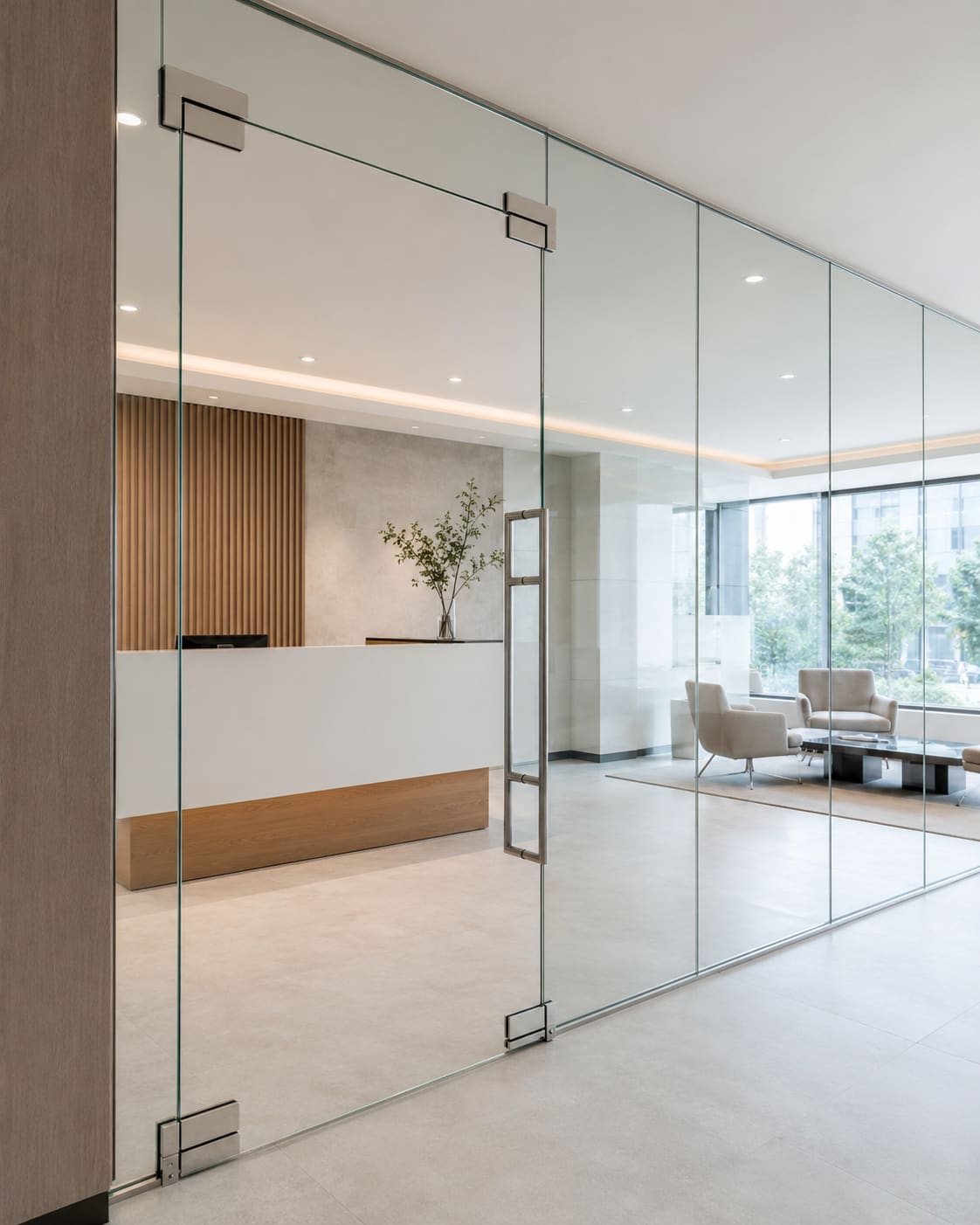
- Uses: frameless glass doors, shower enclosures, glass railings, glass partitions, facades, tabletops
- Indicative Hyderabad supply price: INR 90 to 250 per sq ft depending on thickness
One caveat to plan for is 'spontaneous breakage' from nickel sulphide inclusions, a rare but real risk in large toughened panels. For overhead or high-rise glass, heat-soak testing or lamination is the accepted safeguard.
Laminated Glass
Laminated glass is safety glass made by permanently bonding two or more glass panes with a tough plastic interlayer, usually PVB (polyvinyl butyral) or the stronger SGP (SentryGlas), under heat and pressure. When it breaks, the fragments stay stuck to the interlayer rather than falling out, which is the same principle used in car windshields. This makes it the preferred choice for overhead and fall-protection applications.
Beyond safety, the interlayer blocks around 99 percent of UV rays and cuts noise, making laminated glass ideal for road-facing bedrooms and offices along busy corridors like the Outer Ring Road or Kondapur main road. Interlayer thickness is typically 0.38mm or 0.76mm; thicker and acoustic-grade interlayers improve sound and security performance further.
- Standard configurations: 6.38mm, 8.38mm, 10.76mm and 12.76mm
- Holds together when broken, preventing falling shards
- Blocks about 99 percent of UV and can cut noise by up to 35 to 40 decibels in thicker acoustic units
- Uses: glass skylights, glass canopies, balcony railings, toughened glass shopfronts, security glazing, soundproofing
- Indicative Hyderabad supply price: INR 130 to 360 per sq ft
For homes near flight paths or arterial roads, pairing laminated glass with acoustic glass partitions indoors gives a noticeable drop in ambient noise.
Toughened Laminated Glass: the Strongest Combination
Toughened laminated glass combines both technologies by laminating two toughened panes with a PVB or SGP interlayer, giving the highest strength and the safest failure mode available. It resists heavy impact like toughened glass yet holds together like laminated glass, so even a fully shattered panel stays in its frame. This dual behaviour is why it is specified for the most safety-critical work.
- Uses: overhead glazing, skylights, walkable glass floors, unsupported-top railings, spider facades
- Recommended for balconies and staircases where a person could fall through a broken panel
- Typical railing specification: 13.52mm toughened laminated (two 6mm toughened plies plus interlayer)
- SGP interlayers are roughly 5 times stiffer and 100 times more rigid than PVB, ideal for frameless standoff glass railings and high wind zones
- Indicative Hyderabad supply price: INR 380 to 650 per sq ft
For high-rise balconies in Kokapet and the Financial District, where wind loads are significant, most consultants now insist on toughened laminated rather than single-ply toughened glass.
Heat-Strengthened and Wired Glass
Heat-strengthened glass is partially tempered glass that is about 2 times stronger than annealed glass but is not a true safety glass, because it breaks into larger fragments rather than small granules. It resists thermal stress and is often used in facades and spandrel panels where full toughening is unnecessary but extra thermal resistance is needed. It is frequently laminated to make it fully safe, and it is also less prone to nickel-sulphide spontaneous breakage than fully toughened glass.
Wired glass has a steel mesh embedded during manufacture; the wire holds fragments in place when the glass cracks, and it offers limited fire integrity, which is why it appears in older stairwells, fire lobbies and industrial roof lights. Note that wired glass is weaker than toughened glass against impact and is now less common in modern buildings.
- Heat-strengthened: about 2x annealed strength, resists thermal shock, not a stand-alone safety glass
- Wired glass: embedded mesh retains fragments and gives limited fire resistance
- For true fire-rated safety, use certified fire-rated glazing, not ordinary wired glass
How Do the Types Compare on Strength, Safety and Cost?
The quickest way to choose is to weigh three factors together: impact strength, what happens when the glass fails, and cost per square foot. Toughened glass wins on raw strength and value; laminated glass wins on hold-together safety, noise and UV; and toughened laminated wins overall but costs the most.
- Annealed float glass: baseline strength, breaks into dangerous shards, NOT safety glass, cheapest
- Heat-strengthened: about 2x strength, large fragments, not a full safety glass on its own
- Toughened: 4 to 5x strength, blunt granules, best strength-to-price, INR 90 to 250 per sq ft
- Laminated: annealed-level strength but stays intact, blocks UV and noise, INR 130 to 360 per sq ft
- Toughened laminated: highest strength and safest failure, INR 380 to 650 per sq ft
For most Hyderabad homes, 10 to 12mm toughened covers doors, showers and partitions, while laminated or toughened-laminated is reserved for skylights, canopies and any glass someone could fall against or through.
Where Is Safety Glass Mandatory in India?
The National Building Code of India (NBC) 2016 requires safety glass in critical locations: glazed doors and side panels, low-level glazing near floors, wet areas such as bathrooms and pool surrounds, and all overhead or sloped glazing. For facades, glass thickness and type must satisfy the wind-load calculation under IS 875 Part 3, based on the building height and exposure category.
In practice, building approvals and structural consultants in Telangana increasingly ask for test certificates, so specifying certified safety glass up front avoids rework at handover. This is especially true for commercial office front glazing and curtain wall facades in Hitec City and Madhapur.
- Glazed doors and adjacent side panels: safety glass mandatory
- Glazing below 800mm from floor level: safety glass mandatory
- Bathrooms, showers and pool surrounds: safety glass mandatory
- All overhead, sloped and roof glazing: laminated or toughened-laminated mandatory
- Facades and windows: type and thickness set by IS 875 Part 3 wind load
How to Choose the Right Safety Glass for Your Project
As a rule of thumb: use toughened glass for doors, showers and partitions; laminated glass where falling shards are a hazard or noise is a concern; and toughened laminated for overhead glazing and fall-protection railings. Match the glass to the risk, not just to the budget, because retrofitting the correct glass later costs far more than getting it right at order stage.
- Doors, showers, partitions: toughened glass, 8 to 12mm
- Skylights, canopies, glass floors: toughened laminated, always
- Balcony and staircase railings: 12mm toughened or 13.52mm toughened laminated
- Road-facing rooms and security glazing: laminated glass, acoustic interlayer if noise is severe
- West and south facades in Hyderabad heat: toughened, ideally with a reflective or Low-E coating
You can see the range of glass, railing and facade work we have delivered across the city on our projects page, and read our companion guide on toughened versus laminated glass if you are deciding between the two.
Hakimi Aluminium and Glass supplies, fabricates and installs all types of safety glass across Hyderabad and Secunderabad, with on-site measurement and a written estimate before work begins. To discuss your requirement or get a free quote, send us your drawings or a few site photos and we will recommend the correct glass, thickness and standard.