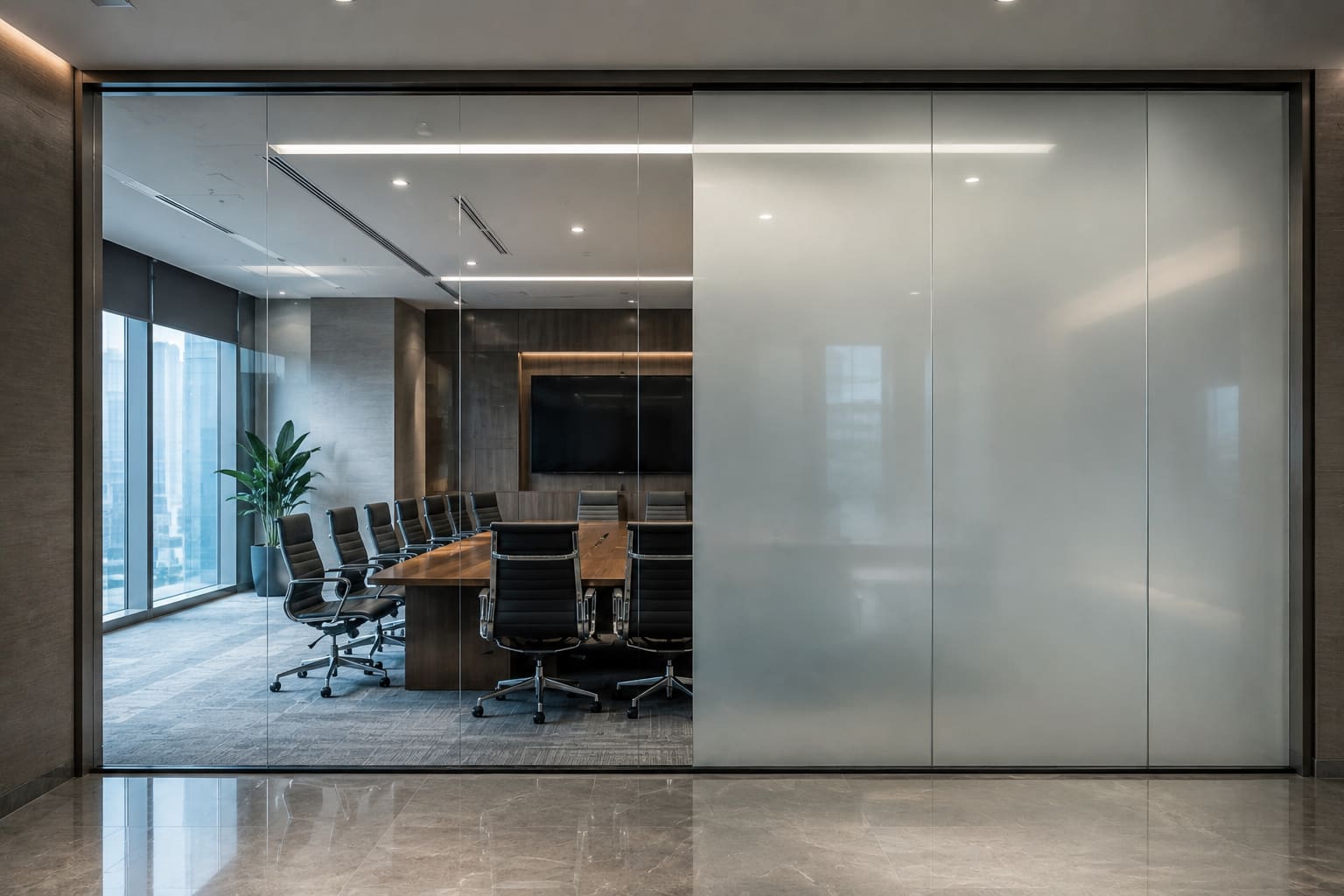
Smart glass suppliers in Hyderabad are concentrated around HITEC City, Gachibowli, Madhapur and Kondapur, where switchable PDLC and electrochromic glass typically costs between Rs 1,600 and Rs 4,500 per square foot installed, depending on technology, glass thickness and the control system. For a genuine turnkey supply-and-fit job in the twin cities, expect PDLC film-laminated glass at the lower end and imported electrochromic panels at the upper end, with most residential and office projects landing around Rs 2,200 to Rs 3,200 per sq ft.
Choosing the right supplier matters far more than chasing the lowest quote, because Hyderabad's harsh summers (45C peaks in May), dusty pre-monsoon winds and humid monsoon months put real stress on the film lamination, wiring and control electronics. A cheap stick-on film that fogs at the edges within eighteen months costs more in the long run than a properly laminated panel that lasts a decade.
This guide explains the switchable smart glass options available locally, honest INR price bands for 2026, the questions that separate a serious fabricator from a reseller, and exactly how to vet a Hyderabad or Secunderabad supplier before you release an advance.
What smart glass options can you buy in Hyderabad?
Hyderabad suppliers stock three main switchable glass types, each suited to different budgets and use cases across the twin cities. Understanding the difference before you call for quotes stops you from overpaying for imported electrochromic when a local laminated PDLC panel would do the same job.
- PDLC (Polymer Dispersed Liquid Crystal): the most common option locally, switching from frosted to clear the instant electricity is applied. Ideal for conference rooms, doctor cabins and bathroom privacy across HITEC City and Financial District offices. Price band: Rs 1,600 to Rs 2,800 per sq ft installed.
- Electrochromic glass: tints gradually to cut heat and glare while drawing very little power, and holds its state without continuous current. Best for west-facing facades in Kokapet and Financial District towers. Price band: Rs 3,200 to Rs 4,500 per sq ft, usually imported with longer lead times.
- Switchable PDLC film (retrofit): a self-adhesive film applied to existing glass, useful for Banjara Hills villas and rented Gachibowli offices where you cannot replace the pane. Price band: Rs 900 to Rs 1,700 per sq ft.
For Hyderabad's climate, laminated PDLC smart glass - where the film is sealed between two glass layers under heat and pressure - consistently outlasts stick-on film, because the lamination shields the liquid crystal from heat cycling, UV and dust ingress. If you are weighing this technology against traditional window coverings, our comparison of smart glass versus blinds breaks down the trade-offs for Indian conditions.
How much does smart glass cost in the twin cities?
Smart glass in Hyderabad and Secunderabad is priced per square foot and varies by technology, glass thickness and control hardware, so always confirm exactly what the quote includes before comparing dealers. The single biggest cause of price disputes in this market is a headline rate that quietly excludes the driver, wiring and GST.
- Laminated PDLC (8-13mm toughened): Rs 1,800 to Rs 2,900 per sq ft.
- Retrofit PDLC film only: Rs 900 to Rs 1,700 per sq ft.
- Imported electrochromic panels: Rs 3,200 to Rs 4,500 per sq ft.
- Transformer/driver and low-voltage wiring: Rs 3,500 to Rs 12,000 per zone, sometimes billed separately.
- Remote, mobile-app or wall-switch control: Rs 2,000 to Rs 8,000 depending on the level of automation and whether it ties into home-automation systems.
A typical 6ft x 4ft (24 sq ft) glass partition for a Kondapur office cabin therefore runs roughly Rs 55,000 to Rs 75,000 including a driver and a wall switch. A full office glass cabin fit-out with several switchable panels naturally scales from there. Always ask whether the rate is inclusive of 18% GST, installation and site measurement, because some Kukatpally and Balanagar dealers quote ex-works and add these afterwards, which can inflate the real cost by 20-30%.
Prices also move with the dollar for imported electrochromic and film stock, so a quote older than four to six weeks may no longer hold. For an accurate figure on your exact opening sizes, it is worth asking a local fabricator to send a free measured quote rather than working off per-square-foot guesses.
Where are Hyderabad's smart glass suppliers located?
The bulk of smart glass supply and fabrication capacity sits along the western IT corridor, because that is where commercial demand is highest and site visits are quickest.
- HITEC City and Madhapur: the densest cluster, driven by IT office fit-outs, co-working spaces and showroom partitions.
- Gachibowli, Kondapur and Nanakramguda: strong for corporate cabins, meeting rooms and Financial District towers.
- Kokapet and the Financial District: high-rise residential and commercial facades where electrochromic and DGU facade glazing is specified.
- Banjara Hills, Jubilee Hills and Film Nagar: premium villa and clinic work, often bathroom and bedroom privacy glass.
- Secunderabad, Kukatpally and Uppal: a mix of retail, hospital and residential jobs, served by fabricators who travel across the twin cities.
A supplier's physical proximity matters for one practical reason: after-sales service. When a driver fails or a panel needs re-sealing three monsoons later, a fabricator with a workshop in Madhapur or Kondapur will reach a Gachibowli site far faster than an online reseller shipping panels from another state.
How do you vet a smart glass supplier in Hyderabad?
Vet a Hyderabad smart glass supplier by checking their local installation record, warranty terms and the origin of their PDLC film before paying any advance. The market has genuine fabricators alongside resellers who simply forward your order to a third party, and the difference shows up in after-sales support.
- Ask to visit a completed local site in Madhapur, Gachibowli or Jubilee Hills so you can watch the switching speed and check clarity, haze and any edge banding in person.
- Confirm a written warranty of at least 3 to 5 years on the film and 1 to 2 years on the electronics, with on-site service inside the twin cities rather than a courier-return policy.
- Check the film brand and thickness. Reputable suppliers name the manufacturer and share a datasheet rather than saying only 'imported'.
- Insist on proper edge sealing and a certified electrician for the 48V/65V driver wiring, because poor sealing is the number-one failure mode in Hyderabad's monsoon humidity.
- Get the quote itemised: glass, film, driver, control, GST and installation as separate lines so you can compare like with like.
- Ask how many switchable-glass jobs they complete per month; a fabricator doing this weekly will handle lamination bubbles and driver sizing far better than an occasional installer.
It also helps to review a supplier's broader portfolio. A team that regularly delivers glass partitions and frameless glass partitions understands the framing, floor channels and door hardware that smart glass has to integrate with. You can gauge quality and range by browsing their completed projects before committing.
Is smart glass worth it for Hyderabad's climate?
Smart glass is worth it in Hyderabad primarily for privacy-on-demand and glare control, and electrochromic types additionally reduce cooling load meaningfully during the city's long, hot summers. A west or south-facing electrochromic facade in Kokapet or the Financial District can cut solar heat gain by 30 to 50%, easing AC bills through April to June when temperatures regularly cross 40C.
For interiors, PDLC partitions replace fabric blinds and curtains that trap Hyderabad's fine construction and road dust, which is a genuine hygiene advantage in clinics, labs and IT offices around HITEC City. Flip the switch for a client meeting, flip it back for daylight - no cords, no laundering, no dust reservoirs.
The honest caveats: all smart glass needs a stable power supply and a periodic driver check, and voltage fluctuation in some pockets of the twin cities can shorten driver life if a surge-protected supply is not used. Budget for an occasional maintenance visit and specify a driver with over-voltage protection. If you want a plain-English primer on the underlying technology, our explainer on how smart glass works covers the physics without the sales spin.
Which rooms and applications suit smart glass best?
Smart glass earns its premium where privacy needs to change on demand or where glare and heat are a daily nuisance. It is less justified on a shaded internal wall that never needs to switch.
- Conference and board rooms: instant privacy for confidential meetings without permanent frosting, the top use case in Gachibowli and Financial District offices.
- Doctor cabins, clinics and diagnostic rooms: hygienic, wipe-clean privacy that replaces dust-holding curtains.
- Bathrooms and bedrooms in Banjara Hills and Jubilee Hills villas: clear for the view, frosted for privacy at the touch of a switch.
- Retail and showroom facades: a clear shopfront by day, a frosted projection surface after hours.
- West-facing facades and skylights: electrochromic tinting to control the brutal afternoon sun in Kokapet and Nanakramguda towers.
For larger openings and building envelopes, smart glazing is often combined with conventional glass facade work and structural glazing so that switchable and fixed panels read as one clean elevation. Discuss zoning early - you rarely need every panel to switch, and grouping controls sensibly keeps both the wiring and the bill under control.
What is the installation and lead-time process?
Buying smart glass is a short project, not an off-the-shelf purchase, so plan for a measure-fabricate-fit sequence rather than same-day delivery.
- Site measurement: a fabricator visits to record exact opening sizes, check the power point location and confirm glass orientation. Accurate measurement here prevents costly re-fabrication.
- Fabrication and lamination: laminated PDLC panels are made to size, which typically takes 1 to 2 weeks; imported electrochromic can take longer depending on stock.
- Electrical prep: a certified electrician runs the low-voltage supply to each zone and positions the driver in an accessible, ventilated spot.
- Installation: fitting a standard partition or cabin usually takes 1 to 3 days once the glass arrives; retrofit film on existing panes can often be done in a single day.
- Commissioning: switching is tested across every zone, the control is handed over, and the warranty and driver location are documented.
Ask your supplier to keep the driver reachable rather than buried inside a sealed false ceiling, because it is the component most likely to need attention over the years. A tidy, labelled driver location turns a future service call into a ten-minute job instead of a demolition.
How to compare quotes without getting caught out
The lowest per-square-foot number rarely wins once you normalise the quotes, so compare on total delivered cost and after-sales terms, not the headline rate.
- Normalise the scope: make sure every quote includes glass, film, driver, control, wiring, installation and 18% GST before you compare.
- Check the film specification: switching voltage, transparency, haze percentage and the named manufacturer should match across quotes.
- Confirm the glass make-up: thickness, toughening and the number of laminate layers all affect both price and durability.
- Weigh the warranty: a slightly higher quote with 5-year film cover and local on-site service usually beats a bargain with 1 year and courier-return.
- Watch for exclusions: ex-works pricing, extra transport, and 'driver charged separately' are the common surprises in this market.
When you have two or three comparable, itemised quotes, a quick site visit from the fabricator will settle any remaining doubts about switching quality and fit. If you would like a transparent, itemised proposal for your exact openings, you can request a no-obligation quote and see the full breakdown before committing to anything.